
S&P 500 and Nasdaq Record Highs Shatter Expectations Amid Tech Surge
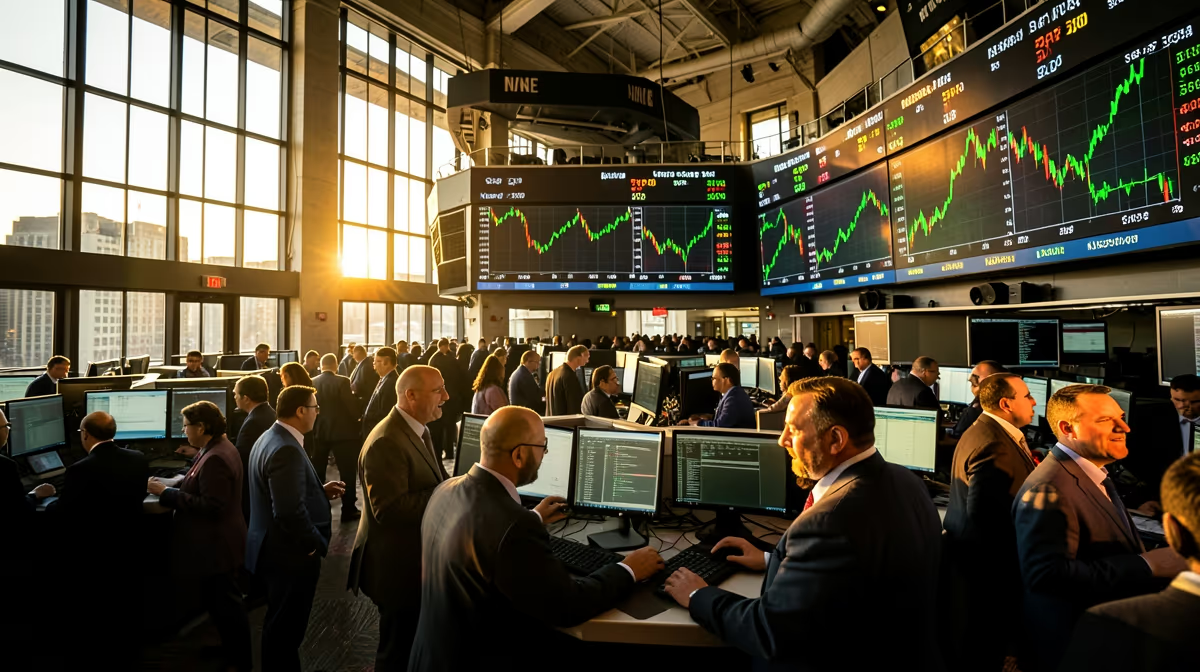
The floor of the New York Stock Exchange has become the site of a profound psychological divergence, where the clinical precision of high-frequency trading meets the raw enthusiasm of the artificial intelligence boom. While the broader economic landscape remains clouded by shifting interest rates and cautious households, Wall Street experienced another monumental session as the S&P 500 and Nasdaq record highs were shattered once again, fueled by an unstoppable rally in semiconductor giants.
This milestone represents more than a simple numerical uptick; it is a defiant assertion of the technology sector’s resilience in the face of mounting macroeconomic headwinds. As leading tech stocks like Nvidia and AMD propelled the indices to these unprecedented levels, the move underscored a growing rift between the record-breaking valuations of corporate America and the lived experience of the average consumer.
The S&P 500 and Nasdaq have reached historic record territory as semiconductor giants Nvidia and AMD lead a tech-heavy rally that has effectively neutralized pressures from a slumping bond market and dreary consumer sentiment.
A Defiant Surge to New Heights
The trajectory of the S&P 500 throughout the autumn of 2026 has been characterized by what market observers describe as a remarkable and defiant trip toward value creation. For months, the index appeared to be in a holding pattern, seeking a catalyst strong enough to break through previous ceilings established earlier in the year.
The achievement on October 6, 2026, marks the S&P 500's first record close since August, a significant psychological breakthrough for investors who had begun to fear the rally had stalled. This surge was not a broad-based lift across all sectors but was instead a targeted upward movement. Major technology and semiconductor stocks acted as the primary engines, providing the necessary momentum to pull the broader market indices into record territory despite significant resistance elsewhere in the financial ecosystem.
The October Milestone
The movement observed on Tuesday saw both the S&P 500 and the Nasdaq Composite hitting new peaks simultaneously. This dual-record achievement is a clear indicator of the market's current heavy reliance on growth-oriented technology equities. While the S&P 500 tracks the 500 largest publicly traded companies in the U.S., its market-capitalization-weighted structure means that when firms like Nvidia and AMD see massive gains, they exert a disproportionate influence on the index’s direction.
| Date | Market Event | Primary Driver |
|---|---|---|
| August 2026 | S&P 500 Plateau | Consolidation after previous record streaks |
| Early October 2026 | Analytical Debate | Concerns rise regarding market breadth and bubble parallels |
| October 6, 2026 | New Record Highs | Nvidia and AMD lead tech rally despite bond market slump |
The Silicon Engines: Nvidia and AMD
At the heart of this record-breaking performance lies the semiconductor industry, specifically the firms responsible for the hardware powering the next generation of artificial intelligence. Nvidia and AMD have emerged not just as sector leaders, but as the primary architects of the current bull market.
The surge in these Nvidia and AMD stock prices reflects a resilient investor enthusiasm for AI chip demand. These companies are currently viewed as the essential infrastructure providers for the global digital economy. As corporations worldwide scramble to integrate AI into their operations, the demand for the high-end processing units produced by these two firms has created a "super-cycle" of investment that appears to be independent of broader economic anxiety.
Shrugging Off the Bond Market
Perhaps the most striking aspect of this rally is its ability to ignore the bond market. Traditionally, when bond yields rise or the bond market faces a "slump," technology stocks—which are often valued on future earnings—experience downward pressure. However, the current demand for AI-related equities is so robust that it has successfully shrugged off these traditional negative correlations. Investors are prioritizing the potential for long-term technological disruption over short-term fluctuations in federal reserve rates and bond yields.
A Tale of Two Economies
While Wall Street celebrates these historic highs, a different story is unfolding among the general public. There is a striking disconnect between soaring equity valuations and the dreary outlook reported by everyday consumers. This divergence highlights a persistent political and economic disconnect regarding the financial wellbeing of average households compared to the performance of corporate indices.
Consumer sentiment has remained stubbornly low, with many reporting a sense of economic malaise that contrasts sharply with the "green" screens seen by financial analysts. This "dreary" consumer mood is often attributed to the lingering effects of inflation and high interest rates, which impact daily household budgets far more directly than they impact the balance sheets of trillion-dollar tech firms.
The Political Dimension
This gap between the S&P 500 and consumer sentiment creates a complex political angle. While the stock market is often used as a barometer for national economic health, the current rally's narrow focus on the technology sector means that the benefits are primarily felt by retail investors, retirement account holders, and stakeholders in major tech-heavy mutual funds. For those without significant exposure to the equity markets, the record highs may feel like a distant phenomenon that does not reflect their own financial reality.
Structural Vulnerabilities and Historical Echoes
Not all analysts are viewing the current record highs through a lens of unalloyed optimism. A significant point of concern among market strategists is the "lack of breadth" in the current rally. Market breadth refers to the number of individual stocks participating in an upward move; a healthy market typically sees a wide range of companies across different sectors rising together.
Analysts drawing parallels to the late 1990s dot-com era point out that the current market is heavily concentrated in a narrow cohort of AI leaders. This concentration could be concealing underlying structural weaknesses in small-cap sectors that are far more sensitive to high interest rates and domestic economic headwinds.
The heavy reliance on a narrow cohort of AI leaders to sustain market records might conceal underlying structural weaknesses in small-cap sectors that are more sensitive to high interest rates.
The Dot-Com Parallel
The comparison to the dot-com bubble is rooted in the intense concentration and enthusiasm surrounding a breakthrough technological paradigm. Just as the internet drove a speculative frenzy in the 1990s, artificial intelligence is now the primary driver of global capital inflows toward U.S. equity markets. The worry for some analysts is that if the AI-related growth fails to materialize as quickly or as profitably as expected, the indices—which have become top-heavy—could be vulnerable to a significant correction.
Geopolitical Dominance and Global Capital
The performance of the U.S. stock market is increasingly tied to America’s technological hegemony. The dominance of U.S. firms in high-end semiconductor development reinforces the country’s position as the leader in critical global infrastructure. This technological lead ensures that global capital continues to flow toward U.S. markets, seeking the security and growth potential offered by the world’s leading tech innovators.
This geopolitical angle suggests that the tech stocks rally today is not just a domestic financial event, but a reflection of a global shift. International investors are betting on U.S. semiconductors as the "new oil" of the 21st century, making companies like Nvidia and AMD central to global geopolitical strategy. This influx of international capital helps sustain record highs even when domestic indicators, like consumer sentiment, remain weak.
The Road Ahead: Sustainability and Bond Pressures
As the S&P 500 and Nasdaq attempt to consolidate their new positions, the focus for the next 24 to 72 hours will be on sustainability. Market participants are closely watching whether these indices can maintain their record levels or if the bond market dynamics will eventually force a pullback.
Short-Term Outlook
In the next 24 hours, markets will likely monitor if the momentum from Nvidia and AMD can carry over into broader sectors. The ability of the S&P 500 to sustain its close above previous record levels will be a key indicator of investor confidence. Over the next 72 hours, analysts will assess broader market participation, looking for signs that the rally is moving beyond the "Magnificent" tech leaders and into other areas of the economy.
Best-Case and Worst-Case Scenarios
The best-case scenario for the market involves tech stocks maintaining their robust rally, eventually driving broader market confidence and helping the S&P 500 and Nasdaq consolidate their gains. If this happens, the "dreary" consumer sentiment may eventually lift as the positive wealth effect from the stock market begins to filter through the economy.
Conversely, the worst-case scenario involves rising bond market pressures and the narrow market breadth finally triggering a pullback. If investors decide that AI valuations have become overextended—reminiscent of the dot-com bubble—the lack of support from other sectors could lead to a sharp decline from these record peaks.
Frequently Asked Questions
Why did the S&P 500 and Nasdaq hit record highs?
The S&P 500 and Nasdaq reached record highs as major technology companies, particularly chipmakers like Nvidia and AMD, drove the market higher. AI stocks managed to shrug off broader concerns such as a bond market slump to achieve these new milestones.
What role did Nvidia and AMD play in the recent market record?
Nvidia and AMD acted as primary market leaders, powering the tech sector's upward trajectory. Their strong performance helped lift major indexes even as investors monitored separate economic uncertainties.
When was the last time the S&P 500 reached a record close?
The recent milestone marked the S&P 500's first record close since August. This defiant trip to a new record surprised some market analysts given mixed underlying economic indicators.
How do current stock market highs compare to consumer sentiment?
Stocks hit record highs during a period when consumers still reported feeling somewhat dreary about the overall economy. This disconnect highlights the ongoing divergence between financial market performance and everyday consumer sentiment.
What are the main worries for investors despite the record highs?
Some analysts have expressed concerns regarding market breadth, drawing comparisons or cautionary parallels to past periods like the dot-com bubble. A lack of widespread participation across all sectors remains a key worry for certain market commentators.
What is expected next for tech stocks and major market indexes?
Market participants will continue monitoring bond yields, inflation data, and artificial intelligence sector momentum to see if these record levels can be sustained. Ongoing volatility in interest rates remains a critical factor for the tech-heavy indexes.
Conclusion
The ascent of the S&P 500 and Nasdaq to fresh record highs on October 6, 2026, serves as a testament to the sheer force of the artificial intelligence boom. Spearheaded by the relentless growth of semiconductor leaders Nvidia and AMD, the market has successfully navigated a challenging environment characterized by bond market instability and a noticeable gloom among the general consumer base. However, the path forward remains nuanced. While the technical milestones are clear, the narrowness of the rally and the disconnect with household sentiment suggest that the market’s current strength is highly concentrated. As investors look toward the coming days, the primary question will be whether this tech-led momentum can evolve into a broader, more sustainable economic recovery, or if the historical parallels to past bubbles will necessitate a period of caution. For now, the silicon giants remain in control, rewriting the record books one trade at a time.
Sources
- Stock market today: S&P 500, Nasdaq hit record highs as Nvidia, AMD lead tech higher — Yahoo Finance
- Chart: A look at the S&P 500's remarkable and defiant trip to a new record — CNBC
- S&P 500 Notches First Record Close Since August — Bloomberg.com
- Stocks hit record high even as consumers feel dreary — The Washington Post
- S&P 500 hits record high as AI stocks shrug off bond market slump — Financial Times
- Current S&P 500 Vs. Dot-Com Bubble: Lack Of Breadth Worries Me Most (SP500) — Seeking Alpha


.webp)
