
Francis Halzen Nobel Prize Win Changes Physics As Ghost Particles Unlock Space
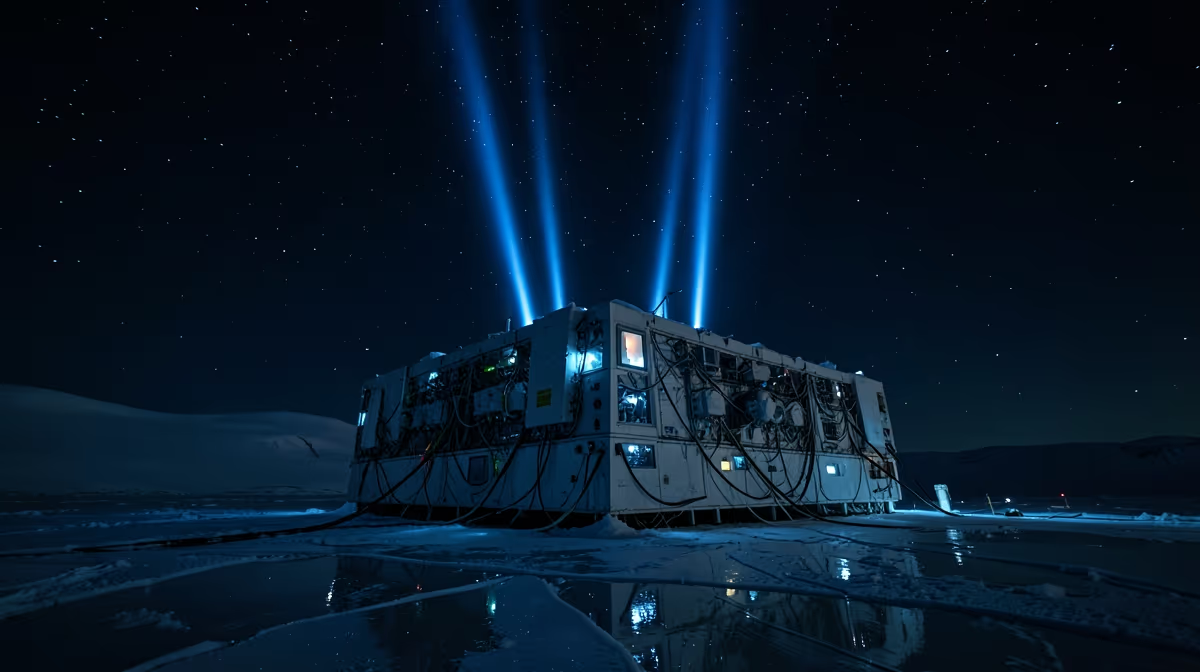
The universe is whispering in a language of particles that pass through our bodies, our buildings, and our planet without leaving a trace. The Francis Halzen Nobel Prize in Physics marks a monumental milestone in our understanding of the universe through the study of cosmic neutrinos, turning these elusive 'ghost particles' into messengers from the deepest reaches of space.
For decades, the scientific community has sought to capture these subatomic whispers, which originate from the most violent and energetic events in the cosmos. On Tuesday, October 6, 2026, the Royal Swedish Academy of Sciences officially recognized the man whose leadership and vision turned the ice of Antarctica into a lens for the stars. Francis Halzen, a prominent physicist from Belgium, has been awarded the 2026 Nobel Prize in Physics for his groundbreaking work in detecting high-energy cosmic neutrinos, effectively opening a new era of multi-messenger astronomy.
The discovery of high-energy cosmic neutrinos marks a massive leap forward in multi-messenger astronomy, allowing scientists to study black holes, exploding stars, and extreme cosmic phenomena with unprecedented clarity by observing particles that travel unhindered across the universe.
Unlocking the Secrets of Ghost Particles
To understand the magnitude of this award, one must first grasp the nature of the neutrino itself. Often referred to as "ghost particles," neutrinos are tiny subatomic particles that possess almost no mass and carry no electric charge. Because of these unique properties, they rarely interact with ordinary matter. Every second, billions of neutrinos pass through every square centimeter of Earth, yet they do so without a single collision with the atoms that make up our world.
The specific focus of Halzen's research involves high-energy cosmic neutrinos. Unlike the low-energy neutrinos produced by our own Sun, these high-energy variants originate from outside our solar system, born in the hearts of distant cosmic events such as supermassive black holes and supernova explosions. Because they travel in a straight line from their source—unaffected by the magnetic fields, dust clouds, or planetary bodies that block or bend light—they act as pure messengers. They provide a direct map back to the most extreme environments in the universe, regions that are otherwise invisible to traditional optical or radio telescopes.
A New Window into the Cosmos
The recognition of Halzen's work validates decades of theoretical and experimental labor. Since neutrinos were first theorized in the 1930s, the challenge has always been one of detection. Capturing a particle that does not want to be caught requires massive, highly sensitive instrumentation. Halzen’s pioneering efforts fundamentally shaped the field of neutrino astronomy by utilizing specialized detectors to capture these elusive particles as they pass through the Earth. This breakthrough allows humanity to observe the universe through a non-light-based medium, offering a revolutionary tool to probe phenomena that have remained mysteries for generations.
The Legacy of the IceCube Neutrino Observatory
The cornerstone of this Nobel-winning discovery is the IceCube Neutrino Observatory. Located at the South Pole, this massive scientific infrastructure was designed to detect the rare occasions when a high-energy neutrino does interact with an atom. When a neutrino strikes the ice, it creates a flash of blue light known as Cherenkov radiation, which is then captured by thousands of optical sensors buried deep beneath the Antarctic surface.
Francis Halzen played a pivotal role in the development and realization of this observatory. By transforming a cubic kilometer of clear Antarctic ice into a particle detector, Halzen and his international team of collaborators created the world’s largest and most sensitive telescope for ghost particles. Major international news outlets, including The New York Times, BBC, Scientific American, and Le Monde, have highlighted the IceCube facility as the primary instrument that enabled this scientific triumph.
International Scientific Collaboration
The success of the IceCube project is not merely a triumph of physics, but a testament to global scientific diplomacy and cooperation. Deep-ice and underground neutrino telescopes of this scale rely on multinational funding, extensive data sharing, and cross-border academic mobility. The recognition of Halzen, while a personal honor, also shines a spotlight on the thousands of researchers and dozens of institutions worldwide that contribute to the operation of such massive data processing pipelines. This shift in recognition dynamics reflects the increasing reliance of top-tier physics breakthroughs on large international collaborations.
| Phase of Discovery | Description |
|---|---|
| Theoretical Foundation | Neutrinos first theorized in the 1930s as fundamental subatomic particles. |
| Infrastructure Development | Construction of deep-underground and ice-based detectors like IceCube. |
| Confirmation | Detection and verification of high-energy cosmic neutrinos from deep space. |
| Nobel Award | Francis Halzen awarded the 2026 Nobel Prize in Physics on October 6. |
A Scientific Breakthrough Decades in the Making
The root cause of this Nobel recognition lies in decades of persistent fundamental physics research. The journey from the early theoretical models of the 1930s to the 2026 award ceremony has been one of extreme technological and intellectual endurance. The primary challenge was moving beyond the detection of solar neutrinos to identifying those arriving from across the galaxy and beyond.
The detection of high-energy cosmic neutrinos serves as a historical parallel to the discovery of gravitational waves by LIGO. Much like the validation of gravitational waves, Halzen's work has confirmed decades of theoretical physics and necessitated the creation of massive technological instrumentation. Both milestones have opened brand-new windows of observational astronomy, allowing us to "hear" or "see" the universe in ways that were previously thought impossible.
Economic and Political Dimensions
Beyond the laboratory, the award carries significant weight in the realms of politics and economics. From a political perspective, this Nobel Prize highlights how foundational basic science remains a pillar of national and regional soft power. For Belgium and the broader European research community, the recognition of Halzen reinforces their standing as leaders in global scientific innovation.
Economically, the project underscores the long-term value of public funding for large-scale scientific infrastructure. Projects like IceCube drive advanced technology development in sensors, high-speed computing, and deep-ice engineering. These innovations often find applications far beyond particle physics, justifying the sustained investment in basic research that may take decades to bear fruit.
Future Outlook: The Next Frontier of Particle Astrophysics
The announcement of the Francis Halzen Nobel Prize in Physics is expected to trigger a wave of global analysis and renewed interest in the field. Within the next 24 hours, continuous global coverage will likely dominate scientific and general news cycles, with a focus on the "ghost particle" narrative. Over the next 72 hours, we expect to see a surge in academic and institutional responses, with universities and research centers providing detailed breakdowns of the IceCube telescope's role in this achievement.
This discovery marks a massive leap forward in multi-messenger astronomy, fundamentally changing our understanding of the universe.
Expert predictions suggest that this Nobel recognition will lead to increased public and academic interest in neutrino astronomy. This is likely to translate into more robust funding allocations for next-generation deep-ice and underground particle detectors. The best-case scenario involves this heightened visibility inspiring a new generation of physicists, securing long-term global support for advanced space and sub-surface telescope projects.
However, there is a potential risk that public discourse may focus too heavily on the esoteric nature of the physics concepts without successfully translating the significance of the discovery to broader technological and societal advancements. If the significance remains locked in academic circles, general engagement could dampen, highlighting the need for clear communication regarding how these "ghostly" messengers help us understand our place in the cosmos.
What Is Still Developing
As the scientific community reacts, formal addresses from international scientific institutions and universities are continuing to emerge. These statements are expected to celebrate the advancement in neutrino astronomy and outline the next steps for mapping more celestial sources. Researchers are already looking toward upgrading existing observatories to deepen our knowledge of high-energy astrophysics and the fundamental laws of nature.
Frequently Asked Questions
Who won the 2026 Nobel Prize in Physics?
The 2026 Nobel Prize in Physics was awarded to Francis Halzen for his groundbreaking work on cosmic neutrinos. His research has provided critical insights into these elusive high-energy particles originating from deep space.
Why is the discovery of cosmic neutrinos so important?
Cosmic neutrinos, often called ghost particles, travel unhindered across the universe from extreme cosmic events. Studying them allows scientists to probe deep space phenomena that are otherwise invisible through traditional light-based telescopes.
What role did space telescopes play in this Nobel Prize?
Advanced detection methods and telescope technology were instrumental in tracking these high-energy ghost particles from space. This instrumentation enabled researchers to capture and analyze data that led directly to the Nobel-winning discovery.
Who is Francis Halzen?
Francis Halzen is a prominent physicist from Belgium whose pioneering research unlocked the mysteries of high-energy neutrinos. His dedication to neutrino astronomy has revolutionized our understanding of the universe.
What happens next in neutrino astronomy following this award?
With this prestigious recognition, research into cosmic neutrinos is expected to accelerate globally. Scientists will continue to upgrade neutrino observatories to map more celestial sources and deepen our knowledge of high-energy astrophysics.
What are ghost particles?
Ghost particles is a popular term for neutrinos because they rarely interact with ordinary matter, making them extremely difficult to detect. Capturing these elusive particles requires massive, highly sensitive detectors buried deep underground or in ice.
Conclusion
The awarding of the 2026 Nobel Prize in Physics to Francis Halzen is more than a recognition of one man’s career; it is the formal acknowledgement of a new era in human observation. By proving that the Earth itself can be used as a filter to catch "ghost particles" from the farthest reaches of the galaxy, Halzen has provided astronomers with a tool that bypasses the traditional barriers of space dust and cosmic distance. The verification of high-energy cosmic neutrinos confirms that we no longer have to rely solely on light to see the stars; we can now listen to the subatomic particles that have traveled billions of light-years to tell us the story of the universe's most violent and mysterious events. As international institutions prepare their formal responses and funding for the next generation of detectors is discussed, the legacy of the IceCube Neutrino Observatory stands as a beacon of what can be achieved through persistent, collaborative, and visionary fundamental science.
Sources
- Nobel Prize in Physics Is Awarded to Francis Halzen — The New York Times
- Breaking News Live Updates October 6: Nobel Prize in Physics awarded to Francis Halzen for groundbreaking work on cosmic neutrinos — timesofindia.indiatimes.com
- 2026 Nobel Prize in Physics awarded to Francis Halzen for discovery of high-energy neutrinos — Scientific American
- 2026 Nobel Prize in Physics awarded to Belgium's Francis Halzen — Le Monde.fr
- 'Ghost particles' from space telescope wins physics Nobel — BBC
- Francis Halzen wins 2026 Nobel Prize in Physics — China Daily


.webp)
