
British Airways Emergency Landing Forces London Flight Into Sudden Plunge
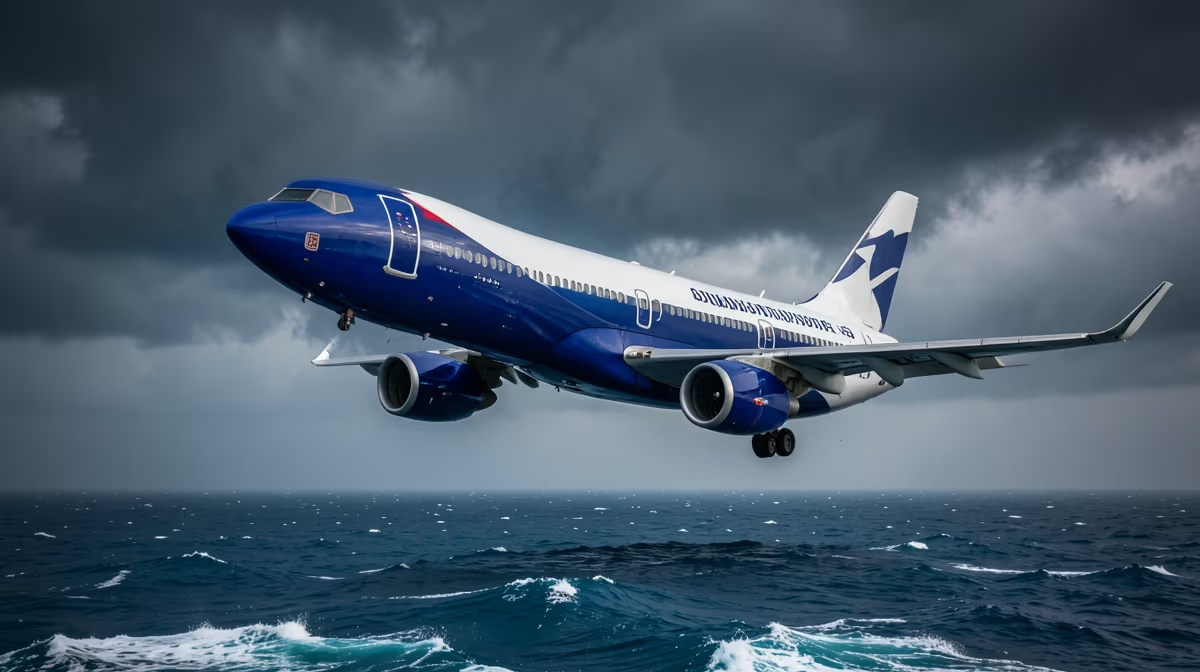
Imagine the steady hum of a transatlantic crossing suddenly replaced by the hiss of deploying oxygen masks and the stomach-churning sensation of the horizon rushing upward. For the passengers aboard British Airways flight BA295, the routine journey from London Heathrow to Chicago O'Hare transformed into a high-altitude crisis that required a British Airways emergency landing after a staggering loss of altitude.
The aircraft, which was navigating the skies over Ireland, experienced a rapid descent that saw it drop approximately 27,000 to 28,000 feet in a matter of mere minutes. This sudden plunge was not a pilot error or a navigational choice, but a controlled emergency response to a critical technical anomaly. As the flight crew worked to stabilize the vessel, the automatic deployment of oxygen masks signaled to every traveler on board that the safety of the cabin environment had been compromised.
The safe return of BA295 to London Heathrow highlights the effectiveness of emergency descent protocols, which prioritize reaching breathable air at lower altitudes during a loss of cabin pressure.
The Rapid Descent Over Irish Airspace
The timeline of the incident begins shortly after the Chicago-bound flight departed from its hub at London Heathrow. As the aircraft reached its cruising altitude and transitioned into Irish airspace, a sudden declaration of emergency altered its trajectory. Data from flight tracking and aviation reports indicate the plane plummeted from its high-altitude position to a much lower level with startling speed.
| Flight Event | Details |
|---|---|
| Departure Point | London Heathrow (LHR) |
| Destination | Chicago O'Hare (ORD) |
| Incident Location | Over Ireland |
| Altitude Drop | 27,000 - 28,000 feet |
| Emergency Status | Declared via BA295 |
| Final Action | Emergency landing at Heathrow |
During this phase of the flight, the crew followed standard operating procedures for a suspected loss of cabin pressure. In such scenarios, the priority is to descend the aircraft to an altitude of approximately 10,000 feet. This specific altitude is critical because it is the level where the atmosphere is thick enough for humans to breathe without supplemental oxygen. The rapid nature of this descent, while terrifying for those in the cabin, is a deliberate maneuver designed to move the aircraft out of the thin, oxygen-poor air of the upper atmosphere as quickly as possible.
Emergency Protocols and the Passenger Experience
Inside the cabin, the atmosphere was one of immediate urgency. When a commercial airliner experiences a potential cabin pressure anomaly at high cruising altitudes, oxygen masks are engineered to drop automatically from the overhead compartments. This system is the first line of defense, providing passengers with the necessary air supply while the pilots execute the rapid descent.
The psychological stress of such an event cannot be understated. Passengers and crew members aboard the affected British Airways flight were thrust into a situation where the physical sensations of a steep dive were compounded by the visual confirmation of an emergency—dangling masks and the urgent movements of the flight staff. This disruption extends beyond the cabin, affecting families waiting in both Chicago and London who were met with news of a diverted and distressed flight.
The aircraft dropped between 27,000 and 28,000 feet in minutes, forcing the deployment of oxygen masks as the crew managed the airborne emergency.
Aviation experts reviewing the incident note that the deployment of masks is a standard response to depressurization. It ensures that even if the cabin air becomes too thin to support consciousness, the passengers remain protected while the aircraft reaches a safe, breathable altitude. Once the pilots reached the target altitude and stabilized the aircraft, the decision was made to turn back toward London Heathrow rather than continuing the long journey across the Atlantic.
Technical Analysis: The Mechanics of Depressurization
While the official investigation into BA295 is ongoing, early speculation from aviation authorities points toward a potential loss of cabin pressure as the root cause. This technical failure occurs when the aircraft's hull or its environmental control systems fail to maintain the artificial atmosphere required for high-altitude travel.
The maintenance of cabin pressure is a complex feat of engineering, involving the aircraft’s engines, outflow valves, and the integrity of the fuselage. If any component in this chain fails, the pressure inside the plane begins to equalize with the thin air outside. To understand the severity of such an event, aviation analysts often look at historical parallels. One such parallel is the Aloha Airlines Flight 243 incident, where a structural failure led to a fundamental reshaping of global aviation safety mandates regarding cabin integrity and fuselage inspection protocols.
While the BA295 incident did not involve a structural failure of that magnitude, it raises similar questions about the reliability of aging fleets and the rigor of maintenance schedules. Experts are currently reviewing the service history of the aircraft to determine if there were prior indicators of a system vulnerability that could have led to this sudden depressurization.
Economic and Regulatory Scrutiny
The fallout from a British Airways emergency landing of this scale is felt far beyond the tarmac of Heathrow. There are immediate financial implications for British Airways, including the significant costs associated with flight disruptions, fuel dumping, and passenger compensation claims. Furthermore, such incidents can lead to short-term stock volatility for the carrier as investors react to concerns over safety and operational reliability.
Beyond the balance sheet, the incident invites intense scrutiny from aviation regulatory bodies. The UK Civil Aviation Authority (CAA) and the Federal Aviation Administration (FAA) in the United States are expected to review the maintenance standards applied to this aircraft. Key players in the industry will be watching to see if this was an isolated mechanical failure or a symptom of a broader issue within the airline's maintenance protocols.
The Impact on Consumer Confidence
Transatlantic routes are among the most lucrative and high-traffic corridors in global aviation. Ensuring consumer confidence on these long-haul flights is paramount. When a "plunge" of 28,000 feet makes headlines, it naturally causes anxiety for the flying public. British Airways and airport authorities must coordinate their responses to reassure travelers that the emergency procedures worked exactly as intended to prevent a tragedy.
Regulatory Oversight and Safety Standards
The investigation will likely focus on: - The aircraft’s maintenance logs and recent service history. - The functionality of the pressurization sensors and outflow valves. - The performance of the crew during the emergency descent. - Standard safety checks conducted prior to the flight's departure.
Geopolitical Stakes of Transatlantic Aviation
The safety of the skies between Europe and North America relies on a seamless web of international airspace coordination. The fact that BA295 declared its emergency over Ireland and was able to safely navigate back to London highlights the critical nature of cross-border emergency response systems.
Transatlantic commercial aviation is governed by standardized safety protocols that require constant communication between the UK, Ireland, and North American aviation authorities. This incident serves as a real-world test of these systems. The ability of the flight crew to declare an emergency and receive immediate priority routing back to a major hub like Heathrow demonstrates the robustness of the current international framework. However, it also underscores how a technical failure in one jurisdiction can have ripple effects across the entire global transport network.
The Hidden Crisis in Aerospace Maintenance
Behind the immediate mechanical incident lies a potential "hidden angle" that analysts are beginning to explore: a vulnerability within the aerospace maintenance sector’s ecosystem. The industry has been grappling with supply chain disruptions and a shortage of skilled labor, which can affect how quickly and thoroughly carriers can service critical systems like those responsible for cabin pressurization.
If the investigation into BA295 reveals that the depressurization was linked to a part failure or a maintenance oversight, it may point to larger systemic issues in the global aerospace supply chain. Ensuring that every aircraft in a major carrier's fleet receives timely and expert servicing is a monumental task that requires a steady flow of high-quality components and experienced technicians. Any bottleneck in this ecosystem can lead to increased risks mid-flight.
As the aviation industry continues to recover and expand, the reliability of these maintenance "ecosystems" remains a primary concern for safety regulators. The British Airways incident serves as a stark reminder that even the most advanced aircraft are dependent on a rigorous and well-resourced support structure on the ground.
Frequently Asked Questions
What happened to the British Airways flight from London to Chicago?
British Airways flight BA295 declared an emergency and was forced to return to London Heathrow after experiencing a rapid descent. Reports indicate the aircraft dropped between 27,000 and 28,000 feet in a matter of minutes over Ireland.
Why did the British Airways flight plummet 28,000 feet?
While investigations are ongoing, initial reports and passenger accounts strongly suggest a rapid loss of cabin pressure prompted the steep emergency descent. During such events, pilots intentionally descend to a lower altitude where breathable air is available.
Who was affected by the emergency landing?
Passengers onboard the Chicago-bound flight experienced the terrifying ordeal firsthand, which included the deployment of oxygen masks as the cabin pressure dropped. Fortunately, the aircraft managed to land safely back at Heathrow Airport with no reports of severe casualties.
What specific safety measures were triggered during the incident?
Oxygen masks automatically dropped from the overhead compartments in the cabin to assist passengers during the rapid altitude plunge. Flight crews followed standard emergency protocols to secure the aircraft and navigate the unscheduled return to London.
Why does an emergency landing like this matter for aviation safety?
An incident involving such a drastic and rapid altitude drop naturally raises serious questions regarding aircraft pressurization systems and mechanical reliability. Aviation authorities closely examine these events to ensure fleet-wide safety and prevent recurring technical failures.
What happens next for the passengers and the airline?
Passengers affected by the diverted flight are typically provided with alternative travel arrangements to reach Chicago as soon as possible. Meanwhile, safety regulators and British Airways engineers will thoroughly inspect the aircraft to determine the exact root cause of the sudden depressurization.
Conclusion
The emergency return of British Airways flight BA295 to London Heathrow stands as a significant incident in recent transatlantic aviation history. The sudden loss of 28,000 feet of altitude, while alarming to those on board, was the result of a calculated emergency maneuver to protect lives following a suspected loss of cabin pressure. As aviation authorities from the UK and the US begin their deep dive into the technical causes of the failure, the focus will remain on aircraft maintenance standards and the reliability of critical environmental systems. While the flight ended safely, the incident highlights the ongoing challenges of maintaining fleet integrity in a complex global supply chain. For now, the successful execution of emergency protocols remains the primary reason a potential tragedy was averted, allowing passengers and crew to return to the ground safely.
Sources
- London to Chicago BA flight declares emergency after dropping 28,000 feet — The Guardian
- British Airways BA295 returns to Heathrow after emergency over Ireland — Beinsure
- Chicago-bound British Airways flight drops 27,000 feet in minutes, makes emergency landing — NBC 5 Chicago
- Oxygen masks drop on British Airways flight as it plunges 28,000ft — AOL.com
- British Airways flight plunges 27,000 feet in minutes. Was it loss of cabin pressure? — Firstpost
- British Airways flight to Chicago makes emergency landing in London — CBS News


.webp)
