
Navi Pillay Nobel Peace Prize Win Triggers Immediate Court Sanctions
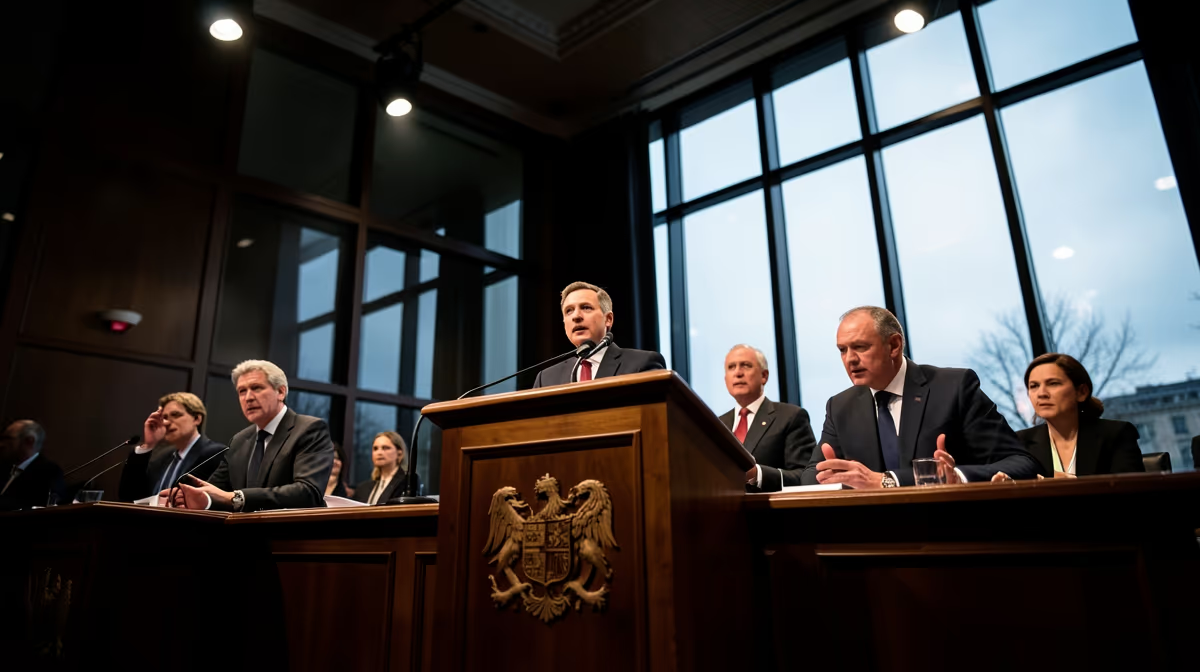
The prestige of a Nobel Peace Prize has rarely collided so directly with the hard edges of global power as it did on Friday, October 9, 2026. The announcement of the Navi Pillay Nobel Peace Prize has sent ripples through the international community, arriving at a time of unprecedented political tension surrounding global judicial institutions and the future of human rights accountability.
The recognition of Navi Pillay refocuses global commitment to international accountability and human rights protection, leading to stronger diplomatic defense of judicial institutions despite political pressures.
Navi Pillay, the former United Nations human rights chief and a South African-born jurist, was awarded the honor for her lifelong dedication to international justice. However, the celebratory atmosphere was almost immediately punctuated by a significant geopolitical counter-move. Just hours after the Nobel Committee revealed its choice, the Trump administration announced severe sanctions against the international court, sparking a dramatic clash between global human rights recognition and powerful government pushback.
The Legacy of Navi Pillay
The selection of Navi Pillay as the 2026 Nobel Peace Prize laureate is a testament to her extensive contributions to international law. As a South African-born jurist who previously served as the United Nations High Commissioner for Human Rights, Pillay has been a leading voice in championing international justice and defending human rights globally for decades. Her career is marked by her service as an International Criminal Court (ICC) judge, where she worked to hold perpetrators of international crimes accountable.
Upon receiving the award, Pillay dedicated her prestigious recognition to the "survivors of international crime." This dedication highlights the ongoing struggles for global accountability and the victims who remain at the heart of the international legal system. The award serves as a powerful validation of international human rights bodies, directly clashing with the current political climate of resistance against multilateral oversight.
Five Essential Facts About the 2026 Winner
- Navi Pillay is a South African-born jurist who has spent her career in the highest levels of international law.
- She served as the United Nations High Commissioner for Human Rights, overseeing global advocacy efforts.
- Her judicial experience includes a significant tenure as a judge for the International Criminal Court.
- She has consistently advocated for the rights of victims and survivors of war crimes and crimes against humanity.
- The 2026 Nobel Peace Prize recognizes her lifelong dedication to the rules-based international order.
A Dramatic Diplomatic Clash
The timing of the Nobel announcement and the subsequent sanctions has drawn intense global scrutiny. While the Nobel Committee sought to honor a champion of justice, the Trump administration moved to penalize the very institution she once represented. This sequence of events highlights the escalating tension between independent international judicial institutions and powerful sovereign states that resist prosecution.
This event highlights the intense friction between international judicial institutions seeking accountability for global crimes and powerful national governments that reject their jurisdiction, raising questions about the future enforcement of international law.
The root cause of this standoff lies in the friction between global human rights accountability and the protection of national sovereignty. The imposition of sanctions just hours after the Nobel announcement may signal a pre-emptive strategy by the U.S. executive branch. Analysts suggest this move could be intended to deter international jurists from pursuing politically sensitive investigations involving allied or domestic figures.
Impact of Sanctions on Global Justice
The sanctions imposed by the Trump administration are not merely symbolic; they carry profound financial and operational implications. By targeting international judicial institutions, these measures create significant hurdles for global legal cooperation. The following areas are expected to be the most affected:
| Impact Area | Consequences |
|---|---|
| Institutional Funding | Sanctions can freeze or complicate the transfer of funds necessary for court operations. |
| Operational Compliance | International organizations may face legal risks when coordinating with sanctioned judicial bodies. |
| Asset Tracking | Investigations involving the tracking of assets from international criminals could be stalled. |
| Global Diplomacy | Relations between the U.S. and traditional allies who support the court are likely to face strain. |
These punitive measures reflect a historical parallel of U.S. confrontations with the International Criminal Court. Past administrations have also utilized economic sanctions and visa restrictions on prosecutors to express opposition to the court's jurisdiction over non-member state citizens.
The Geopolitical Dimension
The juxtaposition of a Nobel Peace Prize for international justice and fresh sanctions on the court draws a clear line in the sand for global diplomacy. It deepens the diplomatic chasm between traditional Western allies, who generally defend the rules-based international order, and unilateralist postures that view international courts as an infringement on national sovereignty.
International human rights advocates, victims of global crimes, and diplomats navigating U.S. foreign policy relations are all caught in the crossfire of this dispute. The award serves as a moral shield for the court, yet the sanctions provide a physical and financial barrier to its work. This struggle raises fundamental questions about whether global judicial bodies can remain independent when faced with the economic and political might of a superpower.
Chronology of the Standoff
- Navi Pillay is awarded the 2026 Nobel Peace Prize for her contributions to international justice and human rights.
- Pillay issues a statement dedicating the award to the survivors of international crimes.
- Hours after the announcement, the Trump administration imposes retaliatory sanctions targeting the international court.
- Global legal and diplomatic bodies begin reacting to the intensifying standoff between international jurisprudence and sovereign state power.
Expert Predictions and Future Outlook
In the next 24 hours, reactions and congratulatory messages will continue to pour in for Navi Pillay, even as the diplomatic fallout from the sanctions intensifies. International legal organizations, human rights advocates, and global governments are expected to formulate official responses to both the recognition of Pillay and the counter-move by the United States within the next 72 hours.
Analysts predict that the immediate future will be defined by heightened diplomatic tensions. The best-case scenario involves the recognition of Navi Pillay acting as a catalyst to refocus global commitment to international law, potentially leading to a stronger diplomatic defense of these institutions. However, the worst-case scenario warns of an escalating rift between the U.S. and international bodies, further undermining the operational capabilities and enforcement power of global courts.
The ongoing prosecutions and investigations led by international judicial bodies will likely be monitored closely to see how the sanctions impact their ability to function. The dual events of the Nobel win and the sanctions have ensured that the debate over international accountability will remain at the forefront of global discourse for the foreseeable future.
Frequently Asked Questions
Who won the Nobel Peace Prize?
Former UN human rights chief and South African-born jurist Navi Pillay was awarded the prestigious Nobel Peace Prize for her extensive work in international justice. She dedicated the award to survivors of international crime.
What happened shortly after Navi Pillay won the Nobel Peace Prize?
Just hours after the announcement recognizing her contributions to international justice, the ICC court faced sanctions imposed by Trump. This sequence highlighted ongoing geopolitical tensions surrounding international legal bodies.
Why is Navi Pillay's Nobel Peace Prize significant?
The award highlights the critical importance of global human rights advocacy and international criminal tribunals. It honors her lifelong dedication to holding perpetrators of international crimes accountable.
Who is Navi Pillay?
Navi Pillay is a prominent South African-born jurist and former United Nations High Commissioner for Human Rights. Throughout her career, she has been a leading voice in championing international justice and defending human rights globally.
Who was affected by the recent Trump sanctions?
The sanctions directly impacted the international court where Navi Pillay previously served as a judge. These punitive measures reflect ongoing political friction between specific world leaders and international judicial institutions.
What happens next following the sanctions and the Nobel win?
The dual events will likely spark renewed global debates regarding the independence of international courts and the protection of jurists. Legal experts and international bodies continue to monitor how these sanctions will affect ongoing prosecutions.
Conclusion
The awarding of the Nobel Peace Prize to Navi Pillay marks a watershed moment for international justice, yet the immediate imposition of sanctions by the Trump administration underscores the volatile nature of global human rights enforcement. While Pillay’s recognition serves as a powerful validation of the rules-based international order, the retaliatory measures against the court signal a deepening divide in how sovereignty and accountability are perceived on the world stage. As global governments and legal bodies formulate their responses over the coming days, the international community faces a critical test of its commitment to the judicial institutions that Navi Pillay spent her life building and defending.
Sources
- Nobel Peace Prize live: Navi Pillay dedicates award to 'survivors of international crime' — BBC
- Nobel for former ICC judge Navi Pillay, Trump sanctions court hours later — India Today
- Who is Navi Pillay? 5 facts about 2026 Nobel peace prize winner — The Hindu
- South African-born jurist Navi Pillay wins Nobel Peace Prize for her work in international justice — AP News
- Former UN human rights chief Navi Pillay awarded Nobel Peace Prize — UN News
- Former UN Human Rights Chief Navi Pillay wins Nobel Peace Prize — ohchr


.webp)
