
US Green Card Halts For Indian IT Firms Trigger Major Talent Crisis
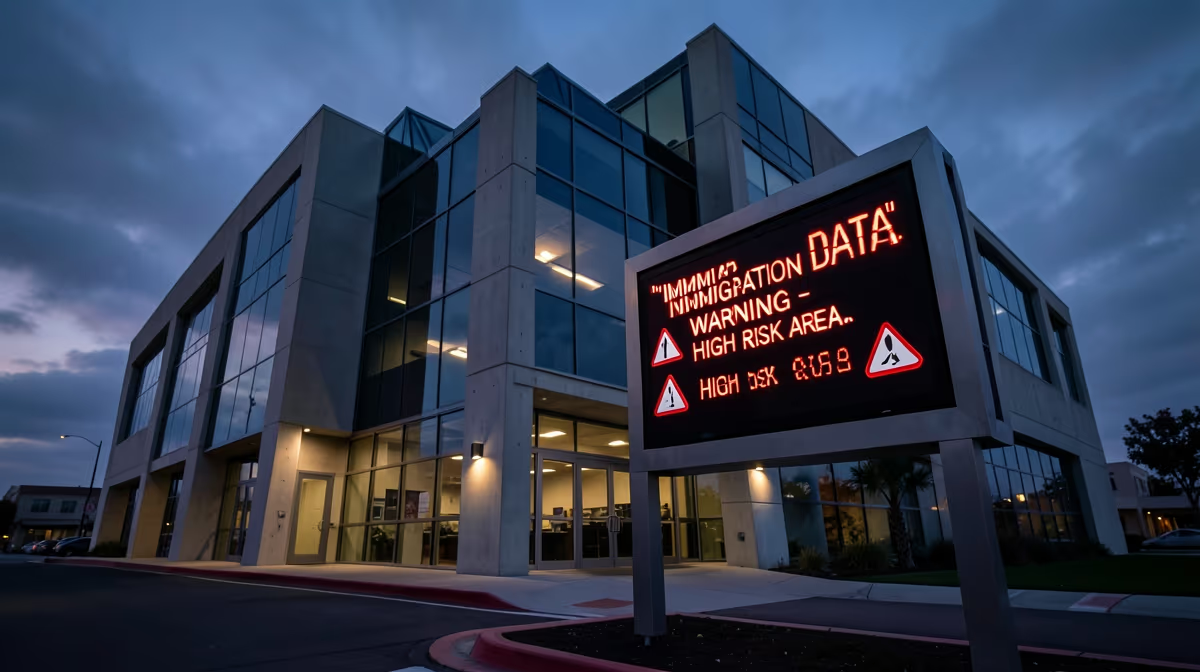
Thousands of tech professionals who once viewed the permanent residency pathway as a mathematical certainty now find themselves in a state of regulatory limbo. The decision by United States authorities to US halts green card processing for some of the world’s largest technology service providers has effectively severed the most critical bridge for high-skilled migration, sending a clear signal that the era of routine labor certifications is under threat.
This unprecedented move targets the very foundation of the employment-based immigration system, specifically focusing on the Program Electronic Review Management (PERM) labor certification. For the major Indian IT firms involved—including Tata Consultancy Services (TCS), Infosys, Wipro, and HCL—the suspension is not merely a bureaucratic delay; it is a direct challenge to their operational models in the North American market.
The suspension of major IT firms from the PERM and green card programs represents a structural shift in US immigration enforcement, prioritizing domestic labor protection over the established talent pipelines of global outsourcing giants.
A Systematic Freeze on Permanent Residency
The core of this disruption lies in the suspension of these firms from the PERM scheme. This program is the mandatory first step for any US employer seeking to sponsor a foreign national for a permanent employment-based green card. By halting this process, the US government has effectively blocked the path to permanent residency for a vast number of skilled foreign workers currently residing in the US on temporary visas.
The list of affected entities reads like a who’s who of the global technology and consulting landscape. Alongside the Indian "Big Four"—TCS, Infosys, Wipro, and HCL—the suspension also encompasses Cognizant and the American tech giant Microsoft. The involvement of such high-profile companies underscores the scale of the investigation and the perceived severity of the compliance failures.
The Role of PERM in Global Tech
Allegations of H-1B Visa Abuse and Fraud
The catalyst for this regulatory crackdown is a series of allegations involving systemic H-1B visa abuse and potential visa fraud. US authorities have initiated stricter audits and probes into how these major IT contractors utilize both the H-1B temporary work visa and the subsequent permanent labor certification pathways.
This development creates major uncertainty for thousands of skilled technology professionals who rely on their employers to sponsor their transition from temporary work visas to permanent residency.
The root cause of the suspension stems from ongoing scrutiny regarding whether these firms have bypassed standard recruitment protocols or manipulated the visa system to favor lower-cost foreign labor over domestic candidates. While these firms have historically managed large global engineering workforces through these programs, the current regulatory environment is focusing on whether these practices have crossed the line into systemic abuse.
Political and Geopolitical Pressures
On a geopolitical level, this crackdown underscores the fragile nature of the Indo-US economic partnership. While the two nations are deeply integrated in the technology sector, the mobility of high-skilled labor remains a significant point of contention. The suspension of these firms from the green card pipeline directly affects the broader framework of tech-driven bilateral trade and commerce.
Economic Fallout and Market Reaction
The financial impact of the news was immediate and focused. As information regarding the suspension reached the public, Indian IT stocks faced substantial downward pressure. In particular, the American Depositary Receipts (ADRs) of prominent firms like Infosys and Wipro fell sharply as investors began to price in the long-term operational risks associated with a restricted talent pipeline.
| Impact Area | Consequences for Affected IT Firms |
|---|---|
| Stock Markets | Immediate fall in ADRs and downward pressure on domestic Indian stocks. |
| Talent Retention | Increased difficulty in retaining high-skilled workers without a green card path. |
| Operational Costs | Likely increase in talent acquisition costs and potential shifts in delivery models. |
| Workforce Strategy | Necessity to accelerate localization and domestic hiring in the US. |
Investor sentiment is currently weighed down by the fear that a prolonged suspension could lead to a "brain drain" from these companies. Skilled workers who see their path to permanent residency blocked may look for opportunities with firms that are not under federal suspension, complicating the long-term workforce deployment strategies of the affected multinational corporations.
A Shifting Landscape for Global IT
Beyond the immediate compliance accusations, this regulatory friction is likely to accelerate a "hidden" strategy among Indian IT giants: localization. By aggressively hiring domestic American talent or shifting delivery hubs to nearshore locations, these firms may attempt to reduce their reliance on traditional visa pathways that are increasingly subject to federal audits.
- Localization: Increased recruitment of US citizens and permanent residents to mitigate visa risks.
- Nearshoring: Moving operations to geographic locations closer to the US that have more favorable immigration or trade agreements.
- Legal Challenges: Evaluating official legal responses to the US authorities to contest the suspension or clarify compliance.
- Enhanced Audits: Implementation of stricter internal controls to ensure every H-1B and PERM filing survives intense federal scrutiny.
The historical parallel to this situation can be found in previous cycles of US immigration policy where H-1B visa fee structures were tightened, audit requirements were heightened, and the definitions of "specialty occupations" were made more restrictive. However, the suspension of major firms from the PERM scheme itself represents a more aggressive level of enforcement than seen in recent years.
Future Outlook: What Lies Ahead
The next several days and weeks will be critical for the affected firms as they navigate this regulatory crisis. Analysts expect increased market volatility for Indian IT stocks as the industry waits for official statements from the US Department of Labor and the US Immigration Authorities.
Predicting the Next 72 Hours
Best-Case and Worst-Case Scenarios
Conversely, the worst-case scenario involves a prolonged suspension of green card and PERM processing. This could lead to severe talent retention issues for major Indian IT firms in the US market, potentially forcing a massive restructuring of their service delivery models and a significant loss of market value as their ability to deploy senior, specialized staff is curtailed.
Frequently Asked Questions
Why did the US halt green card processing for Indian IT firms?
The United States suspended major Indian IT companies from the PERM green card and immigration program over ongoing allegations of H-1B visa abuse and fraud. This regulatory action targets the sponsorship processes used by these firms to secure permanent residency for foreign workers.
Which companies are affected by the US green card suspension?
Major technology and IT services firms, including Infosys, Tata Consultancy Services (TCS), Wipro, Cognizant, HCL, and Microsoft, have been impacted by this suspension. The restriction halts their ability to file and process green card applications for employees under the affected schemes.
What is the PERM scheme and how does this affect it?
PERM (Program Electronic Review Management) is the system employers use to obtain labor certification from the US Department of Labor for foreign workers seeking employment-based green cards. Being suspended from this scheme blocks these prominent IT firms from moving forward with permanent residency applications for their workforce.
How are Indian IT stocks reacting to the US visa suspension?
The announcement has placed immediate pressure on Indian IT stocks, with American Depositary Receipts (ADRs) for major firms like Infosys and Wipro falling following the news. Investors are closely monitoring how the suspension will impact long-term talent retention and operations.
What happens next for employees of these IT firms?
Employees currently caught in the suspension face potential delays or halts in their green card processing pipelines while investigations or reviews take place. Legal and immigration experts are assessing the full scope of the restrictions to determine if alternative visa extensions or workarounds remain viable.
Are these measures part of a broader crackdown on work visas?
Yes, US authorities frequently scrutinize employment-based immigration programs like H-1B and PERM to ensure compliance and prevent perceived abuse or wage undercutting. Recent actions target specific large outsourcing and technology giants to enforce stricter adherence to immigration laws.
Conclusion
The suspension of major Indian IT firms and Microsoft from the US green card and PERM processing programs marks a significant escalation in the enforcement of immigration compliance. Driven by allegations of systemic H-1B visa abuse and fraud, this move has already sent ripples through the financial markets, impacting the ADRs and stock prices of global tech leaders. As companies like TCS, Infosys, and Wipro prepare their legal and diplomatic responses, the primary concern remains the long-term stability of their workforce pipelines in their largest overseas market. While the prospect of a swift resolution exists, the current landscape suggests a period of heightened scrutiny and potential operational restructuring for firms that have long relied on traditional visa pathways to power the global technology sector.
Sources
- US visa chaos: Tata, Wipro among IT firms suspended from PERM scheme; what it means — The Times of India
- US Halts Green-Card Processing For Infosys, TCS, Cognizant, Others — Deccan Chronicle
- US suspends Microsoft, Infosys, TCS, Wipro, Cognizant from green card programme over alleged H-1B abuse — Moneycontrol.com
- Why US has suspended Indian IT firms Cognizant, TCS, Wipro, HCL from Green Card filings — The Indian Express
- US Suspends Infosys, TCS, Wipro, HCL, Cognizant From Green Card Programme; Alleges Visa Fraud — News18
- Indian IT Stocks Under Pressure: Infosys, Wipro ADRs Fall After US Suspends Major Firms From Immigration Programme — NDTV Profit


.webp)
