
Voter roll protest in Delhi triggers a high-stakes national showdown
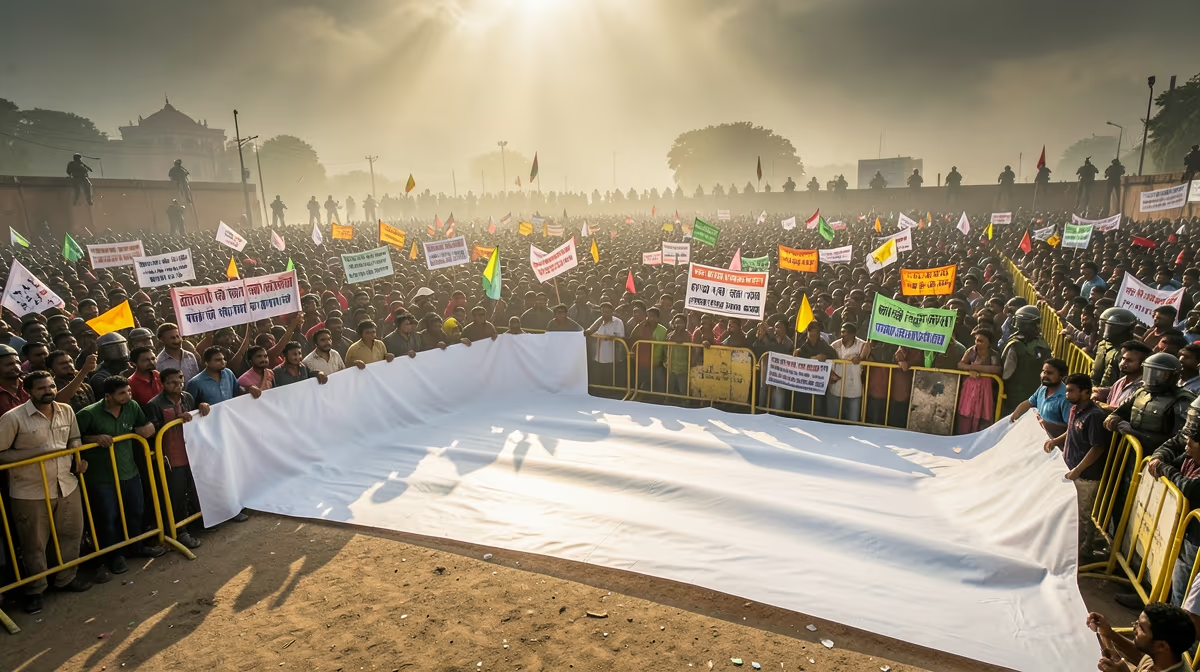
Ramlila Maidan once again stands at the epicenter of national political friction as thousands flood central New Delhi over contested electoral rolls. The massive INDIA bloc Delhi protest has directly challenged the administration of Chief Election Commissioner Gyanesh Kumar, turning official voter lists into a volatile institutional battleground.
The convergence of top opposition leaders and thousands of demonstrators at Ramlila Maidan signals a critical confrontation over the transparency of India's electoral oversight.
Accompanied by dense throngs of supporters, senior opposition figures converged on the capital to voice acute objections to administrative revisions carried out by election authorities. The demonstration represents a major escalation in friction between the central opposition coalition and the Election Commission of India. Beyond the political rhetoric, the gathering disrupted central corridors of the capital, testing the limits of municipal crowd control and drawing intense domestic and international scrutiny toward the mechanisms governing democratic verification.
The Scale of Mobilization at Ramlila Maidan
The Ramlila Maidan rally brought together thousands of political workers, civil society participants, and allied regional representatives who marched alongside key national leaders. Prominent figures including Rahul Gandhi and Akhilesh Yadav accompanied the crowds directly to the historic demonstration grounds. The sheer density of the turnout transformed central Delhi into a staging ground for coordinated anti-establishment messaging.
A visual centerpiece of the protest was the physical display of a truncated voter list measuring approximately one kilometer in length. Opposition organizers unfurled this physical scroll across the venue to showcase what they assert are sweeping and unwarranted omissions from the official voter records. Demonstrators pointed to the extensive document to argue that recent updates have compromised voter access and created widespread systemic irregularities.
The assembly at Ramlila Maidan functioned not merely as a gathering for party workers, but as a public display of unified opposition resistance. The presence of both Rahul Gandhi and Akhilesh Yadav walking among the ranks underscored the high priority the coalition places on the issue, using the physical space of Delhi to project collective resolve against centralized administrative decisions.
Capital Security Grid and Urban Disruptions
Ahead of the massive influx of marchers, law enforcement authorities heavily fortified New Delhi with strict security protocols. Approximately 10,000 security personnel were deployed across strategic perimeters, transit arteries, and sensitive zones surrounding the venue. Police checkpoints, layered barricading, and tactical deployments were established to monitor crowd movements and ensure public order remained intact.
The preemptive mobilization of security forces reflected official concern over potential unrest given the volatility surrounding electoral controversies. The deployment had immediate logistical repercussions across the National Capital Region:
- Widespread traffic diversions along central transit corridors connecting central Delhi to neighboring districts.
- Heightened commuter delays and congestion along primary road arteries leading toward Ramlila Maidan.
- Localized economic interruptions as commercial transport, market logistics, and daily business activities slowed near the demonstration perimeter.
- Stringent surveillance and perimeter control shifting standard urban policing toward high-containment protocols.
Analysts note that the deployment of 10,000 personnel indicates an institutional shift toward increasingly tight security envelopes for urban political assemblies. While these measures prevented catastrophic breakdowns of law and order, they also altered the everyday flow of commerce and daily transport throughout Delhi NCR.
Disputes Surrounding Electoral Integrity and the CEC
At the heart of the demonstration is an escalating dispute targeting the Election Commission of India and Chief Election Commissioner Gyanesh Kumar. The CEC Gyanesh Kumar protest reflects profound friction between opposition parties and the leadership of the statutory body responsible for administering the country's franchise.
The display of a kilometer-long truncated voter list at Ramlila Maidan served as the visual centerpiece for the opposition's claims regarding electoral roll discrepancies.
The opposition contends that the recent revisions of the voter rolls threaten democratic integrity by disenfranchising eligible voters through nontransparent administrative removals. The core grievances focus on:
- The administrative mechanisms utilized to excise registered names from updated electoral registers.
- A perceived lack of procedural transparency during the roll revision process.
- Concerns regarding the administrative accountability of the Election Commission during routine and special updates.
- Demands for verifiable scrutiny of removed entries prior to the formalization of upcoming electoral contests.
The opposition alliance argues that transparency in the voter registration apparatus is essential to public trust. When major political parties challenge the credibility of voter rolls, it triggers wider public anxiety regarding institutional impartiality and the rule of law.
Historical Context and Political Consolidation
The venue of the demonstration carries immense historical weight in Indian political history. Ramlila Maidan has historically served as the crucible for transformational civic movements and anti-establishment mobilization. Notably, the current assembly draws comparisons to the 1974–1975 JP movement, as well as subsequent anti-corruption demonstrations that utilized the same grounds to galvanize national opposition against centralized authority.
By organizing the Rahul Gandhi voter roll protest at this specific site, the INDIA bloc seeks to harness this historical legacy. The rally acts as a platform to consolidate anti-establishment momentum across disparate regional parties. With figures like Rahul Gandhi and Akhilesh Yadav sharing the stage, the coalition has attempted to move the debate from institutional petitioning into mass street mobilization.
This strategy aims to unify multiple opposition factions behind a single institutional grievance. By focusing squarely on democratic norms, voter accessibility, and the conduct of the Election Commission, the coalition has crafted a narrative intended to appeal across regional borders and build sustained political momentum.
Institutional Scrutiny and Global Observations
The developments in Delhi have resonated far beyond domestic news cycles. International observers and foreign media have closely monitored the mobilization at Ramlila Maidan, viewing the administrative friction over voter rolls as an important barometer of India's institutional robustness and democratic health.
When demonstrations question the administrative handling of voter lists, international focus turns toward institutional checks and balances. The friction underscores how deeply administrative decisions in election management impact external perceptions of domestic stability. Simultaneously, prolonged domestic tensions and major capital demonstrations introduce localized economic disruptions, transport gridlocks, and heightened caution regarding political continuity.
Projected Developments Over the Next 24 to 72 Hours
The trajectory of this confrontation will unfold through distinct phases over the coming days, dictated by security management and political positioning.
The Next 24 Hours
Security measures across New Delhi are expected to gradually wind down as crowds disperse from Ramlila Maidan. Tactical deployments will scale back, allowing normal traffic corridors across Delhi NCR to resume standard operation. Concurrently, political rhetoric generated from the rally speeches will heavily dominate national television broadcasts and digital media discourse, with political parties analyzing the impact of the mass turnout.
The Next 72 Hours
Over the subsequent 72 hours, political maneuvering is anticipated to escalate within legislative and administrative spheres. Discussions surrounding the voter roll revisions and the actions of the Election Commission under Gyanesh Kumar are likely to intensify inside parliamentary corridors and party headquarters. Opposition leaders are expected to maintain public pressure through formal memorandums and continued demands for administrative reform.
Best-Case and Worst-Case Scenarios
The forward outlook hinges on institutional responsiveness and the strategy adopted by political stakeholders:
- Best-Case Scenario: The protest concludes without major civil confrontation. Opposition delegations submit formal memorandums detailing their voter roll grievances, leading to a constructive, transparent dialogue with the Election Commission that clarifies the revision process and restores public confidence.
- Worst-Case Scenario: Tensions over electoral roll transparency remain unresolved, triggering secondary protests and broader civil unrest. Stricter security clampdowns could follow, resulting in prolonged political gridlock and heightened polarization between the opposition coalition and statutory authorities.
Analysts expect sustained polarization, with opposition parties continuing to press the Election Commission on transparency standards as future electoral milestones draw closer.
Frequently Asked Questions
What is the INDIA bloc protest rally in Delhi about?
The opposition INDIA bloc held a major protest rally at Ramlila Maidan in Delhi to voice strong opposition against controversial voter roll revisions. Leaders and supporters gathered to demand accountability regarding electoral transparency.
Who are the key figures leading the anti-CEC protest in Delhi?
Prominent political leaders including Rahul Gandhi and Akhilesh Yadav participated in the massive march alongside thousands of supporters. The rally specifically targeted concerns involving Chief Election Commissioner Gyanesh Kumar and the election oversight process.
Why are opposition parties protesting against the voter roll revisions?
Opposition parties claim that the recent voter roll revisions threaten the integrity of the democratic process and disenfranchise eligible voters. Demonstrators even displayed a 1 kilometer long cut voter list at the venue to highlight discrepancies.
How many security personnel were deployed for the Delhi opposition rally?
Authorities tightened security significantly across Delhi ahead of the demonstration, deploying approximately 10,000 security personnel. This massive deployment aimed to maintain law and order as massive crowds accompanied leaders to Ramlila Maidan.
What impact does this anti-CEC protest have on national politics?
The rally highlights mounting tensions between India's opposition coalition and election authorities over electoral transparency. It serves as a unified platform for opposition parties to challenge administrative decisions ahead of upcoming political milestones.
What is expected to happen next following the Ramlila Maidan rally?
Following the massive turnout at Ramlila Maidan, opposition leaders are expected to escalate their political pressure and institutional challenges regarding electoral rolls. Further demonstrations and parliamentary strategies may follow as parties continue to demand reforms.
Conclusion
The mass gathering at Ramlila Maidan represents a pivotal moment in the ongoing dispute over India's electoral processes. Verified developments confirm that thousands of demonstrators, led by Rahul Gandhi, Akhilesh Yadav, and other senior alliance figures, mounted a major public challenge against voter roll revisions and the administration of Chief Election Commissioner Gyanesh Kumar, under the watchful presence of 10,000 deployed security personnel. While security deployments across New Delhi are slated to recede, the administrative and political consequences are set to expand. The coming days will test the willingness of institutional authorities and opposition leaders to engage in transparent dialogue, determining whether these grievances lead to procedural clarity or deepen the institutional rift.
Sources
- INDIA Bloc March Live Updates: Massive crowd accompany Rahul, Akhilesh & others to Ramlila Maidan — The Times of India
- Ramlila Maidan Protest: सामने आई 1 Km लंबी कटी हुई Voter List | Rahul Gandhi — Prabhat Khabar
- Indian forces tighten security in Delhi ahead of big opposition protest — The Guardian
- India news: Opposition holds major rally in Delhi over voter roll revisions — DW.com
- 10,000 Security Personnel Deployed Ahead of INDIA Bloc Anti-CEC Delhi Protest — The Quint
- Supporters gather at Ramlila Maidan for INDIA bloc’s protest rally against CEC Gyanesh Kumar — The Hindu


