
Justice Alito Faces Growing Scrutiny Over Supreme Court Integrity
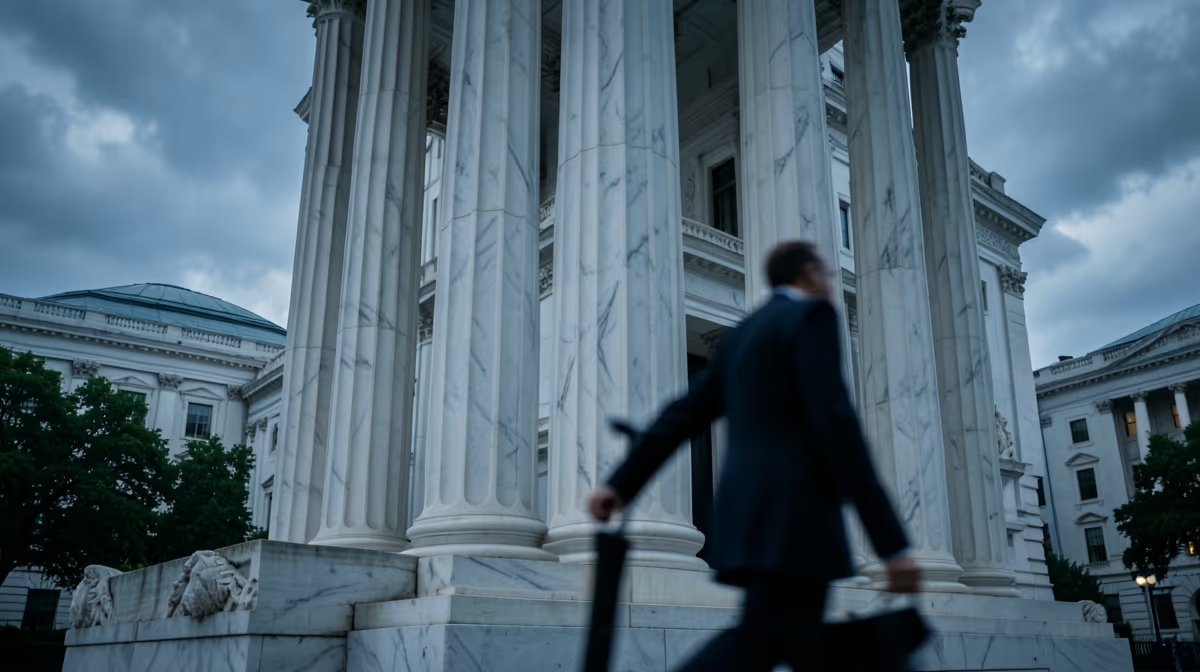
Speculation regarding the composition of the high court has reached a fever pitch, forcing a national conversation on the boundaries of judicial neutrality and the sanctity of the bench. As calls for transparency echo through the halls of Congress, the scrutiny currently directed at Justice Alito serves as a focal point for a broader, deeper debate about the structural integrity of the American legal landscape for the coming generation.
The Context of the Controversy
Samuel Alito is an American lawyer and jurist who has served as an Associate Justice of the Supreme Court of the United States since 2006. Appointed by President George W. Bush, he has spent over 18 years shaping the trajectory of constitutional law. His tenure is defined by his identity as a leader of the court’s conservative majority, with a judicial philosophy grounded in originalism and textualism.
Recent public discourse has shifted toward his conduct outside the courtroom. The current tension stems from reports documenting an inverted American flag flying outside his Virginia home in January 2021, and an Appeal to Heaven flag observed at his New Jersey vacation property in 2023. These symbols, often associated with the Stop the Steal movement, have prompted critics and several Democratic lawmakers to question his impartiality in cases involving the 2020 election and the January 6th Capitol attack. Justice Alito has formally responded, stating he had no involvement in the display of the flags and attributing the actions to his wife, Martha-Ann Alito.
Analyzing the Judicial Impact
The concerns surrounding Justice Alito are not merely about personal conduct; they touch upon the core mission of the Supreme Court as an independent arbiter. As the author of the majority opinion in Dobbs v. Jackson, which overturned the constitutional right to an abortion, his influence on the legal landscape is profound. When the integrity of such a figure is questioned, it impacts public trust in the entire judicial branch.
The lack of a formal, enforceable code of ethics for the Supreme Court has become a central argument for those demanding reform. While the Court adopted a formal code of conduct in November 2023, critics argue that without an enforcement mechanism, the institutional legitimacy of the judiciary remains vulnerable to partisan polarization. This debate is unfolding at a time when the Court is increasingly viewed as the final arbiter of executive and legislative policy, effectively insulating conservative governance from regular electoral cycles.
A Geopolitical and Economic Assessment
From an analytical perspective, the current friction suggests a root cause that goes beyond recent news: the crystallization of an originalist legal ideology designed to reverse post-New Deal social and regulatory consensus. This shift is not confined to social issues; it has significant economic implications. By dismantling the administrative state's regulatory capacity, the Court's current majority, led by figures like Alito, is effectively shifting wealth distribution by reducing corporate compliance costs and liability exposure.
Geopolitically, the stability of these constitutional norms is under observation. The erosion of international confidence in the impartiality of the U.S. judiciary weakens the country’s position as a reliable guarantor of democratic stability and rule-of-law standards. If the perception persists that the judiciary is a political entity, the global impact could be a long-term diminishment of American institutional credibility.
The Political Standoff
The situation is expected to intensify over the next 72 hours. Senate Judiciary Committee members are anticipated to issue formal letters or public statements demanding greater transparency regarding judicial ethics. Legal analysts expect a continued standoff, with Justice Alito likely remaining silent on the issue beyond his previous written responses. This dynamic risks fueling heightened partisan polarization, potentially leading to legislative attempts to impose stricter oversight on the judiciary.
The spectrum of outcomes remains wide. In the best case, the Supreme Court could release a clarifying statement on gift and travel disclosure policies that mollifies public concern without compromising judicial independence. Conversely, the worst-case scenario involves the emergence of new evidence regarding a deeper conflict of interest, which could trigger a formal impeachment inquiry and a constitutional crisis regarding the separation of powers.
Historical Parallels and Future Risks
The current climate shares similarities with the Lochner era of the early 20th century, a period when the Supreme Court systematically invalidated progressive economic legislation based on rigid interpretations of contract liberty. Today, the focus is on a strategic reallocation of federal power away from democratic institutions. While many focus on the optics of flag displays, analysts suggest these ethical scandals may serve as a distraction from the substantive, long-term shifts in federal authority.
As the Court continues to navigate these challenges, the reliance on an unenforceable code of conduct remains the primary friction point. Whether the institution can restore a sense of neutral oversight will likely determine the level of public trust in federal rulings for the next generation.
Frequently Asked Questions
Who is Samuel Alito?
Samuel Alito is an American lawyer and jurist who has served as an Associate Justice of the Supreme Court of the United States since 2006. He was appointed to the Court by President George W. Bush following the retirement of Justice Sandra Day O'Connor.
How long has Samuel Alito been on the Supreme Court?
Justice Alito has served on the Supreme Court for over 18 years. He was confirmed by the U.S. Senate on January 31, 2006, and took his seat shortly thereafter.
What is Justice Alito's judicial philosophy?
Justice Alito is widely regarded as a conservative jurist who generally adheres to originalism and textualism. His opinions often emphasize a strict interpretation of the Constitution and judicial restraint regarding the expansion of federal power.
Did Samuel Alito write the Dobbs v. Jackson opinion?
Yes, Justice Samuel Alito authored the majority opinion in the 2022 case Dobbs v. Jackson Women's Health Organization. The decision effectively overturned Roe v. Wade, concluding that the Constitution does not confer a right to abortion.
Is Samuel Alito still a Supreme Court justice?
Yes, Samuel Alito remains a sitting Associate Justice of the Supreme Court of the United States. He continues to participate in the Court's proceedings and author opinions on cases before the bench.
What was Samuel Alito's career before the Supreme Court?
Before his appointment to the Supreme Court, Alito served as a judge on the United States Court of Appeals for the Third Circuit for 15 years. He also held several positions in the executive branch, including serving as the United States Attorney for the District of New Jersey.
Conclusion
The scrutiny facing Justice Alito underscores a precarious moment for the American judiciary, where concerns over personal conduct intersect with deep-seated debates about the Court's role in a democratic society. With the Senate Judiciary Committee likely to heighten its oversight demands and the Court facing pressure to clarify its ethical standards, the immediate path forward will be defined by the tension between institutional autonomy and the need for public accountability. While Justice Alito has formally denied personal involvement in the events that triggered this crisis, the broader implications for the Court's legitimacy and the American legal landscape will remain a subject of intense focus for policymakers and the public alike.


.webp)

.webp)
