
14th Amendment Legal Battles Are Triggering a Constitutional Shift
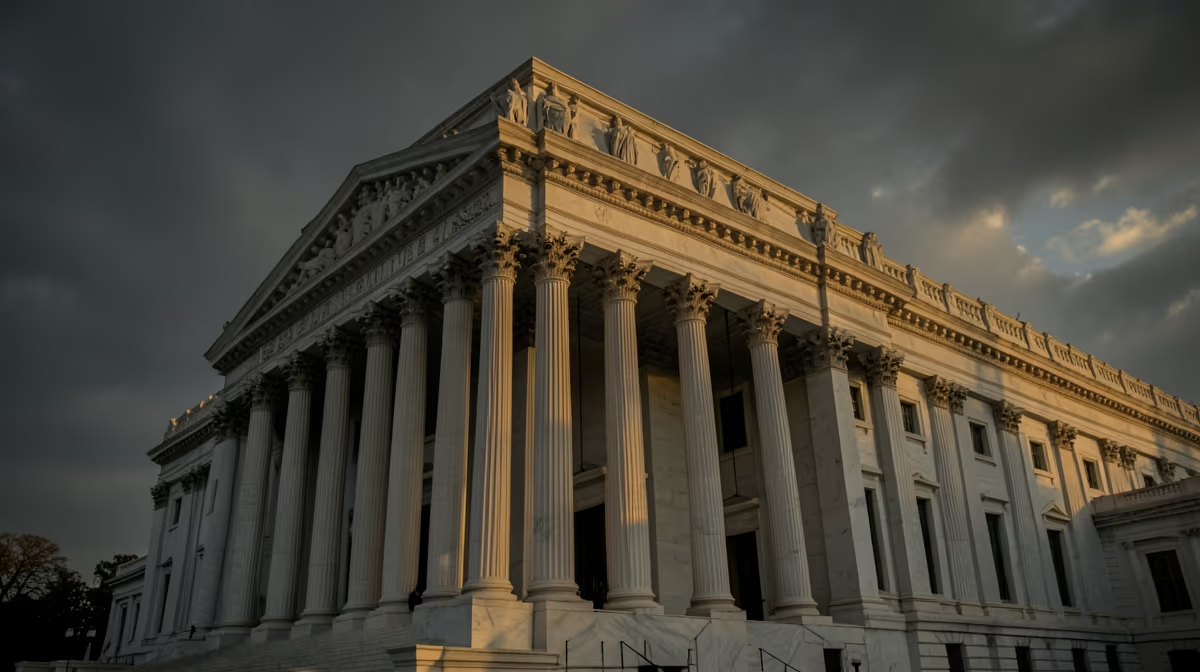
Hidden within the machinery of the United States Constitution lies a mechanism that dictates the boundaries of citizenship and the extent of federal authority over the lives of millions. As legal challenges mount, the 14th amendment remains a cornerstone of American constitutional law, continuously shaped by evolving supreme court decisions that define the very fabric of national identity.
The Historical Foundation and Evolution
Ratified in 1868 following the conclusion of the American Civil War, the amendment emerged as a critical Reconstruction-era tool designed to dismantle the legal foundations of chattel slavery. Its primary objective was to ensure that formerly enslaved people were recognized as full citizens, effectively overturning the discriminatory logic of the Dred Scott decision. Over the subsequent century, this text evolved from a narrow protection for newly freed individuals into the primary vehicle for federal intervention in state-level policy.
The amendment was formally ratified on July 9, 1868. It consists of several vital components, including the Citizenship Clause, the Privileges or Immunities Clause, the Due Process Clause, and the Equal Protection Clause. This structure empowers the federal government to enforce protections against state actions that infringe upon individual liberties, marking a permanent shift in the balance of power between Washington and the individual states.
Key Clauses and Judicial Jurisprudence
The legal potency of the amendment is found in its specific clauses, each serving a distinct function in modern jurisprudence. The Equal Protection Clause, for instance, requires that no state shall deny any person within its jurisdiction equal protection under the law. This mandate has served as the bedrock for landmark cases such as Brown v. Board of Education, which ended state-sponsored racial segregation in public schools, and Obergefell v. Hodges, which affirmed the right to marriage for same-sex couples nationwide.
Equally significant is the Due Process Clause, which forbids states from depriving any person of life, liberty, or property without following established fair legal procedures. While originally conceived to shield individual rights, this clause has seen its scope widen significantly. Constitutional law expert Professor Jonathan Turley has described the amendment as the most significant expansion of federal power in American history, noting that it effectively shifted the balance of authority from state legislatures to the federal judiciary to better protect fundamental individual rights.
The Intersection of Citizenship and Law
Birthright citizenship remains a central point of contention in modern legal discourse. By explicitly stating that all persons born or naturalized in the United States are citizens of the United States and the state wherein they reside, the amendment establishes a clear standard for national belonging. This doctrine has profound consequences for individuals regardless of their parents' legal status.
The interpretation of this clause is not merely academic; it governs the daily lives of every person living in the United States, including non-citizens and marginalized groups. As the Supreme Court interprets the text through the lens of history and tradition, it continues to address questions surrounding the limits of state authority, particularly when local statutes clash with the constitutional requirement for equality and fair treatment.
Current Legal Challenges and Section 3
The focus of current constitutional discourse has shifted toward Section 3, often referred to as the insurrectionist clause. This section prohibits individuals who have engaged in insurrection or rebellion against the United States from holding public office. As the national election cycle nears, this clause has moved from historical obscurity to the forefront of urgent litigation.
Legal scholars and state actors are currently testing the boundaries of state versus federal jurisdiction in electoral qualifications. This has resulted in a flurry of filings in local and state jurisdictions, creating a complex legal landscape. In the next 24 hours, these filings are expected to continue, potentially escalating into intensified briefing cycles and procedural motions in state supreme courts and federal appellate circuits within the next 72 hours.
Geopolitical Implications and Institutional Stability
The internal struggle over the interpretation of the Constitution reflects a broader tension between democratic standards and global credibility. The United States frequently utilizes its human rights framework to project soft power abroad, yet it faces internal scrutiny regarding the consistency of voting access and systemic inequality.
From an economic perspective, the 14th amendment has also shaped the landscape of American capitalism. The interpretation of corporate personhood through the Equal Protection Clause has historically shielded private entities from certain state regulations, a development that continues to influence modern litigation. The potential for a fragmented legal landscape remains a primary concern for observers; a worst-case scenario involves inconsistent ballot access across different states, which could fuel civil unrest and challenge the perceived legitimacy of national institutions. Conversely, a best-case scenario would see a definitive, consensus-driven judicial ruling that provides clarity on eligibility standards, thereby reducing administrative uncertainty and voter confusion.
Expert Outlook on Judicial Intervention
Predicting the path of the judiciary requires an understanding of the current court's approach to structural stability. Expert analysis suggests that the Supreme Court will likely maintain a narrow interpretation of these constitutional questions to avoid broad federal interference in state-level candidate eligibility. By favoring structural stability, the judiciary seeks to navigate the pressures of a polarized political environment without precipitating a constitutional crisis.
This ongoing process highlights the perpetual struggle over the extent of federal versus state sovereignty. As the courts evaluate the application of the Equal Protection Clause to emerging technological and digital civil rights issues, the 14th amendment remains an active, evolving tool for federal oversight. The current state of jurisprudence suggests that while the amendment provides the framework for individual rights, its application remains fluid, shaped by the needs of an era that balances ancient constitutional text with contemporary political demands.
Frequently Asked Questions
What is the main purpose of the 14th Amendment?
The 14th Amendment was ratified in 1868 to grant citizenship to all persons born or naturalized in the United States, including formerly enslaved people. It also guarantees all citizens equal protection under the law and prohibits states from depriving individuals of life, liberty, or property without due process.
What are the key clauses of the 14th Amendment?
The most significant parts of the amendment include the Citizenship Clause, the Privileges or Immunities Clause, the Due Process Clause, and the Equal Protection Clause. Together, these sections establish the fundamental rights of individuals against state government interference.
How did the 14th Amendment change the US Constitution?
It significantly expanded the federal government's power to protect individual rights against state-level abuses. Prior to its passage, the Bill of Rights mostly applied only to the federal government, but the 14th Amendment allowed for the incorporation of these rights to apply to state actions as well.
What is the Equal Protection Clause of the 14th Amendment?
The Equal Protection Clause requires that no state shall deny to any person within its jurisdiction the equal protection of the laws. This provision has served as the foundation for landmark Supreme Court cases, including those ending segregation and legalizing same-sex marriage.
Does the 14th Amendment apply to everyone in the US?
The 14th Amendment generally protects any person within the jurisdiction of the United States, which includes both citizens and non-citizens. While certain political rights like voting are reserved for citizens, the protections of due process and equal protection apply broadly to all individuals present in the country.
What is the significance of the 14th Amendment for birthright citizenship?
The Citizenship Clause of the 14th Amendment explicitly states that all persons born or naturalized in the United States are citizens of the United States and of the state wherein they reside. This established the legal doctrine of birthright citizenship, ensuring that individuals born on US soil are automatically granted constitutional rights regardless of their parents' status.
Conclusion
The 14th Amendment stands as the primary vehicle for federal intervention in state laws that may infringe upon fundamental liberties. While the amendment was born out of the necessity to rectify the injustices of the post-Civil War era, its application continues to evolve in response to 21st-century political and digital challenges. As state and federal courts navigate the complexities of ballot access and citizenship eligibility, the central objective remains the balance between individual protection and institutional stability. Future developments will be defined by the Supreme Court’s pursuit of narrow, consensus-driven rulings intended to preserve the integrity of the electoral process amid significant political polarization.


.webp)

.webp)
