
Russia Ukraine War Escalation Forces Urgent Global Security Rethink
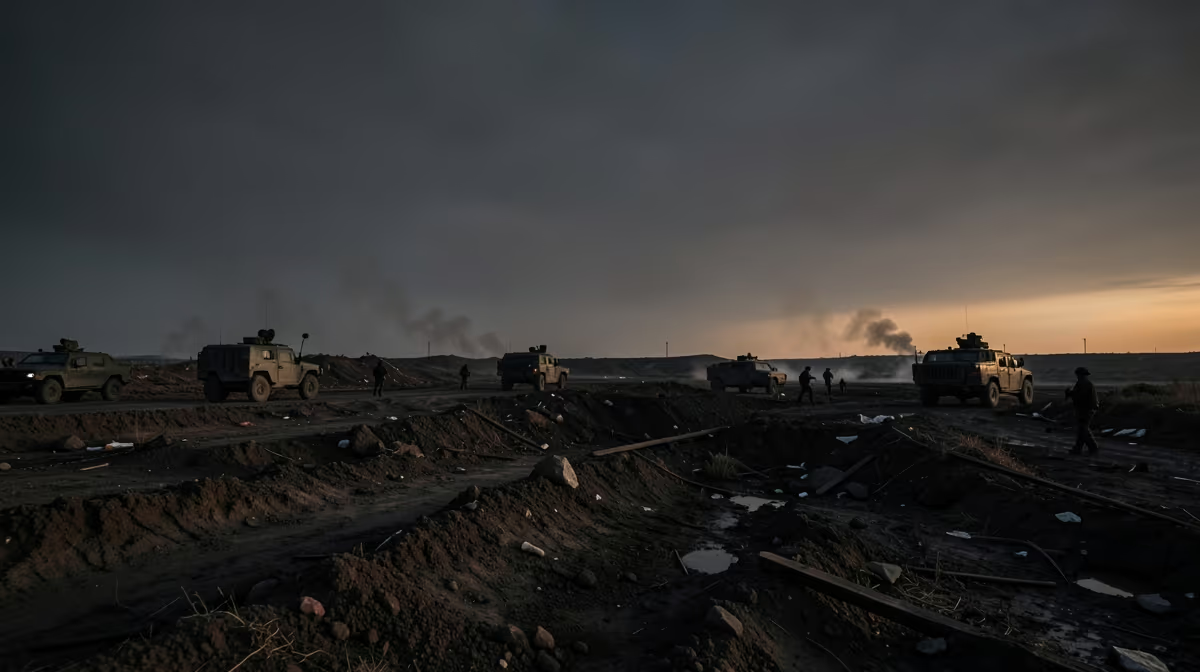
The ongoing russia ukraine war continues to reshape global security paradigms, prompting urgent defense analysis from international observers as the region faces further geopolitical escalation. While the frontline remains locked in a high-intensity struggle, the implications of this conflict extend far beyond the immediate geography of eastern Europe, impacting global markets and the established international order.
Current Status of the Frontlines
Russian forces have intensified their offensive operations in eastern Ukraine this week, focusing on strategic logistical hubs near Pokrovsk as frontline clashes reached a sustained period of high-intensity combat. Military analysts and defense officials report that Moscow is leveraging superior artillery numbers and aerial glide-bomb strikes to pressure Ukrainian defensive lines, which are currently suffering from personnel shortages and ammunition constraints. The current theater of operations remains centered in the Donetsk region, where Russian units have made incremental gains toward Pokrovsk, a critical node for Ukrainian supply lines. Ukrainian forces have responded with defensive maneuvering and increased use of First-Person View drones to mitigate the Russian advantage in heavy armor and indirect fire, though the attrition rate remains high for both sides as winter approaches.
Key Facts of the Conflict
The conflict, which saw a full-scale invasion launched by Russia on February 24, 2022, has become the largest refugee crisis in Europe since World War II. International organizations estimate that hundreds of thousands of casualties have been sustained among both military forces and civilians. Significant portions of Ukraine infrastructure, including vital energy grids and major cities, have been destroyed by systematic Russian missile and drone strikes. Throughout this period, Ukraine has received billions of dollars in defense aid from NATO countries to sustain its resistance. Despite this support, the front lines remain largely static in terms of territorial control, characterized by industrial-scale attrition, entrenched defensive lines, and intense trench warfare.
Why the Conflict Matters
The war has triggered a massive shift in global geopolitics, reviving the NATO alliance and causing energy and food prices to spike worldwide. Because Ukraine and Russia are major global suppliers of grain and energy, the conflict has exacerbated inflation and food insecurity in many developing nations. This is a crisis that directly affects the stability and cost of living for people across the planet. The humanitarian impact is equally profound, affecting millions of refugees and those remaining in the war zone, alongside the global population reliant on stable commodity markets. The long-term decoupling of Western financial systems from the Russian economy, coupled with the fracturing of global supply chains, marks a fundamental change in how international trade and security intersect.
Root Causes and Strategic Analysis
The collapse of the post-Cold War security architecture in Europe serves as the primary root cause of this conflict, highlighting a fundamental incompatibility between Russia perceived existential security sphere and Ukraine aspiration for Euro-Atlantic integration. This struggle is set against a broader shift toward a multipolar world order, where liberal democratic institutions are being tested against autocracy. Analysts point to a hidden dimension in this competition: the control over Ukraine vast critical mineral deposits, including lithium, titanium, and rare earth elements, which are essential for the global transition to green energy technologies. Historical parallels are often drawn to the 1938 Munich Agreement, reflecting a failure of containment policies, combined with the attrition-based dynamics of the First World War. Furthermore, the strategic alignment between Moscow and Beijing, and the increased securitization of trade routes across the Eurasian landmass, demonstrate how this conflict has become a focal point for global power reconfigurations.
Diplomatic and Military Outlook
International diplomatic efforts continue to stall as Kyiv maintains its demand for long-range strike capabilities against military targets deep within Russian territory. While the United States and NATO allies have increased shipments of air defense systems, there is no consensus regarding the authorization of Western-made long-range missiles for offensive strikes inside Russia, citing concerns over potential escalation. Ukrainian President Volodymyr Zelenskyy has emphasized that the situation remains extremely difficult, calling on Western partners to expedite the delivery of critical air defense assets to protect civilian infrastructure. Conversely, the Kremlin has dismissed calls for de-escalation, with spokesperson Dmitry Peskov stating that the goals of the Special Military Operation will be achieved regardless of external military assistance provided to the Kyiv regime.
Projections for the Theater of Operations
Over the next 24 hours, the region will likely see continued localized Russian tactical advances in the Donetsk region, coupled with intensified long-range drone and missile strikes on Ukrainian energy infrastructure and logistical hubs. Looking toward the next 72 hours, observers expect increased diplomatic posturing following fresh military aid announcements and continued defensive maneuvering by Ukrainian forces to stabilize frontlines near Pokrovsk. Expert predictions suggest the conflict is likely to persist as a war of attrition, with Russia focusing on grinding down Ukrainian defensive depth while Ukraine seeks to leverage long-range strike capabilities to degrade Russian logistics. While the best-case scenario involves a stabilization of the front line leading to a pragmatic ceasefire, the worst-case scenario remains a catastrophic breach of Ukrainian defensive lines or an escalatory event involving direct kinetic confrontation between NATO and Russian assets.
Frequently Asked Questions
What is the primary cause of the Russia-Ukraine war?
The conflict stems from long-standing geopolitical tensions, including Ukraine desire to align with Western institutions like NATO and the EU. Russia perceives this expansion as an existential threat to its security and influence in the region, leading to its full-scale invasion in February 2022.
How long has the Russia-Ukraine war been going on?
While the full-scale invasion began on February 24, 2022, the conflict dates back much further to 2014. This was marked by Russia annexation of Crimea and the start of fighting in the Donbas region between Ukrainian forces and Russian-backed separatists.
What are the current goals of Russia and Ukraine?
Russia aims to solidify control over occupied Ukrainian territories and prevent Ukraine from joining NATO, often framing its objectives as the demilitarization of the country. Ukraine primary goal is to restore its territorial integrity, regain control of all occupied lands, and secure its sovereignty through international military and financial support.
What role has NATO played in the Russia-Ukraine war?
NATO members have provided extensive military aid, intelligence, and humanitarian support to Ukraine to help it defend against Russian aggression. While the alliance has not deployed its own troops to fight directly in Ukraine, it has reinforced its member states on the eastern flank to prevent the conflict from spreading.
What is the impact of the war on the global economy?
The war has caused significant disruptions to global energy supplies, particularly natural gas and oil, leading to spikes in inflation and cost-of-living crises worldwide. Additionally, since both Russia and Ukraine are major exporters of grain and fertilizer, the conflict has severely impacted global food security and commodity prices.
Are there any current prospects for peace negotiations?
Peace negotiations have remained stalled for a long period due to fundamentally opposing conditions set by both sides. Ukraine insists on the withdrawal of Russian troops from all occupied territories, while Russia demands that Ukraine acknowledge the annexation of these regions as a prerequisite for any formal talks.
Conclusion
The Russia Ukraine war remains a complex, high-stakes conflict that has fundamentally altered the European security architecture. With Russian forces maintaining offensive pressure in Donetsk and Ukraine continuing to hold defensive lines while seeking enhanced military support, the situation is locked in a state of attrition. As both sides remain committed to their objectives, the risk of long-term instability persists. The coming weeks will likely be defined by tactical maneuvering on the battlefield and intense diplomatic efforts regarding the use of long-range capabilities, while the global impacts on energy and food security continue to necessitate international vigilance.


.webp)

.webp)

