
Social Security Solvency Projections Face a New and Unexpected Turning Point
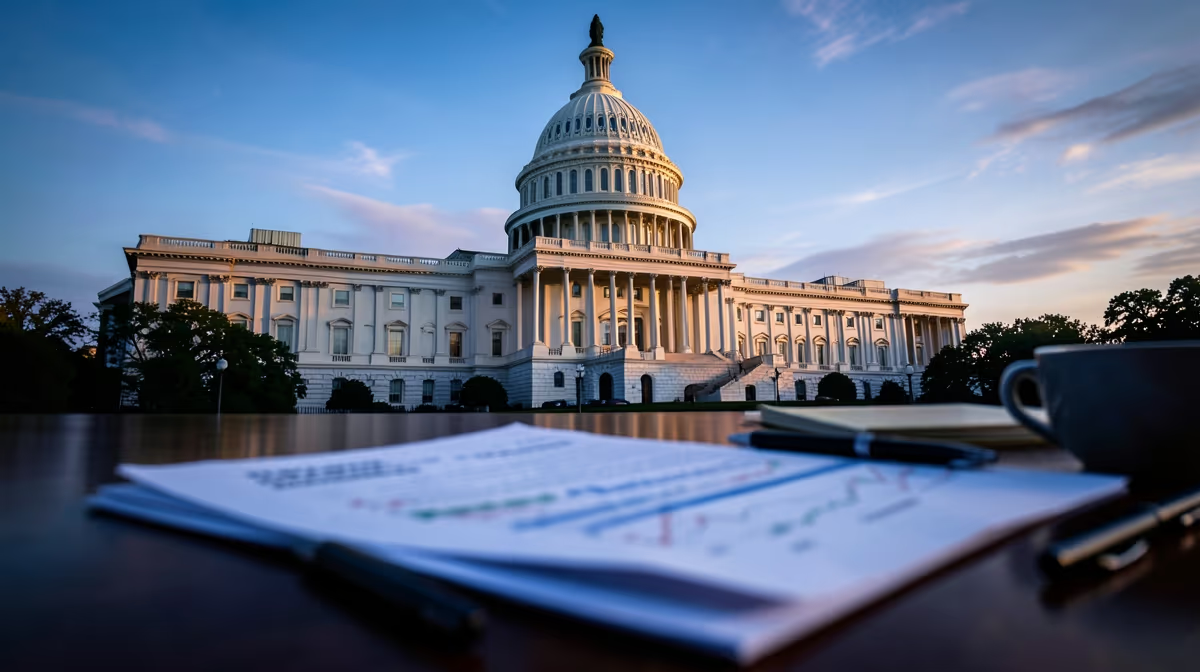
The Social Security Board of Trustees recently released its 2024 annual report, projecting that the program's Old-Age and Survivors Insurance Trust Fund will be depleted by 2033, one year later than previously estimated, due to higher-than-expected tax revenue and a robust labor market. This shift in the insolvency timeline provides a brief window for policymakers to address the structural imbalances inherent in a system that serves as the bedrock of retirement policy and a significant force in the broader economic impact on the country.
The Evolution of the Federal Safety Net
Social Security is a federal program in the United States designed to provide financial support to people when they retire, become disabled, or pass away. It functions essentially as a mandatory savings plan: while you work, you and your employer pay a portion of your income into the system, and that money is used to pay benefits to current retirees and other eligible people today. Signed into law by President Franklin D. Roosevelt in 1935 as part of the New Deal, the program was created to address the economic hardship caused by the Great Depression and provide a foundation for long-term financial security for the American public. Today, it also provides disability insurance for workers who can no longer work due to severe medical conditions, and eligible survivors of deceased workers, such as spouses or children, can receive benefits.
The Numbers Behind the Solvency Crisis
The 2024 report highlights that the system faces a long-term funding gap as the number of retirees continues to grow relative to the number of workers. While the OASI fund is projected to exhaust its reserves in 2033, the Disability Insurance Trust Fund is expected to remain solvent throughout the 75-year projection period. If the funds are depleted, incoming tax revenue would still be sufficient to pay approximately 79 percent of scheduled benefits. The program is currently funded primarily through a 12.4 percent payroll tax split equally between employers and employees. The improvement in the 2024 outlook is largely attributed to a stronger-than-expected recovery in employment and wage growth following the pandemic, though actuaries note that lower-than-projected birth rates over the long term remain a significant headwind for the system's dependency ratio.
The Practical Significance of Reform
For millions of Americans, these payments are the primary source of income during their later years. Without these monthly disbursements, a significant portion of the elderly population would fall below the poverty line. Changes to the program's solvency—or the ability to pay full benefits—could dictate the financial stability and quality of life for current workers who are planning for their own retirements. Essentially every working American who pays payroll taxes is involved in the system, and nearly every retiree, disabled individual, or surviving family member who receives benefits is directly impacted by these shifting fiscal projections. Treasury Secretary Janet Yellen, serving as a Trustee, underscored the urgency of the situation, stating that strengthening these programs is essential for the economic security of millions of Americans.
Structural and Political Realities
The root cause of the current challenge is a structural demographic imbalance resulting from a shrinking worker-to-retiree ratio caused by the aging Baby Boomer cohort and declining fertility rates. This has shifted the system from a sustainable pay-as-you-go social contract to an unfunded mandate that exerts upward pressure on federal interest rates and displaces private capital investment. Politically, this remains the third rail of American politics where electoral survival necessitates avoiding benefit cuts, leading to systemic legislative paralysis and reliance on short-term debt financing. Historians often draw a parallel to the expansion of the Roman Empire's grain dole during periods of economic stagnation, where state survival became inextricably linked to the provision of subsidies to a growing non-productive class. Furthermore, the systematic erosion of the program's real value through long-term inflation acts as a stealth tax on the elderly to mitigate government insolvency without explicit legislative changes.
Geopolitical and Fiscal Constraints
Beyond domestic finance, increased fiscal vulnerability reduces US global hegemony by constraining the discretionary budget available for defense and international influence operations as mandatory entitlement spending consumes a larger share of GDP. Because legislative action is the primary vehicle for addressing the shortfall, proposals debated in Congress include increasing the payroll tax rate, raising the cap on earnings subject to Social Security taxes, or gradually increasing the full retirement age. However, deep partisan divisions on fiscal policy have prevented comprehensive reform, leaving millions of Americans concerned about the long-term viability of their retirement security.
Anticipated Legislative Movement
In the next 24 hours, the focus remains on ongoing discussions regarding 2025 cost of living adjustment (COLA) adjustments and administrative budget proposals from the Social Security Administration. Looking toward the next 72 hours, we expect increased focus on Congressional committee hearings concerning long-term solvency projections and legislative proposals to address the trust fund depletion date. Expert prediction suggests that policymakers will likely defer major structural reforms until after the current election cycle, focusing instead on marginal administrative improvements and COLA fine-tuning. The best-case scenario involves a bipartisan agreement on an incremental funding bill that delays trust fund depletion while protecting current beneficiary levels, while the worst-case scenario remains legislative gridlock leading to uncertainty regarding future benefit payments, causing market volatility and public anxiety among older demographics.
Frequently Asked Questions
What is the full retirement age for Social Security?
The full retirement age depends on your birth year. For anyone born in 1960 or later, the full retirement age is 67.
How is my Social Security benefit amount calculated?
Your benefit amount is based on your highest 35 years of earnings adjusted for wage inflation. The Social Security Administration applies a formula to these indexed earnings to determine your primary insurance amount.
Can I work while collecting Social Security retirement benefits?
Yes, you can work while receiving benefits, but your payments may be temporarily reduced if you are younger than full retirement age and earn above a certain annual limit. Once you reach full retirement age, your earnings no longer affect your benefit amount.
How do I apply for Social Security benefits online?
You can apply for retirement benefits by visiting the official Social Security Administration website at ssa.gov. The online application process typically takes about 15 minutes.
Is Social Security income taxable?
Depending on your total combined income, a portion of your Social Security benefits may be subject to federal income tax. The IRS uses your adjusted gross income plus non-taxable interest and half of your Social Security benefits to determine if you owe taxes.
When is the best time to start taking Social Security?
The best time to start depends on your personal financial situation and health. While you can claim as early as age 62, waiting until your full retirement age or later results in a significantly higher monthly benefit payment for life.
Conclusion
The Social Security system is currently on a trajectory toward trust fund depletion by 2033, a reality underscored by the 2024 Trustees Report. While recent economic performance and wage growth have provided a slight buffer, the core challenge of balancing an aging demographic with a sustainable funding model remains unresolved. Congressional action is the only viable path to long-term solvency, yet political polarization continues to complicate the implementation of structural reform. As the nation approaches the 2030s, the debate will shift from administrative adjustments to the necessity of fundamental legislative changes to protect the economic security of future generations.


.webp)

.webp)

