
Tupolev Tu-160 Fleet Modernization Signals a Major Shift in Global Strategy
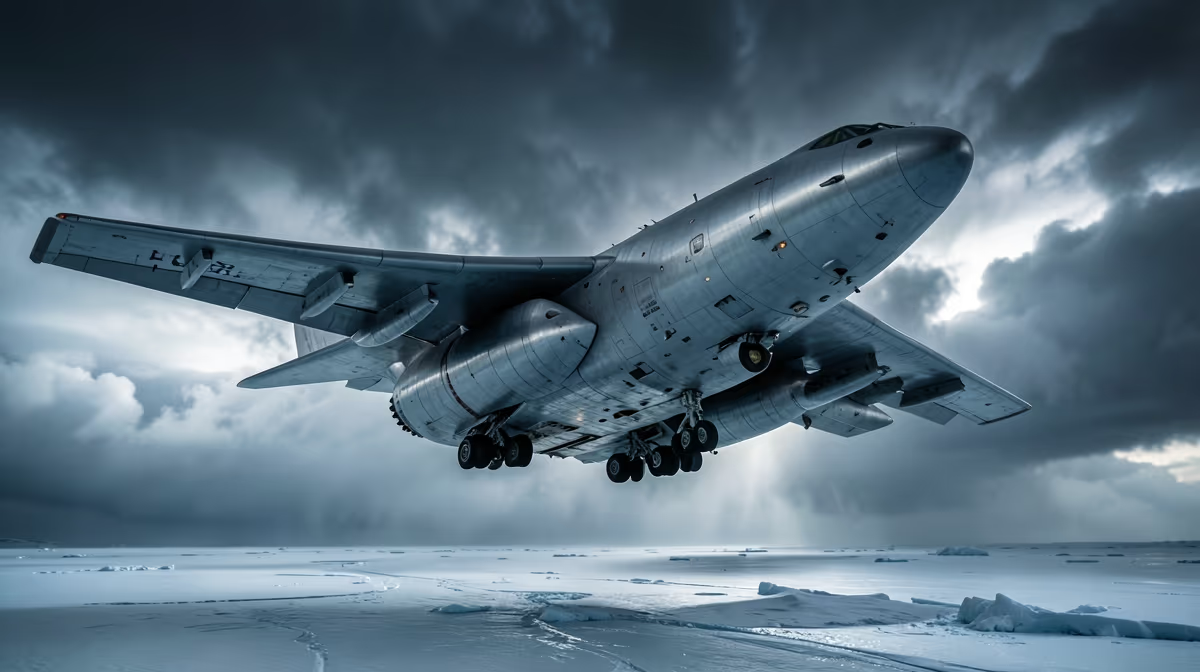
The Tupolev Tu-160 remains a centerpiece of the Russian Air Force, often cited in discussions regarding global military escalation due to its capacity as a supersonic strategic bomber. Often referred to as the White Swan by its crews, this massive, long-range aircraft represents a critical component of the Russian nuclear triad, forcing a persistent reassessment of defense protocols among NATO members and international security analysts.
The Genesis and Evolution of the Blackjack
Development of the Tu-160 began in the 1970s during the Cold War as a direct Soviet competitor to the American B-1 Lancer. The first production models entered service in 1987, and despite the collapse of the Soviet Union, Russia has continued to modernize the fleet. The aircraft is widely recognized by its NATO reporting name, Blackjack, and is characterized by its variable-sweep wings, which allow the plane to adapt its shape for high-speed flight or efficient cruising. As the largest and heaviest combat aircraft currently in service worldwide, it serves as a powerful symbol of long-range military deterrence. Recent efforts by the Russian Ministry of Defense have focused on the Tu-160M variant, incorporating updated avionics, engines, and advanced electronic warfare suites to keep the aging airframes technologically relevant for contemporary warfare.
Core Specifications and Operational Capability
The engineering behind the Tu-160 is designed for both speed and sustained reach. It is capable of supersonic flight, reaching speeds of over Mach 2.0, which makes it one of the fastest bombers in any national inventory. The aircraft is powered by four turbofan engines, each capable of producing approximately 55,000 pounds of thrust with afterburners. One of its most distinct features is the internal weapons bay, which allows it to carry a wide array of long-range nuclear and conventional cruise missiles while maintaining aerodynamic efficiency. The integration of updated NK-32-02 engines in the modernized Tu-160M variant provides significantly increased range over the original versions, further extending its global operational reach.
Strategic Significance in Modern Geopolitics
The Tu-160 functions as more than just a piece of hardware; it is a fundamental pillar of Russia’s nuclear deterrence strategy. Its presence in modern geopolitical tensions is significant because the aircraft is capable of launching long-range strikes from deep within Russian territory, posing a constant strategic challenge to existing defense systems. For the United States, the presence of the Tu-160 is a frequent subject of NORAD patrol tracking. Whenever these bombers appear in international airspace near the North American Arctic or along the fringes of the Atlantic and Pacific, U.S. and Canadian interceptor jets are routinely scrambled. These maneuvers are widely viewed as a mechanism to signal long-range power projection capabilities, effectively forcing the U.S. to reallocate resources away from other theaters, such as the Pacific, to maintain North American airspace security.
Analytic Perspectives on Power Projection
From an analytical standpoint, the reactivation and modernization of the Tu-160 fleet serves as a symbolic and kinetic assertion of Russia's nuclear triad viability, challenging the perceived decay of post-Soviet strategic reach. Politically, this functions as a form of domestic consolidation through hyper-nationalistic military displays designed to counter US-led containment strategies and NATO expansion. Economically, however, the program places severe strain on the Russian aerospace sector to modernize legacy airframes, potentially diverting limited capital from civilian technological diversification toward high-maintenance strategic deterrence. Some experts suggest the program functions as a psychological warfare tool intended to exploit US political division, testing domestic American tolerance for renewed Cold War-era direct aerial threats. Defense analyst Mark Cancian of CSIS has noted that while the aircraft is a potent symbol of Russian aerospace engineering, its primary strategic value lies in its ability to serve as a mobile launch platform for cruise missiles, which allows the platform to remain relevant without requiring the bomber to enter sophisticated air-defense bubbles.
Looking Toward Future Operational Status
In the next 24 hours, the expected operational tempo involves increased monitoring by NORAD and NATO surveillance assets in response to routine long-range aviation sorties near Arctic boundaries. Looking ahead to the next 72 hours, analysts anticipate a continuation of strategic deterrence exercises, potential diplomatic statements regarding regional security posture, and intelligence assessments of Russian flight patterns. The expert consensus suggests that the Tu-160 will continue to be used as a primary tool for power projection and signaling. While the best-case scenario involves Russian sorties remaining within international airspace to allow for stable de-confliction procedures, the worst-case scenario involves a miscalculation or mechanical incident leading to an aerial interception involving close-proximity maneuvers, which could increase the risk of inadvertent escalation.
Frequently Asked Questions
What is the primary purpose of the Tupolev Tu-160?
The Tupolev Tu-160, known by the NATO reporting name Blackjack, is a supersonic, variable-sweep wing heavy strategic bomber designed by the Soviet Union. Its primary mission is to deliver nuclear and conventional weapons deep into enemy territory while utilizing its high speed and altitude capabilities.
How fast can the Tu-160 fly?
The Tu-160 is capable of reaching a maximum speed of Mach 2.05, making it the fastest bomber currently in operational service. This high-speed performance allows it to quickly penetrate contested airspace and perform rapid strikes before returning to base.
Is the Tupolev Tu-160 still in service today?
Yes, the Tupolev Tu-160 remains in active service with the Russian Aerospace Forces. Russia has even restarted production of modernized versions, known as the Tu-160M, to maintain and upgrade its long-range strategic bomber fleet.
How does the Tu-160 compare to the American B-1B Lancer?
While both the Tu-160 and the B-1B Lancer are supersonic, variable-geometry aircraft, the Tu-160 is significantly larger and faster. The Tu-160 is designed as a long-range strategic missile carrier, whereas the B-1B was originally intended for both high-altitude nuclear delivery and low-altitude conventional penetration.
What is the operational range of a Tupolev Tu-160?
The Tu-160 has an unrefueled combat range of approximately 7,500 miles. With mid-air refueling capabilities, its global reach is theoretically extended, allowing it to perform long-endurance strategic patrol missions.
Can the Tu-160 carry nuclear weapons?
Yes, the Tu-160 is a key component of Russia's nuclear triad and is designed to carry a variety of nuclear-armed cruise missiles. It can house these weapons in its internal bomb bays to maintain stealth characteristics and aerodynamic efficiency.
Conclusion
The Tupolev Tu-160 remains a formidable instrument of Russian strategic policy, bridging its Cold War origins with modern capability requirements. Through its transition to the Tu-160M variant, the Russian Aerospace Forces continue to leverage this heavy bomber as a tool for both global power projection and domestic symbolic value. While the aircraft does not indicate a shift toward imminent kinetic conflict, its consistent presence near North American and European defense perimeters necessitates a high-readiness posture from NATO and NORAD. As Russia works to overcome the industrial challenges of manufacturing and maintaining these sophisticated airframes, the international community will continue to monitor the platform as a key bellwether for regional defense stability and the ongoing viability of the nuclear triad.


.webp)

.webp)

