
F35 Fighter Jet Deliveries Resume Amid Hidden System Vulnerabilities
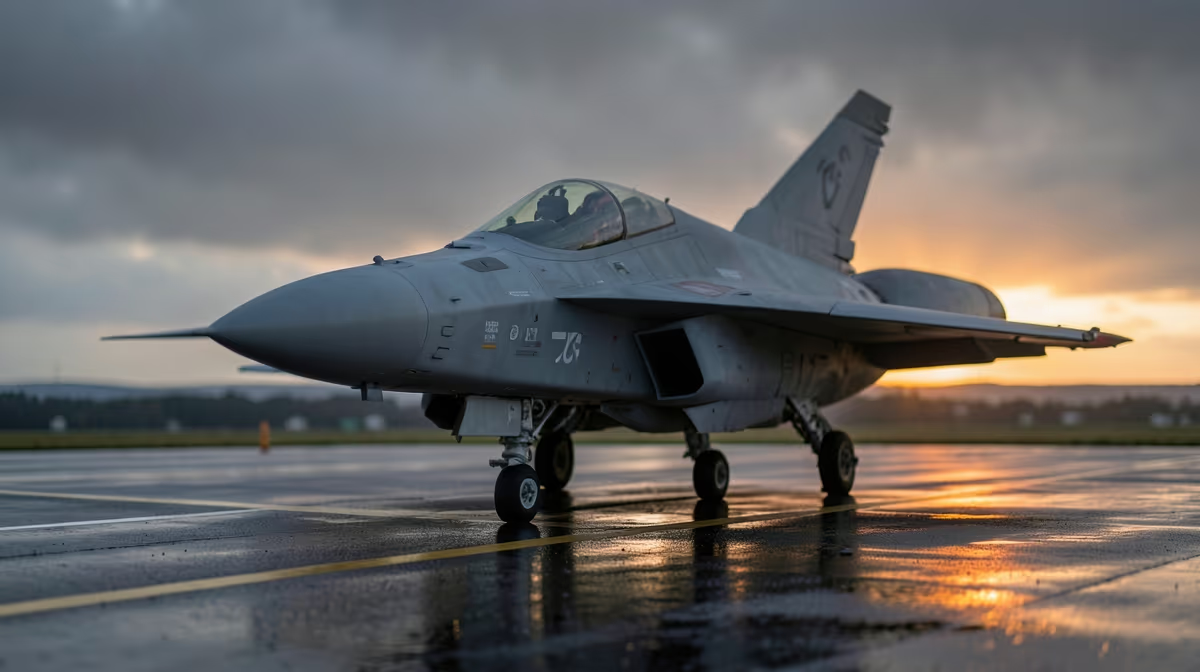
The F35 fighter jet remains at the center of modern military discourse as nations evaluate their strategic aerial needs and the efficacy of advanced stealth technology in contested environments. Following a nearly year-long suspension, the U.S. Department of Defense has officially resumed deliveries of the aircraft, marking a critical milestone in the effort to modernize the backbone of the nation's future air fleet.
The Mechanics of the Delivery Resumption
The delivery pause began in July 2023 when officials determined that the Technology Refresh 3 (TR-3) software, which provides the critical computing power for the aircraft's advanced sensors and radar, failed to meet the rigorous quality standards required for combat-capable deployment. Throughout this period, Lockheed Martin continued to assemble the aircraft at its facility in Fort Worth, Texas, leading to a significant stockpile of completed jets awaiting final certification and software verification.
As of July 2024, the Pentagon confirmed that flight operations have restarted, clearing the backlog of jets. Defense officials opted for a truncated version of the software package, which has been approved for initial deployment. This incremental approach allows the military to accept deliveries of new assets for the Air Force, Navy, and Marine Corps while simultaneously refining the remaining features of the TR-3 suite. Lieutenant General Mike Schmidt, Director of the F-35 Joint Program Office, stated that the commitment remains providing the warfighter with the most capable and lethal aircraft in the world, noting that this initial software release is a significant step toward achieving that goal while maintaining necessary safety standards.
Understanding Stealth and Sensor Fusion
The F-35 Lightning II is a fifth-generation fighter jet engineered with advanced stealth capabilities, including specialized airframe shaping and radar-absorbent materials. These design elements significantly reduce the aircraft's radar cross-section, allowing it to operate undetected in hostile airspace against modern integrated air defense systems. Beyond its invisibility to radar, the aircraft serves as a sophisticated sensor platform.
It utilizes sensor fusion to combine data from its own cameras and internal systems with information gathered from nearby ships and planes. This capability allows the pilot to maintain a 360-degree view of the battlespace, essentially operating as a flying command center. There are three primary variants designed to meet diverse service requirements: the F-35A, which is the conventional takeoff and landing variant; the F-35B, which features short takeoff and vertical landing capabilities; and the F-35C, which is built for operations from aircraft carriers.
The Structural Roots of Program Complexity
The current challenges surrounding the F-35 program, including software integration and production delays, are rooted in the original design philosophy of the Joint Strike Fighter project launched in 1996. The objective was to create a singular, all-encompassing multi-role platform to achieve cost-efficiency through economies of scale. However, this pursuit resulted in what analysts describe as excessive complexity and significant integration debt.
The program has historically utilized a political engineering strategy, distributing supply chain components across 45 states to ensure bipartisan legislative support and defense industry resilience. Economically, the project has transitioned from a fixed-price procurement model to a perpetual sustainment and modernization loop. This effectively creates a software-as-a-service dynamic for a national defense asset, where constant updates are required to maintain combat relevance. Experts note that this shift has expanded the vulnerability of the fleet from traditional hardware issues to potential risks within the software supply chain and the massive cyber-attack surface inherent in a platform requiring cloud-connected updates.
Geopolitical Implications of Technological Dependency
Beyond its role as a tactical asset, the F-35 acts as a powerful instrument of diplomatic lock-in. By integrating allied nations into the U.S. military-industrial ecosystem, the program forces partner countries to commit to decades of technological and logistical dependency. This global footprint, including participation from nations such as the UK, Japan, and Australia, ensures that the aircraft remains a central deterrent against global adversaries.
However, this dependence creates its own set of pressures. As the geopolitical landscape demands high-end aerial superiority, the program must balance its reliance on an international supply chain with the need to address domestic vulnerabilities. The program has become the most expensive weapons initiative in history, and its success is viewed as essential for ensuring that allied air forces can operate safely in contested airspace where traditional jets would be easily identified and intercepted.
Looking Toward Operational Readiness
The next 24 hours will likely see continued scrutiny regarding the status of the TR-3 software upgrades, as the Pentagon manages the integration of these new aircraft into active squadrons. Moving into the 72-hour window, attention is expected to shift toward budget testimony and congressional oversight hearings, where lawmakers will focus on the program's long-term sustainability and the readiness of the existing fleet.
Industry experts predict that the program will face ongoing pressure to stabilize production timelines while simultaneously addressing the complex supply chain vulnerabilities that delay fleet capability upgrades. While the best-case scenario involves the successful and accelerated integration of the full TR-3 software suite, the worst-case, though less likely, involves the discovery of hardware or software defects severe enough to necessitate a fleet-wide grounding, which would represent a major financial and operational setback.
Frequently Asked Questions
What is the primary purpose of the F-35 fighter jet?
The F-35 Lightning II is a multirole stealth fighter designed to perform air superiority, strike missions, and intelligence, surveillance, and reconnaissance tasks. It is intended to replace aging fighter fleets for the U.S. Air Force, Navy, and Marine Corps while providing advanced networking capabilities to allied forces.
How many versions of the F-35 exist?
There are three primary variants: the F-35A, which is the conventional takeoff and landing variant, the F-35B, which features short takeoff and vertical landing capabilities, and the F-35C, designed for carrier-based operations.
Is the F-35 stealthy?
Yes, it is engineered with advanced stealth technology, including specialized airframe shaping and radar-absorbent materials, which significantly reduce its radar cross-section.
How much does an F-35 cost?
Costs vary by variant and production lot, but recent estimates place the per-unit cost of an F-35A at approximately $82.5 million.
Can the F-35 fly at supersonic speeds?
Yes, the F-35 is capable of reaching speeds of Mach 1.6, providing a balance of speed, agility, and low-observable capabilities.
Who manufactures the F-35?
The F-35 is primarily manufactured by Lockheed Martin, with significant contributions from partners like Northrop Grumman and BAE Systems.
Conclusion
The resumption of F-35 deliveries marks a vital step in addressing the production backlog created by the TR-3 software integration challenges. While the Pentagon has achieved a significant milestone by moving toward active fleet deliveries, the program remains under pressure to finalize the remaining features of its software suite and manage long-term sustainment costs. The focus for the immediate future remains on maintaining the balance between technological sophistication and the practical requirements of global air superiority, ensuring that the aircraft continues to function as a core element of U.S. and allied defense strategies.


.webp)
