
FIFA World Cup 2026 Plans Are Secretly Reshaping North American Cities
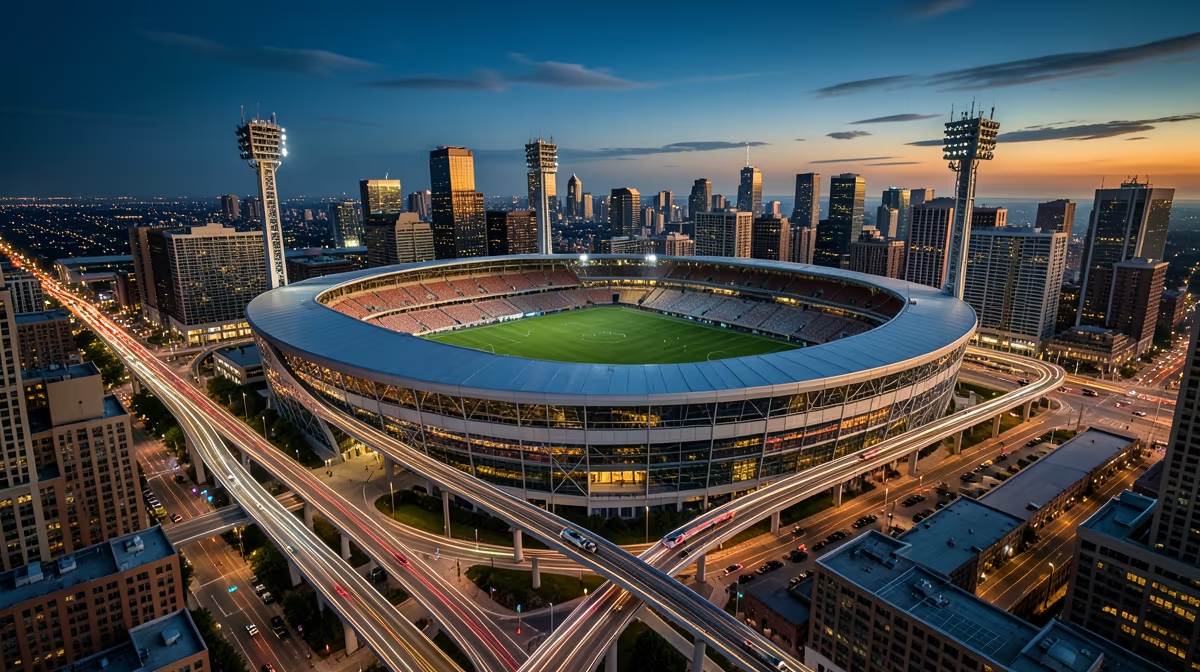
A quiet revolution is unfolding across the urban landscapes of North America, as 16 cities prepare to host a sporting spectacle that promises to redefine global logistics and municipal priorities. The FIFA World Cup 2026 is set to make history as the first tournament to be hosted across three nations, with the United States serving as the primary hub for a tournament that is effectively reshaping how major powers project influence through the lens of international sport.
A New Era for Global Soccer
This tournament is poised to be the largest in history, marking a significant evolution in FIFA's operational scale. By expanding the tournament format from 32 to 48 teams, the governing body is not merely increasing the number of matches to 104; it is fundamentally altering the scope of requirements for host nations. The United States, Canada, and Mexico have entered into a unique tripartite arrangement, signaling a level of regional consolidation in sports governance that has rarely been witnessed on this scale. For the United States, this provides an opportunity to build upon the legacy of the 1994 tournament, which acted as a catalyst for the commercial maturation of professional soccer in the country. Now, the stakes have shifted toward managing the logistical strain of a multi-nation event that integrates 11 American host cities into a singular, interconnected operation.
The Strategic Logic of Expansion
The root cause of this massive undertaking lies in the strategic expansion of FIFA's commercial footprint into the North American market, designed to maximize broadcasting rights and sponsorship valuation. Analysts observe that this is not merely a sports development but a deliberate exercise in public diplomacy. By hosting the world’s most popular tournament, the United States government utilizes the event as a tool of soft power, reinforcing cultural influence while facilitating the integration of North American infrastructure. However, this expansion carries significant economic implications. The model has shifted from traditional public-sector funding to a private-public partnership approach. While this model aims to alleviate the burden on taxpayers, it simultaneously concentrates profits within FIFA and corporate entities, often leaving local municipalities to navigate the financial complexities of stadium readiness and secondary urban upgrades.
Logistical Hurdles and Urban Infrastructure
The reality of hosting 104 matches across 16 cities requires an unprecedented level of coordination in public transportation, cybersecurity, and hospitality. Expert predictions suggest that while the tournament will trigger record-breaking commercial investments in stadium infrastructure, the logistical strain on urban centers remains a significant hurdle. In the next 24 hours, officials and US host city organizers will continue critical meetings regarding security protocols for the opening match announcement. As the timeline progresses, the focus will shift toward volunteer recruitment and ticket registration phases. The best-case scenario envisions a seamless operation that cements the tournament as the most profitable in history. Conversely, there is a recognized risk that capacity bottlenecks in public transportation and escalating security costs could lead to budget deficits or public frustration within the host cities.
The Human and Political Dimension
Beyond the commercial success, the 2026 World Cup serves as a test of regional cooperation and public management. The integration of 11 American cities alongside Canadian and Mexican counterparts requires a unified security and logistics framework. A hidden angle of this preparation is the massive expansion of surveillance infrastructure and private security coordination under the guise of counter-terrorism. While necessary for an event of this global magnitude, it represents a permanent shift in how municipal governments manage large-scale public gatherings. Residents in these 16 cities will experience the most direct impacts of these changes, ranging from updated transit systems designed to handle millions of international visitors to the persistent presence of enhanced safety protocols.
Economic and Historical Context
The tournament holds deep historical significance, reflecting a trajectory that began with the 1930 inaugural event. The exclusion of the 1942 and 1946 tournaments due to global conflict serves as a reminder of how external forces can interrupt the sporting calendar. Today, the focus is on growth and accessibility. The decision to feature 48 teams ensures that a wider variety of global talent is showcased, further cementing the tournament's status as an economic powerhouse. For the U.S. hospitality sector, the influx of international fans represents a substantial opportunity for growth. However, economists warn that the benefits are unevenly distributed, with local host committees bearing the immediate brunt of the preparations while the long-term socio-economic impact remains a subject of ongoing assessment.
What Lies Ahead
As the 2026 date approaches, the focus is narrowing from broad planning to precise execution. The final match is confirmed for MetLife Stadium in New Jersey, a decision that places the New York/New Jersey metropolitan area at the center of the global stage. Development is still ongoing regarding specific team base camps and the finalization of international broadcasting rights, which will determine the true scale of the tournament's global reach. With 16 host cities involved—Atlanta, Boston, Dallas, Houston, Kansas City, Los Angeles, Miami, New York/New Jersey, Philadelphia, San Francisco, and Seattle—the organizational challenge is vast, yet the ambition remains fixed on delivering an inclusive and impactful experience that will echo for decades.
Frequently Asked Questions
Where will the 2026 FIFA World Cup be held?
The 2026 FIFA World Cup will be co-hosted by the United States, Canada, and Mexico. Matches will be spread across 16 different host cities in these three North American nations.
When does the 2026 World Cup start?
The tournament is scheduled to kick off on June 11, 2026. The final match will take place on July 19, 2026, marking the conclusion of the event.
How many teams are playing in the 2026 World Cup?
The 2026 FIFA World Cup will feature a record-breaking 48 teams. This is an increase from the 32-team format that had been used in previous tournaments since 1998.
Where is the 2026 World Cup final being played?
The final match of the 2026 FIFA World Cup will be held at MetLife Stadium in East Rutherford, New Jersey. This venue serves the New York City metropolitan area.
How can I get tickets for the 2026 World Cup?
Official tickets for the 2026 World Cup will be sold exclusively through FIFA's official ticketing portal. Fans are encouraged to register on the FIFA website to receive updates regarding ticket sales phases and application windows.
What are the US host cities for the 2026 World Cup?
The United States host cities include Atlanta, Boston, Dallas, Houston, Kansas City, Los Angeles, Miami, New York/New Jersey, Philadelphia, San Francisco, and Seattle. These cities were selected to host various matches throughout the group and knockout stages.
Conclusion
The FIFA World Cup 2026 represents a transformative moment for North American infrastructure and global sports diplomacy. With 48 teams confirmed and 16 host cities finalizing their operational readiness, the tournament is set to be the largest in history. While the economic potential is immense, the success of the event will ultimately depend on the effective management of urban logistics, security, and the transition of the private-public funding model. As organizers move toward the finalization of base camps and broadcasting rights, the world watches to see if this ambitious regional collaboration can meet the high expectations set by FIFA and the global sporting community.


.webp)
