
Humanoid Robot Tech Is Sparking a Massive Shift in Labor Productivity
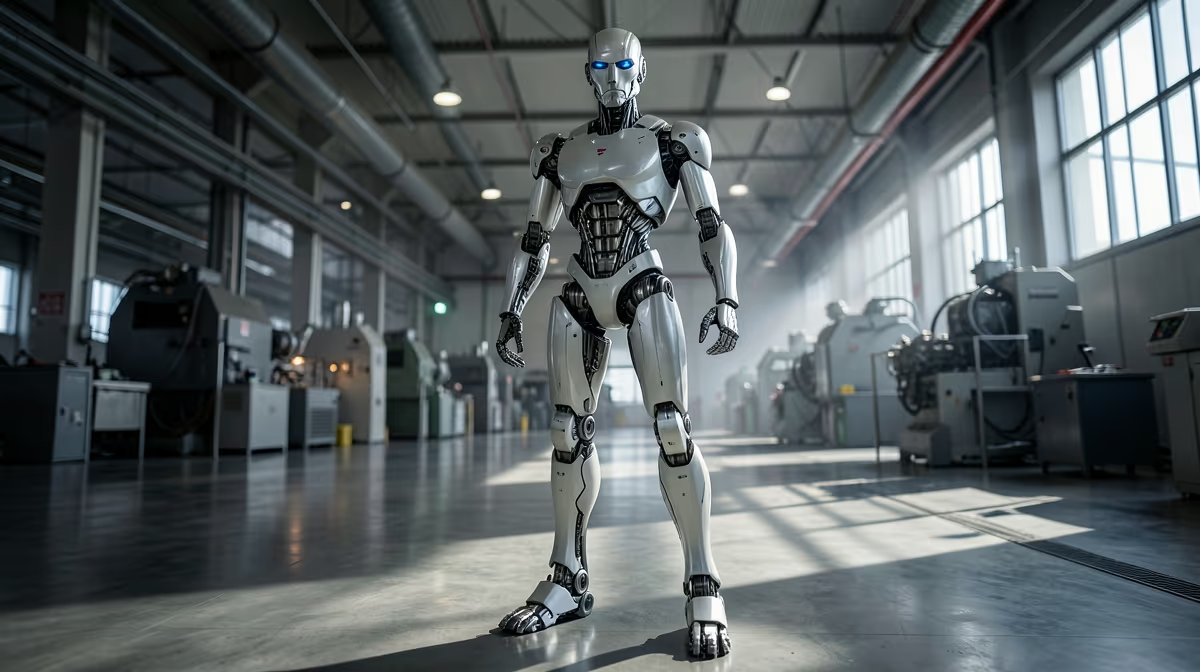
Imagine a factory floor where the most repetitive, back-breaking tasks are no longer performed by humans, but by machines that mirror our own physical form. As the humanoid robot becomes a staple of modern innovation, global industries are bracing for a massive shift in labor automation driven by rapid advancements in AI robotics.
The Evolution of Humanoid Robot Technology
The concept of the humanoid robot is not new, yet the transition from science fiction to functional hardware is accelerating at an unprecedented pace. Early iterations were largely research tools, limited by rigid programming and a lack of environmental awareness. In the last few years, the convergence of generative AI and powerful, energy-efficient electric motors has fundamentally changed the landscape. Unlike traditional factory robots that are bolted to the floor, these new platforms are designed to navigate the human world, climbing stairs and manipulating objects with a dexterity once reserved for biological workers. Engineers are now utilizing advanced AI brains, allowing these robots to learn by observing humans rather than relying on hard-coded instructions for every motion.
Strategic Shifts in Manufacturing and Logistics
Companies such as Figure AI, Tesla, and Boston Dynamics have entered a high-stakes phase of competition, moving beyond laboratory prototypes into active operational testing. The primary driver for this shift is a strategic need to address persistent labor shortages within the United States. In sectors like automotive assembly and warehouse logistics, recruitment has become increasingly difficult, leading firms to prioritize the deployment of autonomous systems that can fill these gaps. Recent industry reports confirm that major U.S. automotive manufacturers are already engaging in pilot programs, testing how these platforms integrate into existing workflows. As of 2024, Boston Dynamics has retired its legacy hydraulic Atlas model to pivot entirely toward an all-electric platform, signaling a clear industrial preference for the efficiency and maintenance profile of modern, fully electric robotic assistants.
The Economic and Political Calculus
The deployment of these machines represents a fundamental transition from a labor-intensive consumption model to a capital-intensive productivity model. At the root of this movement is the pursuit of sovereign labor independence, intended to mitigate the risks associated with shrinking working-age populations and the decay of domestic manufacturing. This creates a complex geopolitical environment, effectively triggering a robotics arms race between the United States and China. In this contest, the nation that establishes the global standard for industrial infrastructure may gain significant technological sovereignty. Domestically, this shift threatens to decouple GDP growth from human employment, potentially weakening the leverage of traditional labor unions while centralizing significant influence within a small group of tech-oligopolies.
Predicting the Near-Term Trajectory
Market observers anticipate significant activity in the coming days and weeks. In the next 24 hours, social media is expected to see a surge in footage showcasing refined bipedal locomotion in warehouse settings. Within 72 hours, analysts project upward volatility in robotics sector stocks as institutional investors respond to competitive claims of human-parity dexterity. Looking further ahead, expert predictions suggest that the integration of large multimodal models into physical hardware is moving the timeline for commercial viability forward by 12 to 18 months. While the best-case scenario involves breakthroughs in battery density that allow for full eight-hour shift operations, industry experts warn of a worst-case possibility: a high-profile safety malfunction during a live demonstration could trigger reactionary legislation, which would inevitably stall research and development.
Why This Matters for the Workforce
The integration of humanoid technology is designed to solve critical labor shortages, yet it raises profound questions regarding the future of work. By taking over dangerous, repetitive, or physically demanding jobs, these robots aim to boost productivity and reduce the cost of goods for the average consumer. However, the impact will be felt most acutely by workers in manual labor industries and logistics. As developers like Brett Adcock of Figure AI emphasize, the goal is to create systems that can think, learn, and reason, ultimately acting as a force multiplier for human labor. Whether this leads to a complementary relationship between humans and machines or a more disruptive economic shift remains one of the central debates for policymakers today.
Frequently Asked Questions
What is the primary purpose of a humanoid robot?
The primary purpose of a humanoid robot is to perform tasks in environments designed for humans, such as factories, homes, or hospitals. By mimicking human anatomy, these robots can effectively use tools and interact with infrastructure built specifically for human use.
How do humanoid robots work?
Humanoid robots function through a combination of advanced sensors, artificial intelligence, and mechanical actuators. Sensors like cameras and LiDAR map the surroundings, while complex algorithms process this data to control motors that simulate human movement and balance.
Are humanoid robots safe to work around?
Modern humanoid robots are increasingly designed with safety features such as force-torque sensors and collision detection software. While they are generally safe in controlled industrial settings, ongoing research focuses on ensuring they can safely navigate and interact with humans in unpredictable residential or public environments.
Which company is leading the development of humanoid robots?
Several companies are currently leading the humanoid robot industry, most notably Boston Dynamics with its Atlas robot and Tesla with the Optimus project. Other significant contributors include Figure AI, Agility Robotics, and Sanctuary AI, all of which are racing to commercialize functional units.
What are the biggest challenges in building humanoid robots?
The primary challenges in developing humanoid robots include achieving efficient battery life, ensuring natural locomotion on uneven terrain, and refining artificial intelligence for complex decision-making. Mimicking the dexterity of a human hand and ensuring cost-effective mass production remain major hurdles for the industry.
When will humanoid robots be available for home use?
While humanoid robots are currently being deployed in specialized industrial and research settings, widespread home availability is likely several years away. Developers are focused on perfecting their reliability and lowering manufacturing costs before targeting the consumer market for household chores.
Conclusion
The rapid transition of humanoid robots from laboratory experiments to industrial pilot programs marks a defining moment in modern automation. With major players like Tesla, Figure AI, and Boston Dynamics now moving toward operational testing in U.S. manufacturing hubs, the technology is undeniably moving closer to widespread commercial viability. While significant technical hurdles concerning battery efficiency, safety, and manufacturing costs persist, the trajectory toward integrated human-robot collaboration is accelerating. Moving forward, the industry will focus on scaling these systems while policymakers begin the difficult task of establishing frameworks for workplace safety. The coming months will be critical as these machines face the realities of the shop floor, testing whether they can fulfill the promise of productivity and economic stability.


.webp)

.webp)
