
Iran War Escalation Triggers Global Alarm as Major Airstrikes Hit
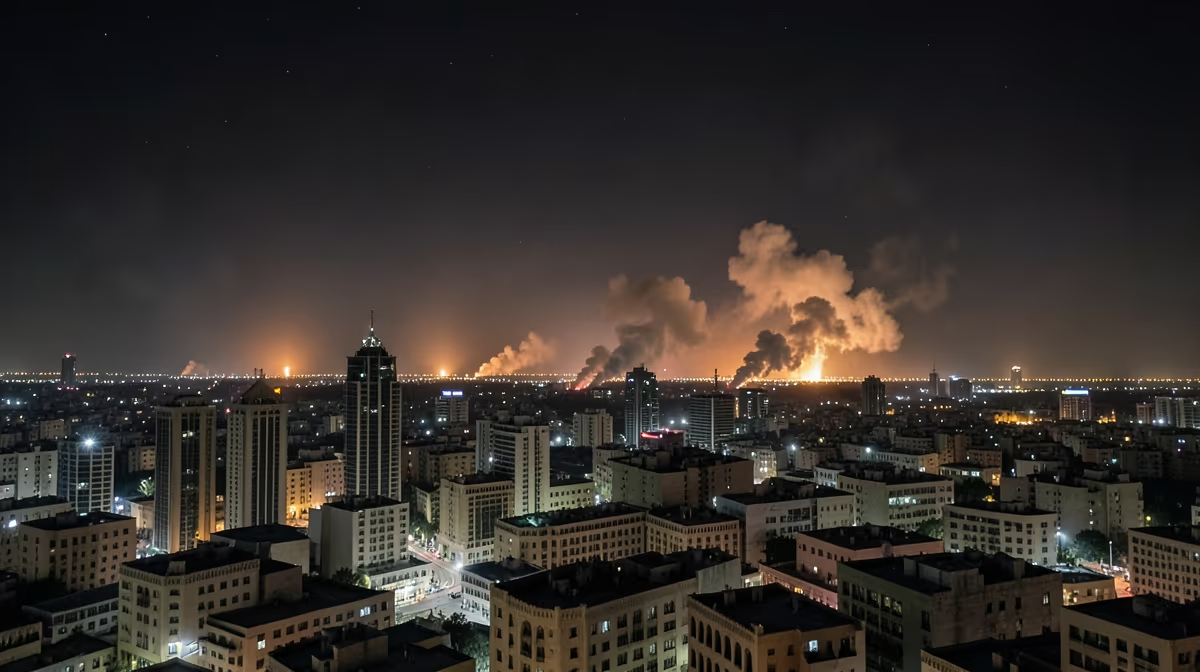
Tensions in the Middle East reached a critical juncture early Tuesday as coordinated airstrikes targeted military installations across western Iran, prompting international calls for immediate de-escalation from global leaders. As tensions continue to mount, the ongoing iran war has captured global attention, forcing nations to reevaluate their security stances.
The military action, which began in the pre-dawn hours, primarily affected logistics hubs and communication centers in several Iranian provinces. Regional air defense systems were heavily engaged, lighting up night skies over major cities as authorities scrambled to assess the full scale of the infrastructure damage. In response to the escalation, commercial airlines swiftly rerouted international flights away from Iranian airspace, causing widespread disruptions in global transit corridors. Neighboring countries placed their armed forces on heightened alert, fearing a broader regional spillover that could severely impact energy markets and maritime trade routes. Diplomatic channels have activated emergency protocols in New York, Geneva, and regional capitals. The United Nations Security Council announced an emergency closed-door session for later today to address the deteriorating security situation and draft a resolution urging restraint from all involved state actors. We are closely monitoring the situation on the ground and urging all parties to exercise maximum restraint to prevent a catastrophic regional conflict, stated UN Secretary-General spokesperson Stephane Dujarric during an emergency press briefing.
Background Context
Decades of geopolitical rivalry, religious and political differences, and disputes over Iran's nuclear program have fueled long-standing hostility between Iran, Israel, and Western nations like the United States, occasionally erupting into open conflict. Tensions involving Iran have reached a critical breaking point, drawing international concern as fears of a wider regional war grow. Following recent escalations, including direct military exchanges and proxy conflicts in the Middle East, world leaders are scrambling to prevent the situation from spinning out of control. For everyday citizens, the headlines can feel overwhelming, but the core issue revolves around power, security, and deterrence. Military actions and counter-actions are happening rapidly, creating a volatile environment where miscalculations could lead to devastating consequences. The historical roots of this friction trace back through key milestones, including the 1979 Islamic Revolution and the US Embassy hostage crisis, the 2015 Joint Comprehensive Plan of Action signing, the 2018 US withdrawal from the nuclear deal and maximum pressure campaign, and the 2023-2024 regional spillover via proxy networks following the Gaza conflict, culminating in direct state-on-state drone and missile exchanges that are reshaping deterrence norms.
Geopolitical and Strategic Analysis
The structural incompatibility between the ideological legitimacy of the Islamic Republic's clerical establishment and the US-led security architecture in the Middle East serves as the root cause of this persistent friction. From a political angle, the regime employs survival tactics utilizing asymmetric deterrence and external proxy networks to deflect internal socioeconomic dissent. Economically, the conflict involves the weaponization of global energy chokepoints like the Strait of Hormuz, sanctions evasion networks, and the high cost of militarization driving domestic inflation inside Iran. Geopolitically, this escalation accelerates a multipolar world order, forcing middle powers to hedge between Western security guarantees and Eastern economic integration with China and Russia. Additionally, a hidden layer of quiet cyber and infrastructure warfare targets water and financial grids, inflicting severe cumulative damage below the threshold of conventional military retaliation. This dynamic reflects historical parallels such as the Iran-Iraq War from 1980 to 1988, which solidified the regime's siege mentality and institutionalized the Islamic Revolutionary Guard Corps' economic dominance.
Key Facts and Verified Developments
Verified facts confirm that coordinated airstrikes targeted military installations in western Iran, commercial airlines have rerouted flights away from Iranian airspace, the UN Security Council has scheduled an emergency session, and neighboring nations have placed defense forces on heightened alert. Military sites in Iran have been struck by aerial attacks, airspace is restricted, and international diplomatic bodies are convening emergency meetings. Meanwhile, the exact attribution of the strikes, total casualty figures, and the extent of structural damage to military and civilian infrastructure remain under active investigation. Broader factual observations indicate that direct military engagements between Iran and its adversaries have increased significantly, global superpowers are urging restraint to prevent a catastrophic regional war, key shipping lanes and trade routes in the Middle East face heightened security risks, economic markets and particularly oil prices are reacting nervously to the instability, and diplomatic efforts are currently underway behind the scenes to de-escalate the crisis.
Economic and Global Impact
This conflict matters far beyond the Middle East because it directly threatens global economic stability and energy supplies. When conflict disrupts trade routes and oil production in this region, people all over the world feel the impact through higher gas prices, inflation, and general economic uncertainty. People living in the Middle East face the most immediate physical danger, but the economic fallout impacts consumers, travelers, and businesses globally through rising costs and market instability. The weaponization of the Strait of Hormuz and potential interruptions to international shipping place immense pressure on global energy markets, forcing policy makers and investors to closely monitor regional military tensions and prepare for cascading strategic consequences.
Outlook and Future Projections
In the next 24 hours, observers can expect intensified diplomatic maneuvering and localized military posturing in the Persian Gulf, accompanied by cyber threat alerts. Moving into the next 72 hours, emergency UN Security Council consultations, potential imposition of new economic sanctions, and heightened naval patrols in key shipping lanes are anticipated. Key players in this evolving scenario include Iran, the United States, Israel, and Saudi Arabia, with primary impact areas focused on global energy markets, Middle East regional stability, and international shipping. Expert prediction suggests that tensions will remain elevated with a high risk of proxy conflict and cyber warfare, though direct all-out military engagement remains constrained by mutual deterrence. In a best-case scenario, successful back-channel de-escalation leads to renewed diplomatic talks and a temporary freeze on provocative military actions. Conversely, the worst-case scenario warns that miscalculation could lead to a kinetic strike on critical infrastructure, sparking a wider regional war and severe disruptions to global oil supplies.
Frequently Asked Questions
Is there currently a war with Iran?
While Iran is not currently engaged in a total conventional war with a major global power, it is heavily involved in complex regional conflicts. This includes proxy warfare across the Middle East involving groups like Hezbollah, the Houthis, and various militias. Tensions remain exceptionally high due to Iran's advancing nuclear program and recent direct exchanges of strikes with Israel.
What would happen if a war broke out with Iran?
A full-scale war with Iran would likely destabilize the entire Middle East and severely disrupt global energy supplies. Because Iran controls the Strait of Hormuz, through which a massive portion of the world's petroleum passes, a conflict could trigger a global economic crisis. Additionally, it risks drawing in other superpowers, leading to a prolonged and devastating multi-front conflict.
Why are tensions so high between the US and Iran?
Tensions stem from decades of geopolitical hostility, starting with the 1979 Iranian Revolution and the subsequent hostage crisis. Recent friction has been driven by Iran's nuclear enrichment activities, its support for anti-Western and anti-Israel militant groups, and economic sanctions imposed by the United States. These underlying issues have repeatedly brought the two nations to the brink of direct military confrontation.
Is Iran a military superpower?
Iran is not a global military superpower, but it is a formidable regional power with a large standing army and a massive arsenal of ballistic missiles and drones. Rather than relying on expensive conventional equipment like modern jet fighters or aircraft carriers, Iran has focused on asymmetric warfare. This strategy utilizes coastal defense, fast-attack craft, proxy militias, and deep underground missile facilities to deter adversaries.
What role does Israel play in the Iran conflict?
Israel views a nuclear-armed Iran as an existential threat and has consistently engaged in a shadow war against it. This covert conflict has involved cyberattacks, the assassination of Iranian nuclear scientists, and airstrikes on Iranian targets in neighboring countries like Syria. Recently, this shadow war has escalated into direct military exchanges, significantly increasing the risk of wider regional war.
How would an Iran war affect global oil prices?
A major war involving Iran would cause immediate and drastic spikes in global oil prices. Iran borders the Strait of Hormuz, a critical maritime chokepoint for international oil shipments that can be easily blocked or mined. Any disruption to this trade route would choke off global energy supplies, leading to severe inflation and economic hardship worldwide.
Conclusion
Recent developments confirm that military installations in western Iran have been struck by coordinated aerial attacks, prompting airspace restrictions, commercial flight rerouting, and emergency diplomatic interventions by the United Nations Security Council. As neighboring defense forces remain on high alert and global markets monitor the situation, realistic next steps involve ongoing diplomatic consultations, heightened maritime patrols, and continuous assessment of regional security risks by international policymakers and analysts.


