
LHS 1140b Signals a Massive Shift in the Search for Alien Life
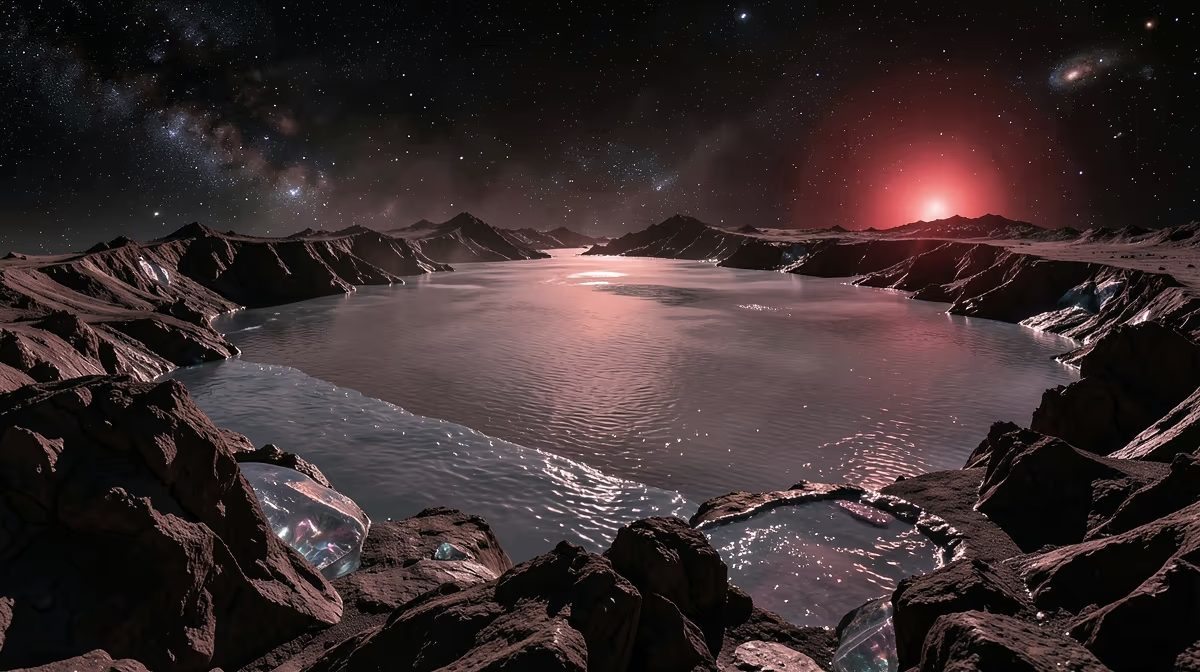
Beyond the familiar glow of our own solar system lies a celestial body that challenges everything we once believed about the habitability of distant worlds. Current spectroscopic data from the James Webb Space Telescope has positioned LHS 1140b as the most compelling subject in our hunt for an atmosphere capable of sustaining liquid water, effectively rewriting the blueprints for where we might search for life.
The Shift in Scientific Consensus
For years, the astronomical community categorized this exoplanet as a mini-Neptune, a world dominated by thick, volatile layers of hydrogen and helium. However, recent high-precision data has forced a dramatic reassessment of that classification. Researchers now believe that the planet, located 48 light-years away in the constellation Cetus, is a rocky super-Earth. This structural pivot is significant; it indicates that rather than being a gaseous giant, the planet likely possesses a solid surface and a composition far more conducive to the delicate balance required for life.
The transition from viewing the planet as a gas-rich sphere to a potential water world represents a major milestone in exoplanet research. By analyzing the light filtering through the planet's fringes, astronomers have detected signals that suggest a nitrogen-rich atmosphere. This, combined with its location within the habitable zone of its host star, provides the necessary environmental framework to support a vast liquid ocean.
Verified Physical Characteristics
LHS 1140b orbits a red dwarf star that is notably cooler and smaller than our Sun. While red dwarfs are often characterized by erratic stellar activity that can strip planets of their atmospheres, the host star in this system appears to be relatively quiet, allowing for a more stable climate. The exoplanet itself is roughly 1.7 times the radius of Earth and possesses a mass approximately 5.6 times that of our home planet.
This high density points toward a substantial iron-nickel core, consistent with a rocky, terrestrial structure. Because it sits at the ideal distance from its star, it avoids the extreme scorching common to many other known exoplanets. Current modeling suggests the existence of an eyeball planet configuration, where a central, liquid ocean could persist on the side of the planet permanently facing its star, maintained by a stable, protective atmosphere.
The Mechanics of the Search
The primary driver behind this intense scientific scrutiny is the goal of detecting atmospheric biosignatures. Charles Cadieux, lead author of the study and a doctoral student at the Université de Montréal, has noted that among all currently known temperate exoplanets, this system represents our best opportunity to indirectly confirm the existence of liquid water on an alien world. The use of the James Webb Space Telescope has been pivotal, providing the resolution required to distinguish between a hydrogen-dominated shell and a nitrogen-based atmosphere.
This research does not exist in a vacuum. It is part of a broader, global effort to map the most viable candidates for extraterrestrial life. The scientific community is now funneling resources into high-sensitivity atmospheric characterization to determine if the detected gases are indeed indicative of a biological process or simply the result of geological activity.
Geopolitical and Economic Implications
The emergence of such a high-profile target has sparked a subtle shift in how nations and private entities approach space exploration. As we move away from purely scientific observation, there is an increasing discourse surrounding the strategic value of potential habitable zones. This has initiated a new space race among global powers and private consortiums to develop the infrastructure necessary for long-range, deep-space observation.
There is a growing economic valuation tied to the development of deep-space infrastructure. Contracts for future observatories and planetary characterization missions are becoming central to national aerospace strategies. This shift from terrestrial research to the pursuit of off-world strategic high ground is beginning to challenge the established norms of the Outer Space Treaty, leading to discussions regarding planetary sovereignty and the rights to astronomical assets. The quest for what some call an existential insurance policy has effectively turned the search for habitable worlds into a cornerstone of international strategy.
Future Outlook and Expert Predictions
In the coming 24 hours, media and public attention are expected to spike as the latest peer-reviewed studies regarding the planet's atmospheric composition gain wider circulation. Over the next 72 hours, academic discourse is set to intensify as researchers debate the implications of these findings for existing habitability models.
The expert consensus points toward this planet becoming the primary focus for the next cycle of telescope observations. The best-case scenario is that these observations confirm an atmosphere capable of supporting liquid water, which would firmly establish this world as the leading candidate for future life-signature studies. Conversely, a worst-case scenario involves new data revealing atmospheric signals inconsistent with life-sustaining conditions, which would inevitably force the scientific community to pivot their limited resources toward more stable or temperate candidates elsewhere in the galaxy.
Historical Context
The current mission to map and analyze these distant systems bears a striking resemblance to the 15th-century Age of Discovery. Just as maritime powers once raced to chart new territories to ensure hegemony over trade routes and resources, modern space agencies and private consortiums are now driven by the need to understand the potential for future off-world habitability. This is not merely an academic endeavor; it is a fundamental reconfiguration of human strategy, shifting our focus toward a future where our understanding of life is no longer confined to the boundaries of Earth.
Frequently Asked Questions
What is LHS 1140b?
LHS 1140b is a massive super-Earth exoplanet orbiting within the habitable zone of a red dwarf star located about 48 light-years away in the constellation Cetus. It is considered one of the most promising candidates for atmospheric study due to its rocky composition and proximity to Earth.
Could LHS 1140b support life?
LHS 1140b is located in the habitable zone, the region where temperatures are suitable for liquid water to potentially exist on the surface. Recent data from the James Webb Space Telescope suggests it might possess a nitrogen-rich atmosphere, a key requirement for habitability.
Is LHS 1140b an ocean world?
Scientific analysis indicates that LHS 1140b may be a water world or an eyeball planet with a vast liquid ocean. Models suggest that a significant portion of its mass could be water, potentially forming a global ocean centered on the side facing its star.
How far away is LHS 1140b from Earth?
It is located approximately 48 light-years away from Earth. While this distance is vast, it is relatively close in astronomical terms, allowing for detailed study using advanced space telescopes.
How big is LHS 1140b compared to Earth?
It is classified as a super-Earth with a radius about 1.7 times that of our planet and a mass roughly 5.6 times greater. Its high density suggests an iron-nickel core similar to Earth's internal structure.
What is the star that LHS 1140b orbits?
It orbits a small, dim M-dwarf star known as LHS 1140. This star is relatively quiet compared to other red dwarfs, meaning it is less likely to strip its planets of their atmospheres with harmful stellar flares.
Conclusion
The scientific journey to understand LHS 1140b marks a turning point in our exploration of the cosmos. By moving from broad discovery to specific, high-resolution atmospheric characterization, we are inching closer to answering whether we are alone in the universe. While the presence of a life-sustaining environment remains a hypothesis to be confirmed, the data provided by the James Webb Space Telescope has successfully shifted the planet to the center of global astronomical efforts. As researchers continue to analyze spectroscopic signatures, the focus will remain on the search for liquid water and nitrogen-rich atmospheric markers, ensuring that this super-Earth remains a top priority for the next generation of space exploration.


.webp)


.webp)
