
Mamdani and Netanyahu: A Tense Shift in US Foreign Policy Reality
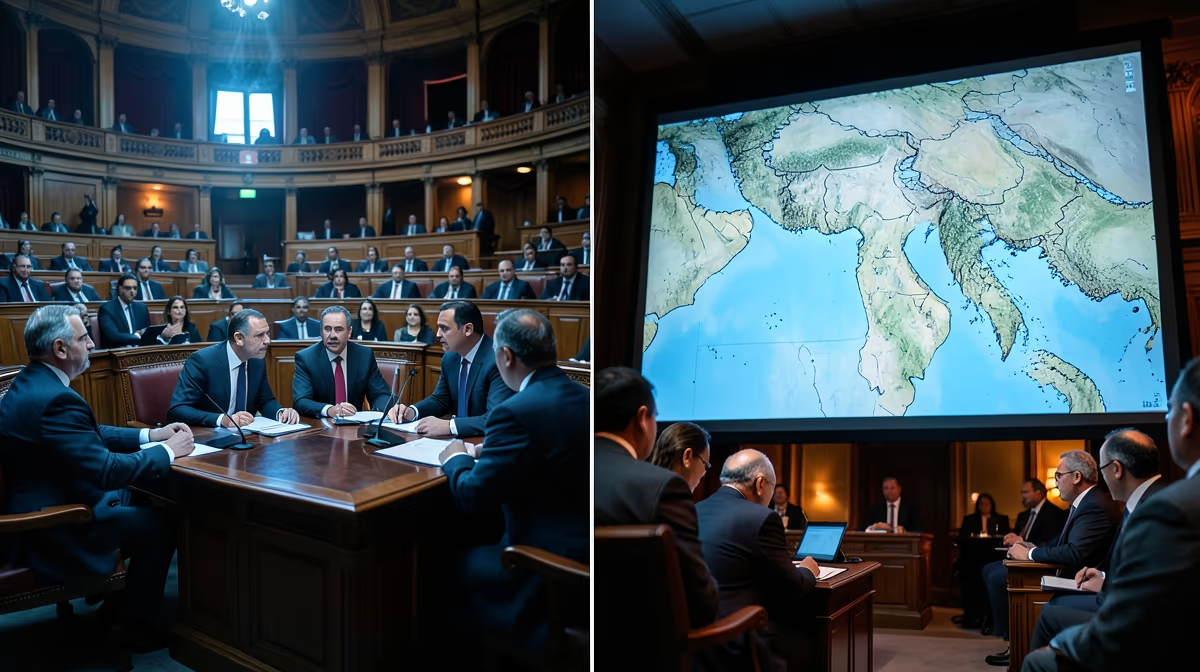
The discourse surrounding Zohran Mamdani and Netanyahu has intensified as shifting perspectives within American political circles continue to challenge long-standing US foreign policy, particularly concerning the ongoing Israel-Gaza conflict. While traditional alliances have long served as the bedrock of Middle East diplomacy, a new wave of grassroots dissent is forcing a public reckoning regarding the sustainability of the current U.S.-Israel strategic alignment.
The Academic and Political Intersection
Prominent academic figures and political leaders are increasingly centering their critiques on the long-term implications of Prime Minister Benjamin Netanyahu’s governance. As scholars like Mahmood Mamdani provide theoretical frameworks to analyze the historical trajectories of settler-colonialism, their influence has begun to permeate legislative discussions. The debate often hinges on whether the current military strategy in Gaza aligns with the long-term national security interests of the United States. While supporters argue that the security alliance is non-negotiable, critics are demanding a reassessment of the unconditional military and diplomatic support historically afforded to the Netanyahu administration. This friction is particularly evident on university campuses, where intellectual inquiries into Zionism and state policy are being scrutinized by legislators, further fueling national debates over the boundaries of free speech and foreign policy.
Shifting Congressional Discourse
The internal fracturing of the Democratic Party has become one of the most significant developments in recent legislative history. Influential members, including those aligned with progressive-populist bases, are actively challenging the status quo by calling for a shift in how the U.S. leverages its diplomatic power. This movement seeks to decouple traditional security commitments from the specific policies pursued by the current Israeli coalition government. Legislative discussions have moved beyond routine oversight, transitioning into a volatile inquiry regarding the ethical and practical costs of the ongoing humanitarian crisis in Gaza. As this divide deepens, policy makers find themselves caught between longstanding institutional allegiances and a rising tide of domestic pressure from voters demanding increased accountability.
The Mechanics of the Diplomatic Rift
The relationship between the Biden administration and Benjamin Netanyahu is currently defined by significant friction, with U.S. officials pushing for changes in military strategy to mitigate civilian casualties and expand humanitarian access. Netanyahu’s persistent pushback against these recommendations has created a visible strain in the diplomatic alliance. This friction is exacerbated by the U.S. government’s scrutiny of internal Israeli political instability, raising concerns among American officials about Netanyahu's survival strategies. The fundamental challenge lies in the U.S. role as Israel’s primary military supplier and international ally; as this relationship faces unprecedented pressure, the ripple effects are felt across global security, impacting everything from the flow of military equipment to the efficacy of regional ceasefire negotiations.
Root Causes and Historical Parallels
The current instability is not an isolated event but rather the culmination of years of changing dynamics in both American and international politics. Analysts often compare the current tension to the 1980s, when the United States pressured the Shamir government during the First Intifada, signaling a departure from the "blank check" approach to regional security. Today, the influence of digital grassroots mobilization has created a new accountability mechanism, allowing citizens to bypass traditional lobby groups and directly engage in the debate over Middle East policy. This shift has placed the U.S. in a defensive stance on the international stage, particularly as Netanyahu’s policies in Gaza risk alienating partners in the Global South, thereby eroding U.S. soft power and complicating diplomatic efforts.
Future Projections and Stability
Predictive modeling for the next 24 to 72 hours suggests an intensification of diplomatic maneuvering, with the U.S. increasing pressure on the Netanyahu administration to provide a concrete timeline for de-escalation. The potential outcomes remain starkly divided. In a best-case scenario, the parties may reach a formal agreement on de-escalation protocols, which would likely stabilize the Israeli governing coalition and reduce regional volatility. Conversely, a worst-case scenario involves a communication breakdown leading to a formal rift in security cooperation, potentially sparking significant domestic unrest within Israel and further complicating the geopolitical landscape. Experts anticipate that public tension between the White House and the Netanyahu administration will continue as the U.S. attempts to pivot its focus toward long-term humanitarian governance and stability.
The Economic and Strategic Consequences
The potential for a fracture in the bipartisan consensus regarding military aid, particularly concerning support for the Iron Dome and other offensive capabilities, poses a significant threat to the defense-industrial complex. As voters express diverse views on how to manage the conflict, the political costs of maintaining current policies continue to rise. This is not merely a matter of foreign policy; it is a central issue for the upcoming U.S. electoral cycle. The intersection of domestic American politics and regional Middle East security has created a high-stakes environment where traditional legislative cooperation is under constant threat of disruption by public outcry and evolving ideological demands.
Frequently Asked Questions
What is the connection between Mamdani and Benjamin Netanyahu?
Mahmood Mamdani, a prominent scholar, has frequently critiqued the political ideologies and policies associated with Benjamin Netanyahu. His writings analyze the historical context of Zionism and the Israeli-Palestinian conflict, often contrasting his academic perspective with Netanyahu's right-wing political stance.
How does Mahmood Mamdani view Israeli policy under Netanyahu?
Mamdani views these policies through the lens of settler-colonial frameworks, arguing that they perpetuate systemic violence and hinder prospects for a lasting peace. He contends that these approaches prioritize political control over human rights.
Have Mamdani and Netanyahu ever debated?
There is no record of a direct public debate between Mahmood Mamdani and Benjamin Netanyahu; their interaction remains purely intellectual.
What are Mahmood Mamdani's main arguments regarding Israel?
He argues that the conflict must be understood by examining the evolution of settler-colonialism and nationalism, asserting that governance under the current leadership has entrenched deep inequalities.
Does Mahmood Mamdani support Netanyahu's security approach?
No, he generally opposes the military strategies championed by Netanyahu, viewing them as instruments of political control rather than genuine peace-building.
Where can I find academic analysis on Mamdani's stance on Netanyahu?
His views are documented in books such as Neither Settler Nor Native and in various peer-reviewed political science journals.
Conclusion
The ongoing debate involving academic critique, grassroots mobilization, and legislative friction underscores a significant evolution in U.S. foreign policy discourse. While the traditional U.S.-Israel alliance remains structurally intact, the intensifying pressure from internal political divisions and the escalating humanitarian crisis in Gaza are forcing a reassessment of diplomatic objectives. As the Biden administration navigates this volatile landscape, the coming days will likely determine whether the current security synergy can be preserved or if a fundamental shift in the strategic partnership is inevitable. The situation remains fluid, with outcomes dependent on both the upcoming diplomatic maneuvers in Israel and the sustained influence of public and political debates within the United States.


.webp)


.webp)
