
Nicaraguan Elections Trigger Regional Crisis That Washington Cannot Ignore
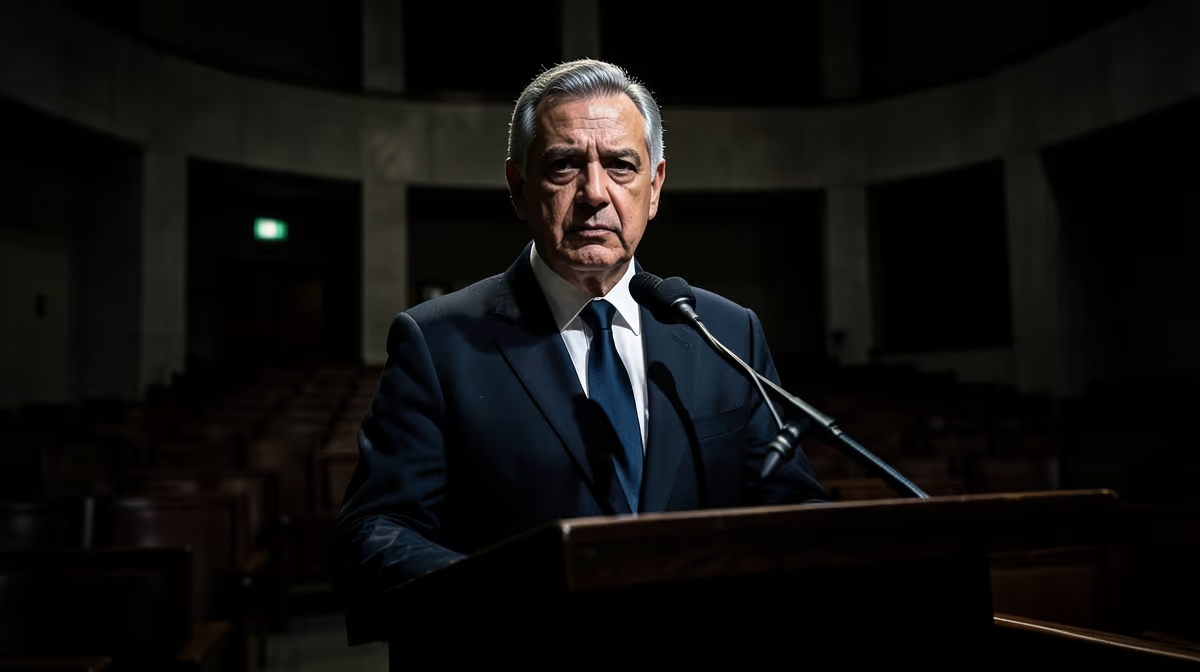
Beyond the borders of Central America, a quiet erosion of democratic norms has reached a critical juncture that challenges the stability of the Western Hemisphere. Following the latest developments in the Nicaraguan elections, global leaders are monitoring the status of the Nicaragua president and the integrity of the voting process, questioning whether the foundations of regional diplomacy can withstand such systemic consolidation of power.
The Mechanics of Political Consolidation
The 2021 general elections serve as a case study in the deliberate dismantling of a competitive political landscape. In the months preceding the contest, the government oversaw the systematic arrest of seven potential presidential candidates and dozens of prominent political figures. By effectively removing all viable opposition from the ballot, the administration ensured that the outcome was predetermined. This consolidation of authoritarian control by the Ortega-Murillo regime has functioned to prevent institutional democratic succession, aiming instead for generational dynastic survival.
For the international community, the voting process was not merely flawed but fundamentally void of legitimacy. International observers, including those from the Organization of American States, were denied access, which prevented independent verification of the results. This lack of oversight, combined with the imprisonment of political opponents and the closure of numerous non-governmental organizations, solidified the transition toward a one-party state.
Historical Context and Institutional Erosion
Nicaragua’s journey from the revolution and civil war of the 20th century to the democratic transitions of the 1990s has been significantly reversed under the current administration. Daniel Ortega, who first rose to power in the 1980s, returned to the presidency in 2007 through democratic means. However, the subsequent years have been marked by a slow but steady centralization of authority.
The turning point for many observers was the 2018 mass protests against social security reforms, which triggered a violent government crackdown. Since that period, the regime has systematically sidelined historical party elites within the Sandinista National Liberation Front, centralizing power under the leadership of President Ortega and Vice President Rosario Murillo. This process of institutionalizing a closed autocratic state has mirrored the final years of the historical Somoza dynasty, where the suppression of moderate dissent and the closing of political space created an increasingly precarious internal environment.
Economic Consequences and International Pressure
The fallout from these developments has moved beyond diplomatic condemnation into the sphere of economic warfare. In response to the electoral irregularities, the United States Congress passed the RENACIA Act, which tightened restrictions on international lending to the Nicaraguan government and sanctioned key members of the ruling party. These sanctions have complicated foreign direct investment and pressured the country's financial systems.
The administration in Managua has responded by characterizing these international measures as imperialist aggression and interference in internal sovereignty. Increasingly, the regime has shifted its focus toward securing economic dependency on non-Western financing from Russia and China. Despite these efforts, the economy continues to face significant pressure, contributing to a cycle of state-sponsored repression and a subsequent, ongoing migration crisis that impacts neighboring Central American nations and the United States.
The Human Cost and Regional Stability
The erosion of democracy carries a heavy toll for the citizens of Nicaragua. Journalists, human rights activists, and religious leaders have faced harassment, imprisonment, or forced exile. The systematic closure of independent media outlets has left a vacuum of information, while the repression of civil society has removed the checks and balances necessary for a healthy democratic system.
For the region, this instability is a catalyst for migration. Thousands of citizens continue to flee the country in search of safety and economic opportunity. This surge in northward migration presents a complex challenge for regional security, as neighboring countries must cope with the influx of those escaping the government's crackdown. The situation has forced the United States to balance its diplomatic pressure against the regime with the humanitarian necessity of addressing the needs of those leaving the country.
Anticipating Future Geopolitical Shifts
As the situation remains fluid, observers expect the United States to continue a strategy of increasing diplomatic and economic isolation of the Ortega administration. Within the next 24 hours, heightened monitoring by the U.S. State Department and the Organization of American States is likely to focus on potential further democratic backsliding. Looking toward the next 72 hours, analysts anticipate the possibility of further targeted sanctions from the U.S. Department of the Treasury against specific officials or government entities.
The expert consensus suggests that the best-case scenario would involve renewed, though unlikely, dialogue regarding transparent future electoral processes and the release of political prisoners. Conversely, the worst-case scenario involves a total collapse of diplomatic relations, potentially leading to the full revocation of trade privileges and an intensification of migration driven by the ongoing domestic repression.
Frequently Asked Questions
When is the next Nicaraguan general election?
The next general election in Nicaragua is scheduled for 2026. These elections typically include votes for the presidency, the National Assembly, and representatives to the Central American Parliament.
Is Nicaragua considered a democracy?
International observers and human rights organizations have increasingly classified Nicaragua as an authoritarian regime. Critics argue that the consolidation of power by President Daniel Ortega and the systematic repression of political opposition have effectively dismantled democratic institutions in the country.
Who is the current president of Nicaragua?
The current president of Nicaragua is Daniel Ortega, who has been in power since 2007. He previously served as president from 1985 to 1990 and is a prominent leader of the Sandinista National Liberation Front.
Why were the 2021 Nicaraguan elections criticized?
The 2021 elections were widely condemned by the international community as illegitimate and a sham. Many opposition candidates were arrested or forced into exile leading up to the vote, leaving voters with no meaningful alternative to the incumbent government.
What impact do international sanctions have on Nicaraguan elections?
The United States and other international bodies have imposed targeted sanctions on Nicaraguan officials in response to electoral irregularities and human rights abuses. These measures aim to pressure the government to restore democratic processes, though the administration often dismisses them as interference in national sovereignty.
Can Nicaraguans living abroad vote in national elections?
Nicaraguan citizens living abroad face significant obstacles to participating in national elections. The electoral system does not provide robust mechanisms for out-of-country voting, effectively disenfranchising a large portion of the population that has migrated due to the country's political and economic crisis.
Conclusion
The political landscape in Nicaragua remains defined by the consolidation of the Ortega-Murillo regime and the systematic exclusion of opposition forces. With the 2021 elections widely labeled as a sham by international authorities and the subsequent imposition of sanctions, diplomatic relations remain at a historic low. As Nicaragua further isolates itself from traditional democratic partners, the focus remains on the ongoing migration crisis and the potential for additional economic and legislative actions from the international community. Future developments will likely center on the effectiveness of continued economic pressure and the humanitarian response to those fleeing the current state of governance.


