
Russian Warships Monitored by Royal Navy in British Waters Today
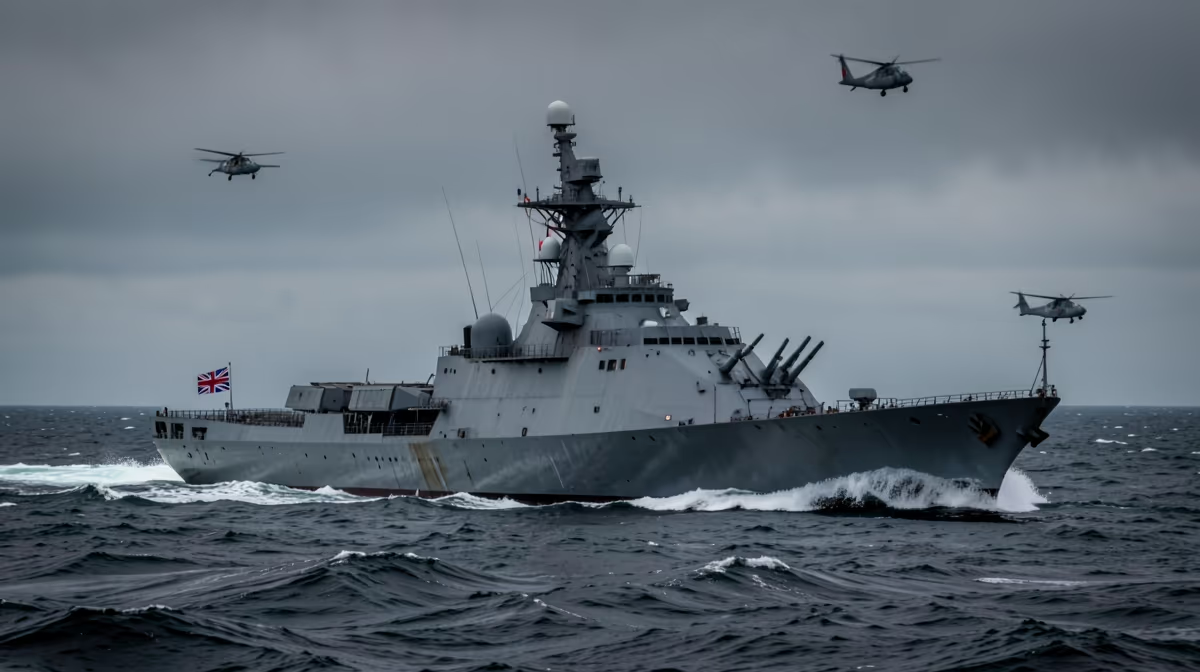
Subtle ripples across the English Channel and North Sea trace the path of foreign hulls operating near British shores, signaling a persistent test of maritime boundaries. Recent developments in naval affairs highlight growing concerns as russian warships transit close to British territorial waters, prompting calibrated responses from regional defense forces.
Chronicle Of Naval Movements
The British Royal Navy has increased monitoring operations in the English Channel and North Sea following the movement of russian warships near UK territorial waters. Defence officials confirmed that Royal Navy vessels and maritime patrol aircraft have been tracking the Russian naval group as it transits international waters close to the United Kingdom. The deployment is part of routine responses to foreign military vessels operating in proximity to British strategic maritime routes.
While foreign warships possess the right of innocent passage under international law, the UK military maintains a persistent presence to ensure national security and monitor activity. Similar passages have occurred with regularity in recent years, prompting standard escort protocols by British naval forces. Tensions between the UK and Russia remain heightened due to the ongoing conflict in Ukraine and broader geopolitical friction. The Ministry of Defence continues to assess the movements and maintain operational readiness across all regional commands. An official Ministry of Defence spokesperson stated that the Royal Navy routinely monitors foreign warships in our areas of interest to ensure compliance with maritime law and to protect the UK security.
Verified facts confirm that Royal Navy vessels are actively tracking russian warships near UK waters, that the operations are taking place in international waters, that maritime patrol aircraft are assisting surface vessels in the monitoring effort, and that no violations of UK territorial waters have been officially reported. What is confirmed at this stage is that russian warships are transiting near British waters, and the Royal Navy is actively escorting and monitoring their movement. Meanwhile, the exact destination of the Russian naval group and the duration of their presence in the region remain under observation.
Understanding The Security Environment
People across Britain are paying close attention after russian warships were spotted moving close to UK waters. The Royal Navy has been monitoring these vessels as they travel near our coastline, a common occurrence that still raises security concerns. While seeing foreign military ships near British shores might sound alarming, the Ministry of Defence has stressed that these ships are being closely watched every step of the way. Royal Navy ships and aircraft are deployed to ensure UK waters remain secure and that international maritime rules are respected.
Key facts of the situation outline that russian warships were detected operating near UK territorial waters, the Royal Navy deployed ships and aircraft to track the movements, such close passes happen periodically as part of routine international posturing, no hostile actions or breaches of UK waters have been reported, and defence officials maintain constant surveillance to protect national security. This situation highlights ongoing tensions between the UK and Russia, reminding the public of the constant, behind-the-scenes work military forces do to keep the country safe. It reassures citizens that Britain borders are actively monitored, even if day-to-day life remains completely unaffected. Those primarily affected include the British public, the Royal Navy, and government defence planners. The historical context shows that the UK and Russia have a long history of strained diplomatic and military relations, and it is standard international practice for the Royal Navy to intercept and escort foreign military vessels that sail close to British waters to demonstrate sovereignty and maintain defence readiness.
Strategic And Geopolitical Analysis
The root cause of these events lies in the structural deterioration of aging Russian naval fleets juxtaposed with the Kremlin geopolitical imperative to project maritime power near critical NATO chokepoints. From a political angle, the movements reflect domestic regime reinforcement through aggressive foreign posturing, contrasted with Western political unity in maritime defense and sanctions enforcement. Economically, there is a heavy fiscal drain of maintaining blue-water naval capabilities under severe Western sanctions, contrasting with the cost-asymmetric disruption of commercial shipping lanes and subsea energy infrastructure in British waters. Geopolitically, these transits test NATO Article 5 thresholds and intelligence-gathering limits in the North Sea and English Channel, redefining the gray-zone conflict spectrum. A hidden angle involves the extensive reliance on aging civilian auxiliary vessels and shadow-fleet tankers for dual-use intelligence gathering, bypassing traditional naval tracking mechanisms. This creates a historical parallel to the Soviet Navy persistent probes of the Greenland-Iceland-United Kingdom gap during the Cold War, serving both strategic and psychological functions. The timeline of this friction includes the 2014 annexation of Crimea triggering increased Russian naval patrols near UK territorial waters, the 2021 Royal Navy escorting the Russian destroyer Vice-Admiral Kulakov following suspected subsea cable mapping, the 2023 establishment of a comprehensive UK-led maritime defense taskforce to monitor rising shadow-fleet and naval activities, and present-day routine interceptions of Russian surface action groups in the English Channel amid heightened UK-Russia diplomatic freezing.
Future Outlook And Tactical Projections
Looking ahead across the next 24 hours, expectations point toward increased Royal Navy monitoring and shadowing of Russian naval vessels operating near British territorial waters and the English Channel. Over the next 72 hours, analysts anticipate heightened intelligence sharing among NATO allies regarding Russian fleet movements, alongside potential RAF maritime patrol aircraft deployments. Key players involved in these operations include the Royal Navy, the UK Ministry of Defence, the Russian Northern Fleet, and NATO Maritime Command. Primary impact areas span the English Channel, the North Sea, UK national security, and key maritime navigation routes. Expert prediction suggests that routine posturing and intelligence gathering by Russian vessels will continue, met with professional, measured shadowing by UK armed forces without direct escalation. In the best-case scenario, russian warships transit international waters uneventfully under close British surveillance, demonstrating effective deterrence and maintaining regional stability. Conversely, the worst-case scenario involves an unintended navigational incident or aggressive maneuvering occurring in busy shipping lanes, leading to diplomatic escalation and heightened military readiness.
Frequently Asked Questions
What is the most famous Russian warship?
The Moskva, the flagship of Russia Black Sea Fleet, is arguably the most famous in recent history due to its dramatic sinking in April 2022. It was a Slava-class guided-missile cruiser that played a central role in naval operations following the invasion of Ukraine. Its loss was a significant blow to the Russian Navy prestige and operational capabilities.
Can Russian warships enter UK waters?
Foreign military vessels, including russian warships, have the right of innocent passage through the territorial waters of other nations under international law. However, the Royal Navy routinely monitors and escorts these vessels when they transit near British waters to ensure national security. Such passages are closely watched by maritime patrol aircraft and surface ships.
How many aircraft carriers does Russia have?
Russia currently has only one operational aircraft carrier, the Admiral Kuznetsov, which has experienced numerous delays, accidents, and prolonged refit periods. Unlike the US or UK navies, the Russian naval strategy places greater emphasis on heavy cruisers, submarines, and land-based aviation rather than a large carrier strike force. Consequently, its power projection via carriers is quite limited.
What happened to the Russian flagship Moskva?
The Moskva was severely damaged and subsequently sank while being towed to port during a storm in the Black Sea. Ukrainian forces claimed responsibility for hitting the cruiser with two Neptune anti-ship missiles, while Russia claimed the sinking was caused by an accidental ammunition fire and subsequent rough seas. This event marked one of the most significant naval losses of the 21st century.
Why are Russian warships operating near the UK?
Russian warships frequently transit through the English Channel and the North Sea as they travel between Russia Northern Fleet, Baltic Fleet, and Black Sea or Mediterranean deployments. These movements are standard operational transits, but they are closely monitored by the UK Ministry of Defence as a matter of routine defence and deterrence. Tensions have heightened these monitoring operations in recent years.
What is the newest class of Russian warships?
The Admiral Gorshkov-class represents one of the newest and most advanced classes of frigates in the modern Russian Navy. These multi-role warships are designed to carry hypersonic Zircon missiles and long-range Kalibr cruise missiles. They intended to gradually replace older Soviet-era destroyers and frigates in long-distance deployments.
Conclusion
The verified developments confirm that the Royal Navy and maritime patrol aircraft continue to actively track and monitor russian warships as they transit international waters near the United Kingdom. While foreign vessels retain rights of innocent passage under international law, British forces maintain persistent surveillance to protect national security and uphold maritime protocols. Realistic next steps involve ongoing intelligence sharing among NATO allies, sustained operational readiness across regional defense commands, and continued professional shadowing of naval assets by the Ministry of Defence as these routine transits unfold.


