
Russian Warships Spark NATO Alert as Defense Forces Respond
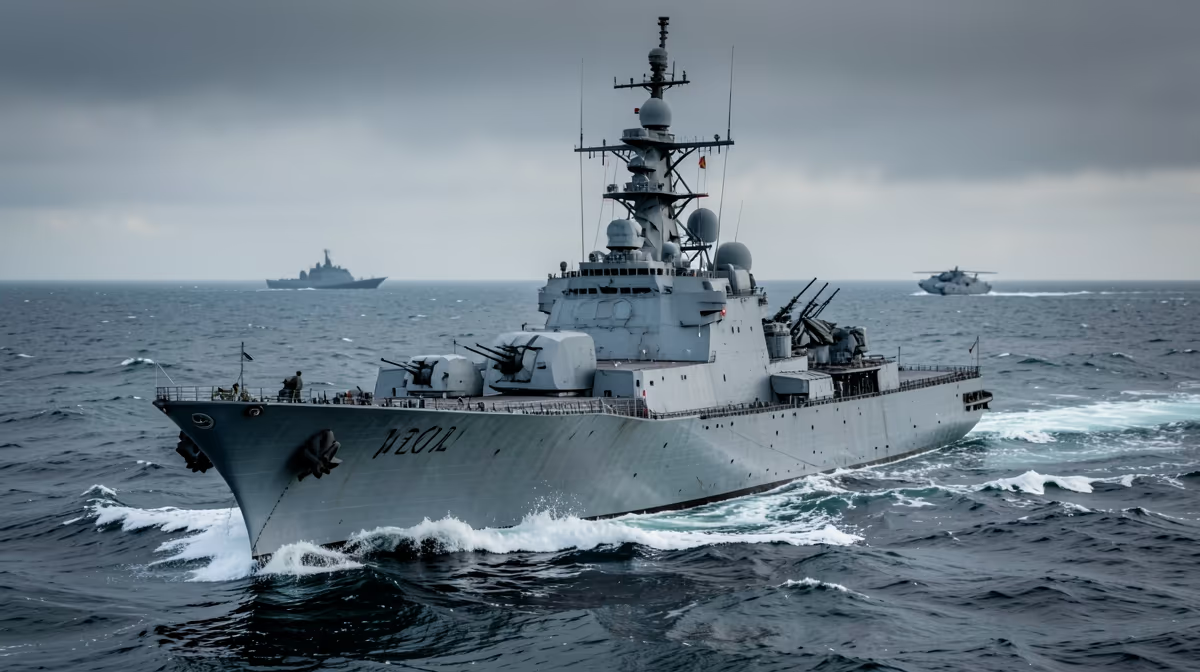
Two Russian naval warships traversed the international waters of the English Channel on Tuesday, prompting heightened monitoring by British and NATO maritime forces as regional tensions remain elevated. Amid this evolving dynamic, the deployment of russian warships highlights the delicate balance of international maritime security and the constant surveillance maintained by global defense networks.
What Unfolded
The deployment involves a Russian frigate and a support vessel operating in close proximity to strategic European shipping lanes. Royal Navy patrol vessels were dispatched to shadow the movement, standard procedure for monitoring foreign military assets transiting through the area. Defense analysts note that while such transits comply with the United Nations Convention on the Law of the Sea regarding freedom of navigation, the timing coincides with broader geopolitical friction between Moscow and Western nations over the ongoing conflict in Ukraine. Similar naval movements have been reported frequently over the past year, reflecting an ongoing pattern of Russian long-distance naval deployments designed to project power and test the response times and surveillance capabilities of NATO member states. A UK Ministry of Defence spokesperson stated that authorities continue to monitor all foreign naval activity in the area of interest through a combination of maritime patrol aircraft and surface vessels to ensure the security of UK waters.
Core Facts And Context
Russian warships are naval vessels belonging to Russia's national navy. They frequently sail in international waters near Europe, the Americas, and Asia, and their movements are closely tracked by NATO and other allied nations. These deployments are often used to project military power globally, while naval exercises and patrols remain standard military operations for major world powers. For most people, seeing news about warships can be scary because it reminds us of military tensions. However, these movements are often a way for countries to show power and test each other's boundaries without actually starting a fight. Governments and military experts watch these ships very closely to make sure nothing gets out of hand. Since the end of the Cold War, Russia has worked to rebuild and modernize its navy to maintain its status as a global military power, regularly sending its fleets on international deployments to show its capabilities.
Strategic And Economic Drivers
The structural decline of Russian domestic shipbuilding capabilities forces a reliance on aging Soviet-era hulls, coupled with the strategic imperative to project state power globally despite severe economic constraints. The Kremlin utilizes naval deployments and port visits as domestic propaganda to project an image of an unbowed superpower, while simultaneously leveraging naval posturing in regions like the Mediterranean and Atlantic to extract diplomatic concessions from regional powers. At the same time, skyrocketing maintenance costs of aging fleets combined with Western sanctions restricting access to critical dual-use marine technologies force a diversion of state funds from modernization to basic operational readiness. This dynamic creates friction points in strategic choke points such as the Baltic Sea, the Black Sea, and the Arctic, while also leading to tactical naval alliances with non-aligned states like China and Iran. An acute shortage of modern dry dock infrastructure in the Russian Far East and Arctic further limits maintenance capacity, forcing damaged or aging vessels to undertake perilous trans-oceanic voyages for basic repairs, echoing the historical challenges faced by the Russian Baltic Fleet during the 1904-1905 Russo-Japanese War.
Why This Matters
The movement of these vessels matters because it increases tensions between Russia and Western countries. When military ships get too close to each other or to foreign coastlines, there is always a small risk of a misunderstanding or an accident that could escalate into a major conflict. Global shipping companies, coastal nations near the patrol routes, and people concerned about international peace and security are directly affected by these operations.
Outlook And Future Scenarios
Over the next 24 hours, defense intelligence anticipates increased surveillance and monitoring of Russian naval movements by NATO forces in the North Atlantic and Mediterranean. Looking toward the next 72 hours, there is potential for the commencement of scheduled or unscheduled naval exercises in contested waters, prompting diplomatic statements. Naval operations will remain postured for deterrence and power projection, avoiding direct kinetic engagement with NATO while maintaining pressure in regional theaters. In the best-case scenario, all naval maneuvers are conducted safely with transparent communications, avoiding accidental escalations or incidents at sea. Conversely, the worst-case scenario involves a miscalculation or unsafe intercept leading to a physical collision or exchange of fire between Russian and NATO or allied assets, triggering severe diplomatic crises.
Frequently Asked Questions
What is the most powerful Russian warship?
The Pyotr Veliky, a Kirov-class battlecruiser, is widely considered the most powerful surface combatant in the Russian Navy. It is heavily armed with anti-ship missiles and advanced air defense systems. Additionally, the Admiral Kuznetsov serves as Russia's flagship and only aircraft carrier.
How many Russian warships have been sunk in the war with Ukraine?
Several notable Russian warships have been destroyed or damaged since the conflict began in 2022. The most high-profile loss was the guided-missile cruiser Moskva, which served as the flagship of the Black Sea Fleet. Ukrainian forces have utilized anti-ship missiles and uncrewed surface drones to target these vessels.
What are the main classes of Russian warships?
The Russian Navy operates various classes of vessels, ranging from heavy cruisers and destroyers to frigates and corvettes. Key modern classes include the Admiral Gorshkov-class frigates and the improved Kilo-class attack submarines. These ships are designed for both power projection and coastal defense.
Where is the Russian Navy's Black Sea Fleet based?
The primary base of the Russian Black Sea Fleet is located at Sevastopol on the Crimean Peninsula. Due to ongoing security threats and Ukrainian strikes, Russia has also relocated a portion of its fleet further east to Novorossiysk. This strategic shift aims to protect naval assets from long-range attacks.
Does Russia have operational aircraft carriers?
Russia currently has only one aircraft carrier, the Admiral Kuznetsov, which has faced extensive delays due to fires, maintenance issues, and modernization efforts. Consequently, the Russian Navy relies primarily on land-based aviation and heavily armed surface combatants for air support. The carrier's return to active service remains uncertain.
What weapons do modern Russian warships carry?
Modern Russian surface ships are heavily armed with supersonic and hypersonic anti-ship missiles, such as the Kalibr and the Zircon systems. They also feature advanced multi-layered air defense networks, including naval variants of the S-400 missile system. This heavy armament reflects Russia's doctrine of anti-access and area denial.
Conclusion
The transit of Russian naval vessels through international waters underscores the persistent strategic posturing and maritime surveillance defining current international relations. Verified developments confirm that British and NATO naval forces successfully monitored the passage without hostile incident, though broader geopolitical friction remains high. As maritime forces maintain close oversight across key regional theaters, the focus shifts toward continuous monitoring and adherence to international maritime law to ensure regional stability.


