
Strait of Hormuz Tanker Maneuver Triggers Global Security Alert
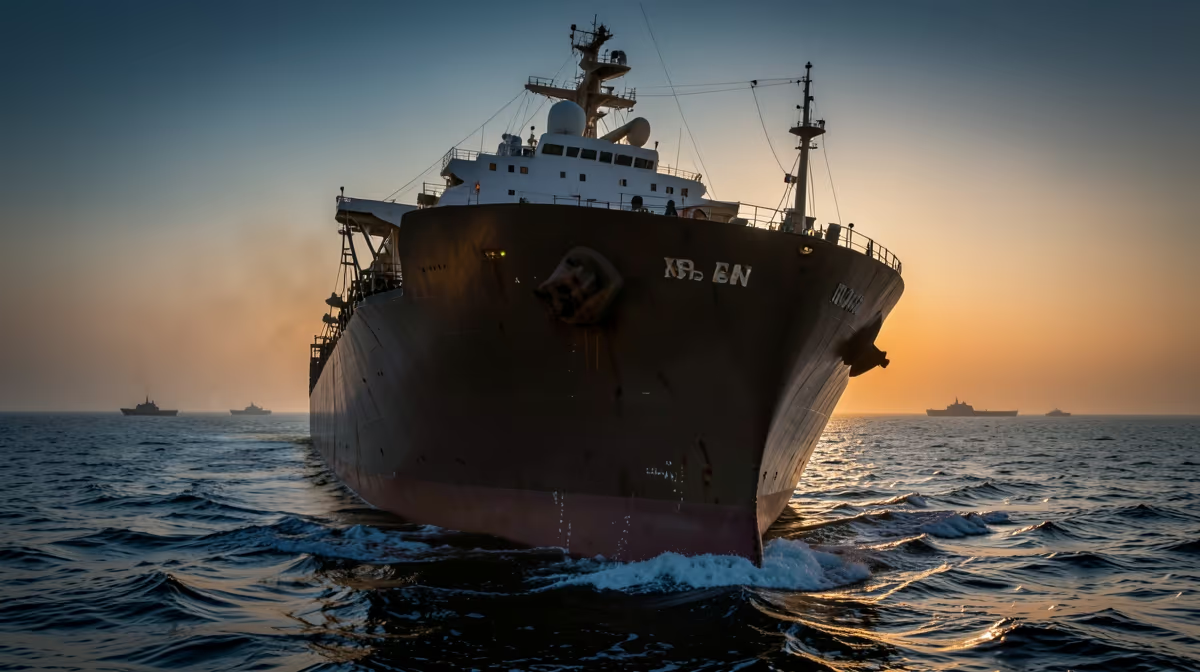
A sudden mid-transit course reversal by a commercial oil tanker in the narrowest reaches of the Persian Gulf has forced international maritime monitors to reassess the stability of the world's most critical energy artery. This unexplained maneuver within the Strait of Hormuz has sparked immediate concerns regarding the security of the global oil supply chain, as regional Strait of Hormuz tension reaches a boiling point that keeps maritime security analysts and energy investors on high alert.
The Anatomy of a Maritime Chokepoint
The Strait of Hormuz stands as the world’s most important oil transit chokepoint, serving as a vital artery for the global economy. Every day, a massive percentage of the world's oil exports must navigate this narrow passage situated between Iran and Oman. Because the shipping lanes are restricted to approximately two miles wide for both incoming and outgoing traffic, the margin for error is razor-thin. When a vessel executes an unannounced and abrupt U-turn in this environment, it does more than just disrupt transit; it sends a signal of potential instability to every market participant reliant on Middle Eastern energy. While maritime authorities continue to investigate the specific triggers for this maneuver, the event underscores how quickly localized navigation issues can transition into broader economic volatility.
What Unfolded in the Gulf
On Wednesday, a commercial oil tanker deviated from its established route in the Strait of Hormuz following a heightened state of alert and specific naval warnings. Tracking data confirmed the vessel abruptly altered its course after receiving signals from Iranian patrol craft that were actively monitoring the passage. This incident occurred against a backdrop of increasing regional friction, as the United States has ramped up its naval presence in the Persian Gulf to deter the unlawful seizure of merchant vessels. While the U.S. Navy 5th Fleet, operating out of Bahrain, has bolstered its regional presence—including the deployment of A-10 Warthog squadrons—to ensure freedom of navigation, it has stopped short of confirming a direct kinetic confrontation regarding this specific tanker. The current situation remains a developing story, with the exact nature of the communications exchanged between the patrol craft and the tanker still undergoing verification.
Economic Consequences and Market Sensitivity
The economic implications of such tactical maneuvers are immediate and often costly. Because the Strait of Hormuz carries roughly twenty percent of daily global oil consumption, any perceived threat to shipping safety leads to a swift reaction in energy markets. Increased maritime insurance premiums and war risk surcharges are frequently passed down to global consumers, creating inflationary pressure and incentivizing speculative volatility in Brent and WTI crude benchmarks. For energy investors, the U-turn is a reminder that the global energy supply chain is highly vulnerable to gray-zone warfare, where state actors utilize maritime chokepoints to exert geopolitical influence. The current environment forces shipping companies to balance the commercial necessity of transit against the growing risk of interception or harassment.
The Geopolitical Security Assessment
From an analytical perspective, this maneuver represents a form of tactical recalibration in response to intelligence regarding potential maritime harassment. It serves as a high-stakes pressure lever; for the United States, it is a demonstration of deterrence intended to signal to allies that Washington remains the ultimate security guarantor in the region without necessarily triggering a formal, large-scale conflict. Historically, this echoes the 1987-1988 Tanker War, where international naval forces were required to escort commercial vessels to maintain the flow of oil. Today, the challenge is characterized by asymmetrical threats, where the ability of the U.S. Navy to maintain freedom of navigation is constantly tested by regional forces seeking to frame Western presence as an aggressive provocation.
Future Outlook and Potential Scenarios
In the next 24 hours, stakeholders should expect increased naval patrols by the U.S. Fifth Fleet and its regional allies to monitor tanker maneuvering and ensure that commercial transit remains unimpeded. Looking toward the next 72 hours, observers should watch for heightened diplomatic back-channel communications between Washington and Tehran aimed at de-escalating friction as tankers adjust routes to avoid localized risks. While expert analysis suggests that a full-scale blockade remains unlikely—as it would trigger severe international economic retaliation—the situation remains fragile. The best-case scenario involves this maneuver being identified as a strictly precautionary measure by the vessel's operators, leading to minimal market disruption. Conversely, the worst-case scenario involves the maneuver signaling a deeper escalation, where maritime harassment leads to a seizure or kinetic engagement, which would cause an immediate and sharp spike in global oil prices.
Frequently Asked Questions
Can oil tankers make a U-turn in the Strait of Hormuz?
While oil tankers technically have the maneuverability to turn around, doing so in the Strait of Hormuz is extremely difficult and dangerous due to heavy maritime traffic and restricted shipping lanes. International regulations generally discourage such maneuvers in narrow chokepoints to prevent collisions and potential environmental disasters.
Why do oil tankers avoid turning around in the Strait of Hormuz?
The Strait of Hormuz is a narrow passage that acts as a vital global energy artery, requiring ships to follow strict traffic separation schemes. Turning a massive supertanker around inside these lanes would disrupt global shipping flows and pose a significant risk of grounding or collision in shallow waters.
Is it legal for a ship to perform a U-turn in the Strait of Hormuz?
Under the principle of transit passage as defined by UNCLOS, vessels are permitted to navigate through the strait, but they must comply with International Maritime Organization traffic regulations. A U-turn that obstructs the lanes or ignores traffic protocols could be considered a violation of safety standards and could trigger intervention by regional naval forces.
What happens if a tanker attempts a dangerous maneuver in the Strait of Hormuz?
If a tanker attempts an unauthorized or unsafe U-turn, it risks being challenged by the Iranian Revolutionary Guard Corps Navy or other regional forces patrolling the area. Such actions are often interpreted as security threats, potentially leading to vessel detentions or intense military scrutiny.
How wide is the shipping lane in the Strait of Hormuz?
The shipping lanes in the Strait of Hormuz are approximately two miles wide for both incoming and outgoing traffic. This limited space makes it nearly impossible for large tankers to perform wide-radius turns without exiting the designated shipping channels and entering Iranian or Omani territorial waters.
Does international law protect the right of tankers to maneuver in the Strait of Hormuz?
International law guarantees the right of transit passage, but this right is balanced against the duty to ensure navigational safety. Vessels are expected to maintain a steady course and follow standard maritime practices, meaning that unnecessary or erratic maneuvers are not protected if they endanger other vessels.
Conclusion
The situation in the Strait of Hormuz remains a critical indicator of global energy stability. While a single tanker’s U-turn does not represent a total cessation of maritime commerce, it highlights the acute vulnerability of international shipping lanes to localized geopolitical friction. Verified developments point to a tightening security environment, characterized by increased naval oversight and the strategic rerouting of commercial vessels. As the U.S. Fifth Fleet and regional actors continue to monitor the passage, the focus remains on preventing a tactical escalation that could disrupt the global supply chain. Stakeholders should monitor for further intelligence from the Persian Gulf, as the interaction between commercial transit and regional security forces continues to dictate the immediate trajectory of global oil prices.


.webp)
