
Valiant Shield Torpedo Strike Reveals Major Shifts in Naval Warfare
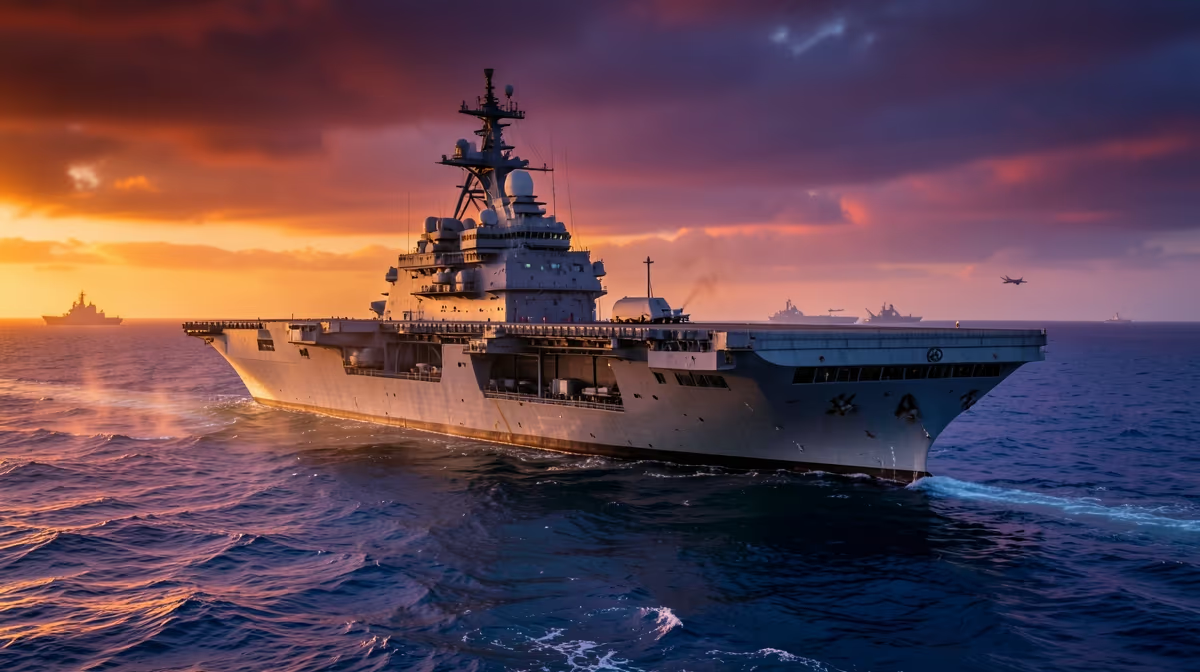
Deep beneath the surface of the Pacific, the intersection of legacy naval platforms and next-generation strike precision is redefining how modern maritime powers project force across contested environments. The recent Valiant Shield torpedo strike involving LPD-10 highlights the rapid modernization of US naval capabilities, as the USS Anchorage LPD-10 continues to play a pivotal role in these complex training scenarios where defense experts are looking closely at how autonomous systems are shifting the landscape of naval warfare evolution.
The Mechanics of Modern Maritime Engagement
During the Valiant Shield 2024 military exercise, the U.S. Navy successfully demonstrated the sinking of the decommissioned amphibious transport dock USS Cleveland (LPD-7) using a coordinated live-fire torpedo strike in the Pacific Ocean. The operation, conducted on June 18, 2024, off the coast of the Northern Mariana Islands, utilized the retired vessel as a target platform to evaluate the efficacy of integrated undersea and surface weapons systems during a multi-domain training event involving the U.S. Navy, Air Force, and Space Force.
The strike involved multiple platforms, including a U.S. Navy attack submarine which deployed a heavyweight torpedo to neutralize the hull. The sinking exercise, or SINKEX, served as a critical test for naval personnel to practice maritime precision targeting and long-range engagement strategies against realistic, full-scale naval assets. The Navy confirmed that the vessel was successfully sent to the seafloor in waters exceeding 6,000 feet deep, following strict environmental regulations and preparations to ensure hazardous materials were removed in accordance with the Marine Mammal Protection Act.
Strategic Context and Operational Evolution
Valiant Shield is a biennial, U.S.-only field training exercise that focuses on joint operations between the Navy, Air Force, Army, and Marine Corps to ensure seamless integration during large-scale military actions. By using a retired ship as a target, the military gathers critical data on the effectiveness of missiles and sensor systems. This process ensures that U.S. naval forces remain prepared to neutralize threats in real-world environments while gathering intelligence on how to best defend against or dismantle similar ships during a potential conflict.
The root cause of such exercises lies in the integration of Unmanned Surface Vessels into Distributed Maritime Operations testing frameworks. Analysts note that this transition marks a shift toward cost-effective, attrition-tolerant weapon systems compared to traditional strike platforms. Historically, these exercises find a parallel in the 1946 Operation Crossroads testing of atomic weapons on decommissioned naval hulls to evaluate post-war maritime survivability, serving as a calibrated signal of maritime superiority.
The Geopolitical and Tactical Landscape
This demonstration serves as a signal to peer adversaries of maturing anti-access and area-denial neutralization capabilities. The Indo-Pacific deterrence strategy is increasingly focused on rapid target acquisition and saturation tactics in contested environments. While the exercise provides essential training for Pacific allied nations and U.S. personnel, it also acts as a point of observation for potential geopolitical adversaries monitoring U.S. military capabilities.
The exercise highlights a dual-sided reality: the best-case scenario involves the successful validation of long-range precision strike capabilities demonstrating a high degree of interoperability with regional partners. Conversely, there is a risk that such maneuvers could be perceived by adversarial regional powers as an escalatory provocation, potentially leading to heightened military responses. The U.S. Pacific Fleet has emphasized that these exercises are intended to provide invaluable experience for crews in employing combat-ready weapon systems, ensuring the maritime force remains ready to deter and defeat any adversary.
Future Outlook and Tactical Validation
Over the next 24 hours, the Navy is expected to release official confirmation of exercise outcomes and tactical imagery regarding the SINKEX performance on the LPD-7 hull. Following this, the next 72 hours will likely involve a deep analysis of weapon systems efficacy and the integration of real-time sensor data into Pacific Fleet operational doctrine. This data is vital for refining future naval weapons integration and enhancing the precision of joint force operations.
The focus remains on multi-domain coordination rather than the mere destruction of the target hull. As the Navy continues to refine its tactics in the Pacific, the data gathered from this exercise will influence maritime deterrence strategies, anti-ship missile deployment, and the overall regional geopolitical posture for years to come.
Frequently Asked Questions
What happened during the Valiant Shield torpedo strike on USS Juneau (LPD-10)?
During a previous Valiant Shield exercise, the decommissioned USS Juneau (LPD-10) was utilized as a target ship during a SINKEX. It was successfully struck and sunk by coordinated weapon systems, including torpedoes and missiles, to test naval combat effectiveness.
When did the USS Juneau (LPD-10) get sunk in Valiant Shield?
The USS Juneau (LPD-10) was sunk during the Valiant Shield 2010 exercise in the waters near Guam as part of military efforts to evaluate weapon capabilities.
Why was the LPD-10 used as a target in Valiant Shield?
The U.S. Navy uses decommissioned vessels as target ships to provide realistic live-fire training, allowing crews to practice complex coordination and evaluate how modern weapon systems perform against an actual hull.
What weapons were used to sink the LPD-10 during Valiant Shield?
The sinking of the USS Juneau involved a variety of weapons, including both air-launched and surface-launched systems, utilizing precision-guided munitions and heavy-weight torpedoes.
Is the USS Juneau (LPD-10) still in service?
No, the USS Juneau (LPD-10) was decommissioned in 2008 and subsequently repurposed for the SINKEX portion of the 2010 exercise.
What is the purpose of a SINKEX like the one involving LPD-10?
A SINKEX is conducted to improve maritime proficiency by allowing crews to fire live munitions at decommissioned ships, providing data on weapon lethality and operational coordination in a controlled environment.
Conclusion
The successful sinking of decommissioned naval assets during Valiant Shield exercises remains a cornerstone of U.S. maritime training and strategic deterrence. By integrating live-fire drills with real-world sensor data, the U.S. Navy continues to validate its long-range precision strike capabilities and autonomous system integration. These exercises confirm the operational readiness of the U.S. Indo-Pacific Command while providing a necessary framework for evolving naval warfare tactics in contested waters. Future analysis of the telemetry data gathered will serve to further refine combat doctrine and ensure that maritime forces are equipped to maintain superiority in an increasingly complex geopolitical environment.


.webp)

.webp)
