
Valiant Shield Torpedo Strike Reveals Major Shift in US Naval Power
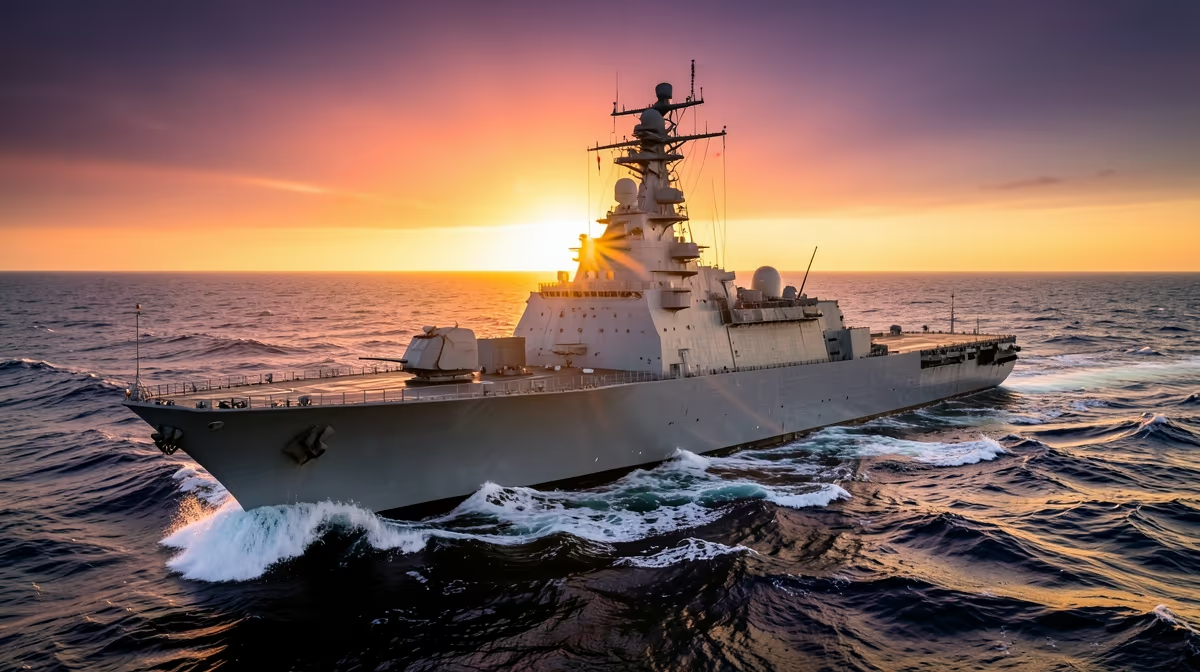
Deep beneath the surface of the Pacific, the silent convergence of sensor data and kinetic force recently redefined the boundaries of maritime warfare during a high-stakes naval exercise. The recent valiant shield torpedo strike involving the LPD-10 marks a significant milestone in modern naval warfare exercises, demonstrating the raw power of coordinated maritime strike capabilities against a decommissioned vessel in a controlled SINKEX environment. By utilizing the decommissioned USS Juneau as a target, the U.S. Navy successfully validated a complex operational cycle that integrates multi-domain assets into a singular, lethal response.
Strategic Objectives of Naval Warfare Exercises
The Valiant Shield 2024 exercise represents a biennial culmination of U.S. Indo-Pacific Command efforts, designed to ensure that diverse service branches can communicate and act as a unified force during high-intensity maritime conflicts. The primary objective of this specific drill was the validation of distributed maritime operations, or DMO doctrine. This framework shifts the strategic reliance away from traditional, centralized carrier-strike groups toward a more decentralized model where individual ships and aircraft act as integrated nodes within a vast, networked strike ecosystem.
Beyond the tactical execution, these exercises serve as a critical component of regional stability. By demonstrating the capability to synchronize fire control data across air, sea, and land assets, the Navy sends a clear signal to regional adversaries regarding the precision and reliability of its long-range engagement protocols. This is not merely an exercise in destruction; it is a rigorous stress test of the sensors, networks, and personnel required to maintain a free and open Indo-Pacific theater in an era of increasing technological complexity.
Analyzing the Torpedo Strike Impact on USS Juneau
The destruction of the USS Juneau (LPD-10) provided military planners with an invaluable dataset. As a decommissioned Austin-class amphibious transport dock, the vessel served as an ideal target to test the effectiveness of underwater and surface-launched weapons systems against real-world hull structures. Following the impact, naval analysts and engineers collected critical telemetry data regarding weapon performance, structural integrity, and the efficacy of sensor-to-shooter connectivity.
While LPD-class vessels are primarily tasked with amphibious assault and logistical support rather than offensive anti-surface warfare, their presence in these drills highlights a shift in tactical employment. The exercise proved that even legacy hulls can be effectively neutralized when integrated into a modern, multi-domain network. For the U.S. Navy, this data is essential for planning future defense procurement and refining the software and targeting algorithms that govern modern precision munitions.
The Mechanics of Distributed Lethality
Modern maritime power projection relies on the seamless integration of expeditionary rapid-response logistics with precision-strike capabilities. During the Valiant Shield 2024 exercises, the U.S. Navy successfully conducted a live-fire sinking exercise, known as a SINKEX, to refine these protocols. The process involves multiple units, ranging from submarines to airborne surveillance platforms, feeding real-time location data into a unified command-and-control system.
This level of interoperability is the cornerstone of the Navy's strategy to counter anti-access/area-denial challenges. By effectively coordinating these disparate elements, the Navy can conduct strikes from distances that minimize the risk to its own personnel and platforms. The successful scuttling of the USS Juneau confirmed that the current weapons integration software can handle high-density targeting data, even in simulated combat environments where electronic warfare or atmospheric interference might be present.
Future Outlook and Technical Assessments
In the immediate 24 to 72 hours following the exercise, military officials are focusing on the analysis of post-action reports and the validation of integrated fire control systems. The data collected from the strike will be disseminated across allied maritime commands to ensure a collective understanding of performance benchmarks. Should the telemetry indicate any latency or targeting discrepancies, technical teams will be required to pause and re-evaluate the weapons integration software—a worst-case scenario that would trigger a thorough review of the current procurement and deployment timeline.
However, the current assessment suggests a high degree of success. The validation of these long-range engagement protocols serves to verify that the Navy's shift toward decentralized, ship-based missile and torpedo platforms is sound. As the participating surface warfare groups return to port or transition to their next phase of operational readiness, the lessons learned from the USS Juneau will continue to inform naval tactical doctrine for years to come.
Geopolitical and Economic Dimensions
The exercise carries significant weight beyond its technical successes. Economically, the validation of high-cost precision munitions is essential for securing future defense procurement budgets, as it proves the ROI of modern naval weaponry. Politically, the SINKEX serves as a demonstration of U.S. naval dominance and interoperability to regional allies, reassuring them of the U.S. military’s readiness to act as a guarantor of security in the Pacific.
This display of power forces potential adversaries to recalibrate their own threat assessments. As the strategic role of various ship classes evolves, the ability of the U.S. to project force against non-capital ships using precision strikes complicates the planning of any hypothetical regional conflict. It remains a core component of the military's broader effort to modernize its approach to maritime defense, ensuring that despite the age of the vessels involved, the underlying combat systems remain at the cutting edge of global standards.
Frequently Asked Questions
What was the Valiant Shield torpedo strike involving LPD-10?
The Valiant Shield exercise is a biennial U.S. military training event focused on the integration of joint forces. During these drills, maritime assets like the USS Juneau (LPD-10) have historically participated in live-fire exercises, including coordinated torpedo or missile strikes against simulated enemy targets.
Did the USS Juneau (LPD-10) participate in a live torpedo exercise during Valiant Shield?
While the USS Juneau (LPD-10) was active in the Pacific theater, Valiant Shield exercises often utilize SINKEX (sinking exercises) where various platforms coordinate strikes. Reports of specific torpedo activity usually involve the broader strike group rather than the transport ship itself conducting the strike.
What is the primary role of LPD-10 in Valiant Shield exercises?
The USS Juneau (LPD-10) serves as an Austin-class amphibious transport dock ship designed to land Marines and their equipment. In Valiant Shield, its primary role is providing logistical support, command and control, and amphibious assault capabilities rather than offensive anti-submarine warfare.
How does a joint force coordinate a torpedo strike in Valiant Shield?
A joint torpedo strike in Valiant Shield involves seamless communication between surface ships, submarines, and aircraft to identify and engage targets. The exercise tests the ability of disparate units to share targeting data and execute synchronized fires across multiple domains.
Are LPD ships equipped to fire torpedoes at enemy vessels?
No, LPD-class ships like the LPD-10 are not typically equipped with torpedo tubes for offensive strikes against enemy vessels. Their self-defense systems are primarily focused on point-defense weaponry, meaning any torpedo strikes observed during training are conducted by supporting submarines or aircraft.
Why is Valiant Shield significant for US naval training?
Valiant Shield is significant because it allows the U.S. military to practice high-end warfare scenarios in a controlled, large-scale environment. It ensures that different service branches can operate as a cohesive force, testing everything from communication protocols to complex live-fire coordination.
Conclusion
The Valiant Shield 2024 exercise has successfully demonstrated the U.S. Navy's ability to integrate multi-domain assets into a cohesive strike force, culminating in the precision destruction of the USS Juneau (LPD-10). Through this SINKEX, the military has validated critical command-and-control protocols and gathered essential data on weapons performance that will shape future maritime tactical doctrine. As the Navy moves forward with analyzing the results, the exercise stands as a clear confirmation of the U.S. military's commitment to maintaining a lethal, integrated presence in the Indo-Pacific. Future operations will now reflect the insights gained from this exercise, ensuring that the U.S. remains prepared for the challenges of modern, high-intensity naval engagement.


.webp)

.webp)
