
China US Trade Restrictions Trigger Global Supply Chain Panic
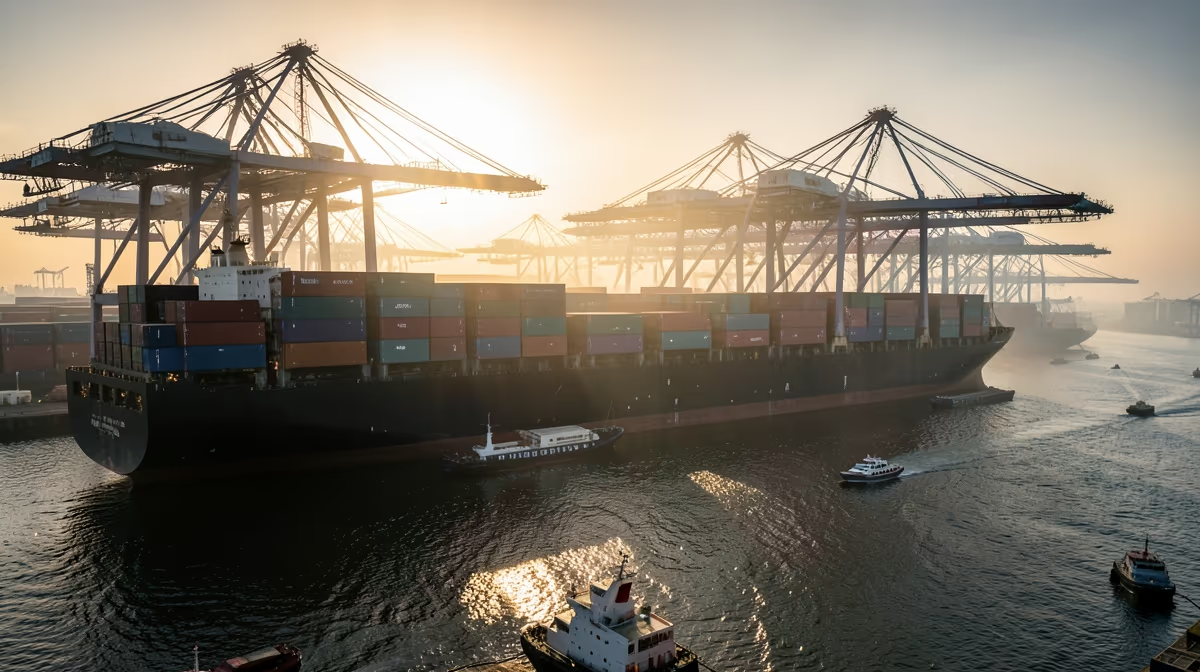
The United States Department of Commerce implemented sweeping new export controls on advanced computing semiconductors and semiconductor manufacturing equipment destined for China, aiming to protect national security and maintain technological leadership. As geopolitical tensions continue to escalate, the latest china us trade restrictions are sending shockwaves through global markets, raising urgent questions about economic sanctions and supply chain disruption. These actions are not isolated events; they represent a fundamental restructuring of international commerce where national security increasingly supersedes traditional free-market principles. The United States and China find themselves locked in a systemic economic standoff, deploying a sophisticated array of economic sanctions, export controls, and tariffs to shape the future of global technological dominance.
What Unfolded
The newly enacted restrictions specifically target high-end artificial intelligence chips and specialized manufacturing tools, significantly tightening regulations introduced in previous years. By closing perceived loopholes, the Biden administration seeks to prevent advanced American technology from bolstering the military capabilities of the People's Republic of China. This policy builds upon a historical timeline that began in earnest in 2018 when the Trump administration initiated Section 301 tariffs, marking the official end of the US post-Cold War engagement era toward China. Subsequent legislative and executive actions, including the passage of the CHIPS and Science Act in 2022 and sweeping export controls on semiconductor manufacturing equipment, laid the groundwork for the current regulatory environment. In 2024, the scope expanded further with steep US tariffs on Chinese electric vehicles, batteries, and solar panels, alongside tightening restrictions on outbound investment in critical technology sectors. Industry representatives and semiconductor manufacturers have expressed concern over the potential impact on global supply chains and revenue losses in the Chinese market. Major chip designers and equipment makers are currently assessing how the expanded rules will affect their long-term operational strategies and international sales. In response, Beijing has strongly condemned the measures, accusing Washington of abusing export control tools and attempting to weaponize trade to maintain its hegemony. Chinese officials have vowed to take necessary measures to safeguard the legitimate rights and interests of domestic enterprises. U.S. Commerce Secretary Gina Raimondo stated during a press briefing that these controls are about national security and human rights, not about economic decoupling or holding back China's economic development. Meanwhile, Chinese Foreign Ministry spokesperson Mao Ning responded by saying that China firmly opposes the U.S. overstretching the concept of national security and politicizing and weaponizing economic and trade issues.
The Mechanics Of The Trade Standoff
The core of the dispute involves a structural incompatibility between China's state-directed capitalist model and the US-led liberal international trading system, compounded by existential competition for technological supremacy in artificial intelligence, semiconductors, and green energy. From a political perspective, a bipartisan consensus in Washington has emerged around weaponizing national security to justify industrial policy, driven by domestic electoral pressures to appear tough on China and protect domestic manufacturing unions. Economically, this dynamic has triggered the bifurcation of global supply chains, rising consumer and production costs through tariff burdens, accelerated de-risking and friend-shoring toward nations like Mexico, India, and Vietnam, and capital flight from Chinese equities. Geopolitically, the situation accelerates the fragmentation of the global economy into rival techno-economic blocs, forcing middle-power nations into precarious balancing acts and redefining multilateral trade governance outside the World Trade Organization framework. A hidden angle involves intense lobbying by Wall Street and multinational corporations who publicly comply with decoupling narratives while quietly lobbying to preserve lucrative market access to Chinese consumer bases and supply chain nodes. Historically, analysts point to parallels with the Anglo-German naval and economic rivalry in the late 19th and early 20th centuries, where rising economic interdependence failed to prevent escalating strategic mistrust and ultimate techno-industrial bifurcation.
Core Economic Impacts
The practical effects of these trade barriers ripple across multiple sectors, impacting everyday consumers, businesses, and governments. For everyday people, these trade restrictions can lead to higher prices on electronics, cars, and other goods as companies are forced to redesign their supply chains. For businesses, it means greater uncertainty and higher costs to build products, which ultimately slows down innovation and economic growth on a global scale. The primary groups affected include consumers, tech companies, manufacturers, farmers, and global supply chain workers in both the U.S. and China, as well as allied nations in Europe and Asia. Key facts underlying these disruptions include strict U.S. export controls on advanced computer chips and the equipment used to make them, alongside Chinese restrictions on the export of critical minerals like gallium and germanium, which are vital for electronics. Furthermore, tariffs remain high on hundreds of billions of dollars worth of goods from both sides, while both governments offer massive subsidies to boost domestic manufacturing of clean energy technology and semiconductors. Other countries are caught in the middle, forced to navigate shifting supply chains and loyalties. As supply chains fracture, multinational corporations face the complex task of relocating manufacturing operations to alternative countries like Vietnam, Mexico, or India, introducing new operational inefficiencies and higher overhead costs.
Near-Term Outlook
In the immediate term, government agencies in both nations are preparing implementation guidelines for recent announcements while markets react to potential supply chain shifts. Key players involved in managing these developments include the US Department of Commerce, the Chinese Ministry of Commerce, the US Trade Representative, and major semiconductor and technology manufacturers. Over the next 72 hours, bilateral diplomatic channels are expected to engage in preliminary discussions to assess the severity and scope of the newly proposed restrictions. Industry experts predict that tensions will remain elevated as both nations use targeted restrictions as strategic leverage, prompting companies to accelerate supply chain diversification. In a best-case scenario, both nations establish a temporary dialogue framework to carve out exemptions for essential commercial goods, preventing further escalation. Conversely, the worst-case scenario entails tit-for-tat retaliatory measures expanding into broader bans on critical raw materials and services, severely disrupting global manufacturing and deepening economic fragmentation.
Frequently Asked Questions
Why are there trade restrictions between China and the US?
Trade restrictions between China and the US stem from ongoing geopolitical tensions, national security concerns, and disputes over intellectual property theft and unfair trade practices. Both nations have implemented tariffs and export controls to protect their domestic industries and critical technologies.
What products are affected by US trade restrictions on China?
The restrictions heavily impact high-tech goods, including advanced semiconductors, artificial intelligence hardware, telecommunications equipment, and renewable energy products like solar panels and electric vehicle batteries. Additionally, raw materials essential for manufacturing these technologies face stringent export limits.
How do US tariffs on Chinese goods impact American consumers?
Tariffs imposed on Chinese imports often lead to higher prices for everyday consumer goods, electronics, and household appliances as importers pass the tax costs down to buyers. This contributes to broader inflationary pressures within the US economy.
Are US companies banned from doing business in China?
US companies are not entirely banned from doing business in China, but they face strict regulations, particularly regarding the export of sensitive technologies and investments in critical sectors. Businesses must navigate a complex system of licenses and compliance checks to operate legally.
What is the impact of China US trade restrictions on the global economy?
These trade barriers disrupt established global supply chains, forcing multinational corporations to relocate manufacturing operations to alternative countries like Vietnam, Mexico, or India. This fragmentation can lead to increased inefficiencies and slower global economic growth.
How have export controls affected China's semiconductor industry?
US export controls have severely restricted China's access to cutting-edge chipmaking equipment and advanced microprocessors, slowing down their domestic artificial intelligence and supercomputing development. In response, China has heavily invested in self-reliance to build its own independent semiconductor supply chain.
Conclusion
The implementation of new U.S. export controls on advanced semiconductors and the corresponding condemnation from Beijing mark another milestone in the ongoing techno-economic competition between the two superpowers. Verified developments confirm that export regulations targeting artificial intelligence hardware and chipmaking tools are actively reshaping trade policies, while diplomatic channels prepare to handle compliance and potential countermeasures. As government agencies issue implementation guidelines and corporations adjust their operational strategies, stakeholders across the global economy continue to navigate the complexities of supply chain bifurcation. Realistic next steps involve ongoing diplomatic assessments, corporate compliance adjustments, and accelerated efforts toward supply chain diversification as both nations institutionalize a permanent era of strategic trade management.


