
Operation Safed Sagar Revealed The Hidden Air Strategy Behind Kargil
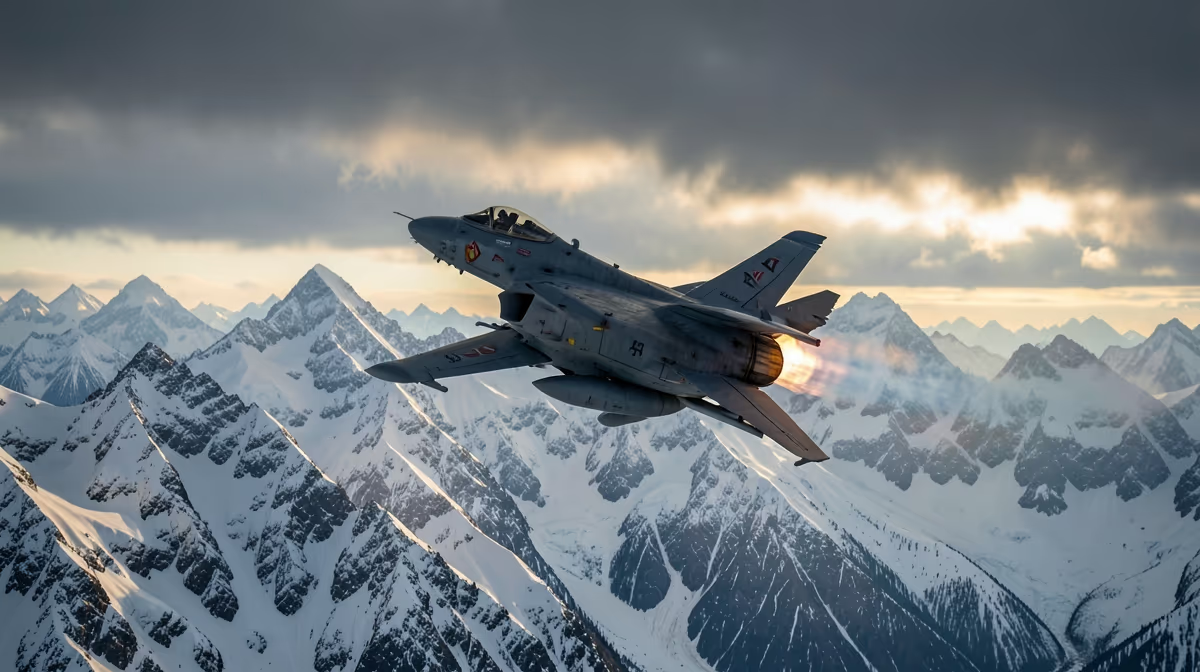
operation safed sagar remains a defining chapter in indian air force history, showcasing tactical brilliance during the 1999 kargil war. When disguised Pakistani soldiers and irregulars secretly crossed the Line of Control into the rugged mountain peaks of Jammu and Kashmir, they triggered a high-altitude crisis that would fundamentally alter modern military strategy.
Operation Safed Sagar, the Indian Air Force's pivotal air offensive during the 1999 Kargil War, deployed fighter jets and attack helicopters into the high-altitude terrain of Jammu and Kashmir to evict Pakistani intruders from strategic peaks. Initiated in May 1999, the operation marked a significant milestone in military history as air power was deployed at extreme altitudes exceeding 10,000 feet, presenting unprecedented aerodynamic challenges due to thin air and rugged topography. MiG-27s, MiG-21s, and later Mirage 2000 jets played a crucial role in precision-bombing enemy supply camps, bunkers, and logistics hubs established on heavily fortified mountain ridges.
The deployment of the Mirage 2000 proved to be a game-changer, equipped with laser-guided bombs that successfully destroyed the heavily fortified command post of the Northern Light Infantry at Tiger Hill. Despite the loss of a MiG-21 and a MiG-27 due to enemy ground fire early in the campaign, the IAF adapted its tactics by flying at higher altitudes and utilizing advanced weaponry to minimize aircraft vulnerability while maximizing devastation to enemy positions. Operation Safed Sagar fundamentally transformed the operational doctrine of the Indian military, demonstrating the decisive impact of joint Army-Air Force synergy in conventional high-altitude warfare. The airstrikes severely degraded enemy morale, cut off critical supply lines, and paved the way for the ultimate ground victory achieved by the Indian Infantry in July 1999. Air Chief Marshal A.Y. Tipnis, who led the IAF during the conflict, noted that operation safed sagar was a unique and unprecedented test of our air power in hostile high-altitude environments, fundamentally redefining our operational readiness.
Background Context and Root Causes
The operational crisis had its roots in a severe miscalculation by the Pakistan Army leadership regarding the nuclear deterrence umbrella, assuming it would prevent India from launching a conventional counter-offensive across the Line of Control to evict infiltrators. During the winter of 1998 to 1999, clandestine infiltration of the Pakistani Northern Light Infantry and irregulars occurred across the Line of Control in the Kargil sector. This strategy was underpinned by civil-military discord between Prime Minister Nawaz Sharif and Army Chief Pervez Musharraf, where the civilian leadership was allegedly kept in the dark, leading to international diplomatic isolation for Pakistan once the operation exposed state sponsorship of terrorism. Local shepherds eventually discovered the intruders in May 1999, prompting the immediate launch of the Indian Army Operation Vijay and the Indian Air Force operation safed sagar.
Operational Execution and Strategic Weapons
Operating at extreme altitudes of over 15,000 feet created massive challenges, as thin air reduced aircraft engine power and made target identification difficult. Because traditional bombing runs were risky and ineffective in the steep terrain, pilots used precision airstrikes and rocket attacks. Fighter jets like the MiG-21, MiG-23, MiG-27, and Mirage 2000, along with Mi-17 and Mi-35 attack helicopters, flew daring missions through narrow valleys to strike enemy supply bunkers. These aircraft operated from high-altitude airbases including Srinagar, Avantipur, and Adampur. Pilots faced severe challenges including thin air, unpredictable weather, anti-aircraft missile threats like Stinger surface-to-air missiles, and the strict political directive not to cross the Line of Control, which left very narrow margins for tactical maneuvers.
Geopolitical and Economic Fallout
The conflict marked the first direct conventional conflict between two declared nuclear states, which compelled the United States under President Bill Clinton to intervene diplomatically, forcing Pakistan into an unceremonious withdrawal and shifting United States strategic calculus toward India. A critical element of the strategic narrative involved electronic intelligence and intercepted communications, specifically the Musharraf-Aziz audio tapes, which provided India decisive narrative control to prove Pakistani military involvement to the global community. Economically, the conflict imposed a substantial fiscal burden on India defense budget for emergency procurement of precision-guided munitions and high-altitude gear, which was offset by a long-term surge in domestic defense modernization and capital expenditure.
Timeline of Conflict
The timeline of the conflict progressed rapidly from initial clandestine movements to intense combat and diplomatic resolution. During the winter of 1998 and 1999, the clandestine infiltration took place across the Line of Control. In May 1999, local shepherds discovered the intruders, leading to the launch of Operation Vijay and operation safed sagar. Throughout June and July 1999, intense high-altitude air and ground combat unfolded, culminating in intense international diplomatic pressure on Pakistan and the eventual withdrawal of intruders. On July 26, 1999, the official end of the Kargil conflict was declared, a date commemorated annually as Kargil Vijay Diwas.
Frequently Asked Questions
What was Operation Safed Sagar during the Kargil War?
Operation Safed Sagar was the code name assigned to the Indian Air Force combat role during the 1999 Kargil War. It involved providing crucial close air support to the Indian Army to neutralize Pakistani intruders entrenched in the high-altitude peaks of Kargil. This marked the first time air power was deployed in such extreme high-altitude terrain.
When was Operation Safed Sagar launched?
Operation Safed Sagar was officially launched on May 26, 1999, shortly after the Indian Army initiated Operation Vijay to clear the Kargil sector of infiltrators. The IAF swiftly mobilized its fighter jets and attack helicopters to strike heavily fortified enemy positions. The operations continued until the intrusion was successfully repulsed in July 1999.
Which aircraft were used in Operation Safed Sagar?
The IAF deployed a variety of aircraft, including MiG-21, MiG-23, MiG-27, and Mirage 2000 fighters, along with Mi-17 and Mi-35 attack helicopters. The Mirage 2000 proved particularly effective due to its ability to drop laser-guided bombs with high precision on enemy bunkers. These aircraft operated from high-altitude airbases like Srinagar, Avantipur, and Adampur.
What were the major challenges faced during Operation Safed Sagar?
The primary challenge was operating in extremely rugged, mountainous terrain at altitudes exceeding 10,000 feet, which severely limited aircraft performance and payload capacities. Pilots had to contend with thin air, unpredictable weather, and the risk of Stinger surface-to-air missiles fired by the enemy. Additionally, the strict political directive not to cross the Line of Control left very narrow margins for tactical maneuvers.
What was the outcome of Operation Safed Sagar?
Operation Safed Sagar played a decisive role in the Kargil War by systematically destroying enemy supply camps, ammunition dumps, and command bunkers situated on inaccessible peaks. The relentless aerial bombardment severely demoralized the infiltrators and significantly reduced casualties for the Indian Army on the ground. It demonstrated the vital synergy between air and land forces in modern mountain warfare.
Who commanded the Indian Air Force during Operation Safed Sagar?
During Operation Safed Sagar, Air Chief Marshal Anil Yashwant Tipnis served as the Chief of the Air Staff, leading the overall strategy and deployment of the IAF. Under his leadership, the air force adapted quickly to the unprecedented challenges of high-altitude combat. Their strategic strikes were instrumental in turning the tide of the conflict in India favor.
Conclusion
Operation Safed Sagar stands verified as a monumental turning point in military aviation history, proving that air power can be effectively adapted to extreme high-altitude mountain warfare. The coordinated efforts of the Indian Air Force and the Indian Army successfully dismantled deeply entrenched supply lines and neutralized fortified enemy positions across the Batalik and Drass sectors. Verified historical records and strategic analyses confirm that the deployment of advanced fighter aircraft and precision munitions was essential in achieving the ultimate objective of clearing the Line of Control. As military historians and defense analysts continue to study the lessons of 1999, the operation remains a foundational reference for joint-service tactical coordination in rugged Himalayan terrain.


.webp)
