
spacex stock developments reveal a massive shift in space technology
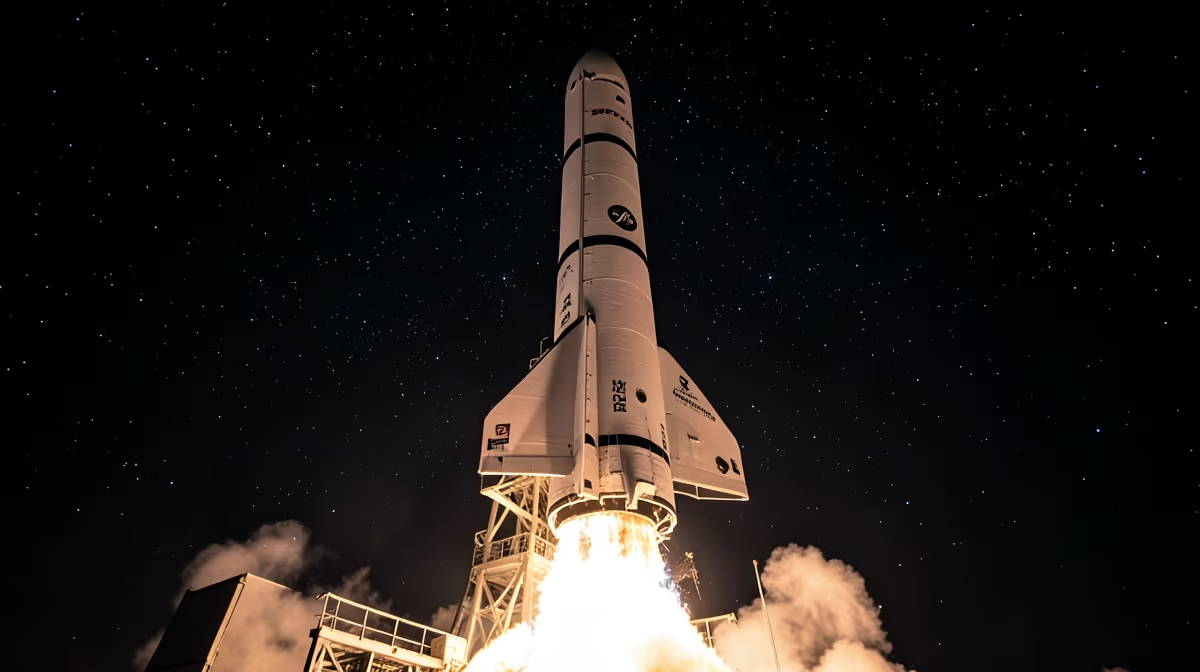
spacex stock remains a hot topic for investors looking to gain exposure to Elon Musk's aerospace company. The market fascination surrounding spcx stock, the broader space x stock price, and related space-tech equities highlights a fundamental shift in how commercial space infrastructure and orbital dominance are financed and managed. SpaceX, formally known as Space Exploration Technologies Corp., is a private American aerospace manufacturer and space transportation services company. Founded by Elon Musk in 2002, the company has grown from a risky startup into the dominant force in the global space industry, regularly launching rockets, cargo, and astronauts. Recently, the company has been making major headlines for its ambitious Starship program, aiming to create a fully reusable rocket system capable of carrying humans to the Moon and Mars. Alongside this, its Starlink satellite internet constellation continues to expand rapidly, providing high-speed internet to millions of users worldwide, particularly in remote and underserved areas.
Launch Operations And Recent Milestones
SpaceX successfully launched another batch of 23 Starlink internet satellites into low-Earth orbit from Space Launch Complex 40 at Cape Canaveral Space Force Station in Florida on Tuesday, marking the company's 85th orbital flight of the year. The Falcon 9 first-stage booster, completing its 14th flight, successfully touched down on the droneship Just Read the Instructions stationed in the Atlantic Ocean approximately 8.5 minutes after liftoff. This mission continues SpaceX's rapid cadence of launches aimed at expanding its global satellite internet constellation. Engineers confirmed that the 23 satellites were successfully deployed into low-Earth orbit approximately 65 minutes after launch, joining the thousands of operational spacecraft currently providing broadband coverage worldwide. Regulatory bodies and maritime authorities had cleared the airspace and shipping lanes prior to the scheduled window. The Federal Aviation Administration continues to monitor launch operations under existing commercial space transportation licenses, ensuring adherence to safety protocols. SpaceX has maintained a steady operational tempo despite ongoing regulatory reviews regarding its larger Starship vehicle testing program in Texas. While no formal post-launch press conference was held, a SpaceX mission controller announced during the live broadcast at main engine cutoff that stage 1 separation is confirmed and the successful landing of the Falcon 9 booster marks another milestone for their reusable rocket fleet.
Core Architecture And Historical Evolution
Before SpaceX, space exploration was almost entirely funded by governments and dominated by massive defense contractors using expensive, single-use rockets. SpaceX disrupted this monopoly by successfully developing the Falcon 1 and Falcon 9 rockets, achieving the world's first orbital-class rocket vertical takeoff and landing, and becoming the first private company to send humans into orbit. The company was founded in 2002 by billionaire entrepreneur Elon Musk with the specific goal of reducing space transportation costs. By pioneering reusable rocket technology, the company drastically changed the economics of space travel. It operates Starlink, which is the world's largest satellite constellation providing global internet coverage, and holds multi-billion dollar contracts with NASA to resupply the International Space Station and transport astronauts. Furthermore, it is actively developing Starship, the largest and most powerful rocket ever built, which is designed for deep space exploration. This operational framework has fundamentally reshaped the global aerospace economy by proving that private companies can build and launch rockets much cheaper and faster than traditional government agencies. Its technology is reshaping modern telecommunications through global satellite internet and is currently the primary vehicle for NASA's return of American astronauts to the Moon, effectively kicking off a new space race that directly impacts everyday consumers in remote areas relying on Starlink, NASA and government space agencies, global telecommunications companies, and taxpayers benefiting from lower commercial space launch costs.
Economic And Geopolitical Dynamics
The root cause of this industry transformation is the aggressive privatization of critical space infrastructure and orbital dominance by a singular corporate entity, fundamentally shifting national security dependencies from traditional defense contractors to commercial agility. This shift introduces complex political angles, including bipartisan tension between traditional military-industrial complex lobbyists and the executive branch favoring disruptive space policy, resulting in regulatory capture debates and congressional oversight battles. Economically, monopoly control over launch services drastically lowers the cost-per-pound to orbit while creating an insurmountable barrier to entry for global competitors, coupled with Starlink's disruption of global telecommunications and sovereign internet infrastructure. On the geopolitical front, this creates a scenario of privatized geopolitics where foreign policy decisions, sovereign communications, and military operations in conflict zones such as Ukraine increasingly rely on the unilateral decisions of a private billionaire CEO. Additionally, a hidden angle involves the deep integration of intelligence agency reconnaissance payloads within commercial satellite constellations, blurring the legal boundaries of civilian infrastructure under the Geneva Convention and international space law. Historically, this mirrors the Dutch East India Company's rise as a corporate-sovereign entity wielding quasi-governmental military and economic power during the 17th-century spice trade monopoly. The timeline of this dominance includes NASA awarding Commercial Resupply Services and Commercial Crew contracts to SpaceX, bailing out the struggling startup, followed by Starlink deployment beginning to establish dual-use commercial and military communication supremacy during global conflicts, and culminating in SpaceX achieving a near-total domestic launch monopoly that forces the Pentagon and intelligence agencies into unprecedented dependency.
Short Term Outlook And Risk Assessment
Looking at the immediate operational horizon, the next 24 hours will involve routine flight readiness reviews and regulatory updates regarding upcoming launch schedules. Moving into the 72-hour window, activities are expected to feature static fire tests or pre-launch countdown rehearsals at launch sites. Key players managing these developments include Elon Musk, NASA, and the FAA, with primary impact areas spanning commercial aerospace, global satellite communications, and defense logistics. Expert predictions point toward a continued cadence of orbital launches with incremental improvements in reuse technology. In the best-case scenario, the industry will see successful execution of scheduled orbital missions and regulatory approval for expanded flight operations. Conversely, the worst-case scenario involves a technical anomaly during pre-launch testing leading to temporary mission delays and regulatory scrutiny.
Frequently Asked Questions
What does SPCX stand for?
SPCX typically refers to a specialized financial ticker or acronym used in investment markets. It is often associated with specific exchange-traded funds or corporate entities tracking unique market sectors. Investors frequently search for this term to track its current performance and portfolio holdings.
How can I buy SPCX stock?
You can purchase shares of SPCX through any standard brokerage account that offers access to major stock exchanges. Simply log into your trading platform, search for the SPCX ticker symbol, and place a buy order during regular market hours. It is always wise to consult a financial advisor before making investment decisions.
What is the expense ratio for SPCX?
The expense ratio for SPCX represents the annual fee that funds charge their shareholders to cover operational costs. These fees are automatically deducted from the fund's assets, which can impact overall long-term returns. You can find the most up-to-date expense ratio directly on financial tracking websites or the issuer's official page.
What are the main holdings in SPCX?
The primary holdings of SPCX consist of the specific assets, equities, or financial instruments included in its portfolio. Fund managers regularly adjust these holdings based on market conditions and the fund's stated investment strategy. Detailed and current lists of these holdings are usually published daily on the provider's official website.
Is SPCX a good long-term investment?
Whether SPCX is a suitable long-term investment depends heavily on your individual financial goals, risk tolerance, and overall portfolio strategy. Past performance does not guarantee future results, so reviewing the fund's historical returns and underlying assets is crucial. Financial experts recommend diversifying your investments rather than relying on a single ticker.
Where can I find the latest news on SPCX?
You can find the latest news regarding SPCX on major financial news platforms like Yahoo Finance, Bloomberg, and MarketWatch. These platforms provide real-time stock quotes, analyst ratings, and press releases concerning the asset. Setting up stock alerts can also help you stay informed about significant price movements.
Conclusion
SpaceX continues to reinforce its dominant position in the global aerospace and commercial launch sectors through consistent operational execution, highlighted by the successful launch and recovery of its Falcon 9 booster and expansion of the Starlink constellation. While public market participants continue to search for avenues like spcx stock to gain exposure to the broader space economy, regulatory oversight by agencies such as the FAA remains a central factor governing future flight schedules and vehicle testing. As commercial space infrastructure matures, the ongoing cadence of orbital missions will dictate both the technological trajectory of reusable rocketry and its integration into global telecommunications and defense frameworks.


.webp)

