
Abhishek Sharma T20I hundred rewrite of history has stunned selectors
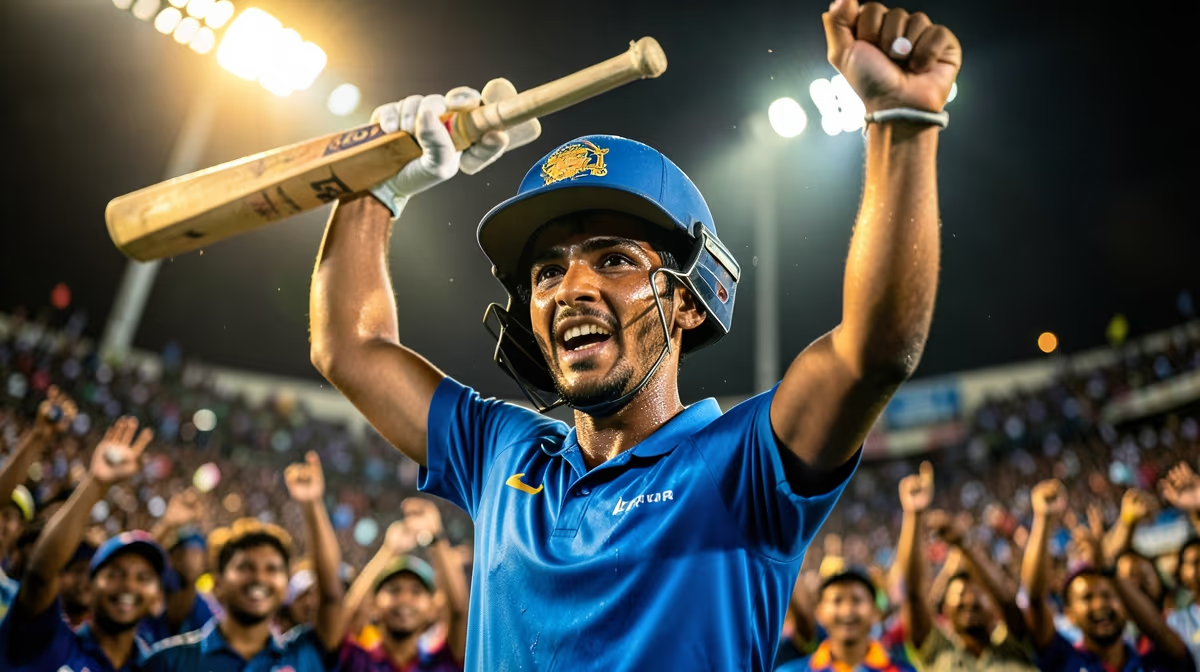
When field restrictions and bowling plans collide with unrestrained hitting power, international cricket occasionally witnesses an innings that fundamentally reshapes the sport. Indian cricket star Abhishek Sharma made history today by securing the fastest T20I hundred by Full Member batter in a thrilling display of power hitting against Afghanistan. Reaching his landmark off a mere 30 balls, the opening batsman unleashed an onslaught during the initial overs that left the opposition bowling unit entirely devoid of answers. This explosive performance not only electrified spectators and sports media worldwide but also set a groundbreaking benchmark for aggressive top-order play in white-ball cricket.
Abhishek Sharma reached his T20I century in just 30 balls against Afghanistan, setting the record for the fastest T20I hundred by a Full Member batter and achieving the highest individual score ever in a T20I powerplay.
The Anatomy of a Record-Breaking Powerplay
The foundation of this historic knock was laid during the mandatory powerplay overs, where fielding restrictions permit only two fielders outside the 30-yard circle. Taking full advantage of these constraints, Abhishek Sharma systematically dismantled the opposition's bowling strategy right from the first over. By executing a high-risk, high-reward approach, he combined raw power with calculated strokeplay to maintain an astonishing strike rate throughout his stay at the crease.
During this frantic opening spell, Sharma claimed the record for the highest individual score in a T20I powerplay. Rather than taking time to assess the pitch conditions, his modern approach prioritized immediate run-rate maximization. By attacking both pace and spin with equal conviction, he forced Afghanistan to repeatedly adjust their field placements and tactical bowling lines. Modern white-ball opening strategies dictate that maximizing field restrictions early can fundamentally tilt a match in a team's favor, and Sharma's masterclass provided a textbook demonstration of that doctrine.
Rewriting the Record Books: From Rohit Sharma to Sahibzada Farhan
Achieving a 30-ball century catapults Abhishek Sharma to the absolute peak of international cricket records. Prior to this match, Indian cricket's fastest T20I century record belonged to former captain Rohit Sharma. Abhishek's performance officially breaks Rohit Sharma's long-standing national milestone, cementing his own place in Indian athletic history. Furthermore, his relentless strokeplay allowed him to storm past Sahibzada Farhan, establishing unprecedented statistical dominance among Full Member nations.
| Statistic / Record Milestone | Details & Historical Context |
|---|---|
| Century Speed | Reached in 30 balls against Afghanistan |
| Full Member Record | Fastest T20I hundred by a Full Member batter |
| National Benchmark | Broke Rohit Sharma's record for India's fastest T20I century |
| Powerplay Achievement | Highest individual score recorded in a T20I powerplay |
| Comparative Milestone | Surpassed Pakistan's Sahibzada Farhan in T20I hitting rate |
This monumental accomplishment is particularly significant because ICC Full Member nations regularly compete against top-tier bowling attacks in high-pressure international environments. To achieve a 30-ball century under these competitive standards demonstrates a dramatic shift in how modern top-order batters approach international fixtures.
Root Causes and the Domestic Crucible
The underlying drivers behind Sharma's record-shattering innings extend far beyond a single afternoon of good fortune. Analysts point to the relentless evolution of aggressive T20 batting strategies, which are fundamentally nurtured through extensive domestic franchise league exposure. Young Indian batters now enter the international arena fully battle-tested against world-class bowling attacks, stripped of the hesitation that historically characterized major international appearances.
This fearless youth development framework within Indian cricket has established an ecosystem where high-risk hitting is systematically encouraged. A clear historical parallel can be drawn to Virender Sehwag's paradigm shift during the mid-2000s, when he redefined aggressive opening batting across both Test and ODI formats. Just as Sehwag forced global bowling strategies to adapt two decades ago, Sharma's 30-ball century demonstrates how a new generation is re-engineering opening expectations in T20 international cricket.
The Psychological and Technical Impact on Global Bowling
Beyond the statistical milestones, Sharma's systematic breakdown of Afghanistan's bowling attack reveals a critical psychological shift in modern white-ball cricket. Powerplay bowling attacks now face systemic demoralization when openers refuse to allow dot balls or defensive overs. When an opening batsman scores at such an unprecedented tempo, traditional bowling adjustments—such as altering lengths or changing field settings—often prove ineffective.
The relentless powerplay onslaught forces international bowling coaches to entirely re-evaluate their scouting reports and defensive preparations for subcontinental openers.
As international bowling units attempt to counter this sheer aggression, technical preparations will need to adapt. Coaches and analytics teams must develop fresh tactical blueprints to disrupt the rhythm of elite openers early in their innings, knowing that a failure to do so within the first six overs can effectively render a team's match-plan obsolete before the mid-innings break.
Selection Dynamics, Commercial Valuation, and Geopolitical Influence
From an administrative perspective, this record-breaking match winning innings presents significant implications for the Board of Control for Cricket in India (BCCI) and the national selection committee. Selectors face mounting pressure to maintain ultra-aggressive squad compositions while managing a smooth transition away from legacy line-ups. A historic performance of this magnitude makes it virtually impossible to overlook youth-centric, high-intent strategies for upcoming major international tournaments.
The economic and geopolitical angles of this achievement are equally pronounced:
- Surging valuations for global T20 broadcasting rights, where historic batting milestones directly translate into record viewership metrics.
- Elevated brand equity and commercial sponsorship opportunities for individual players achieving world-record milestones.
- Increased franchise auction valuations in global leagues seeking elite top-order power-hitters.
- Reinforcement of South Asian cricketing powerhouses in driving global audience engagement and expanding white-ball diplomatic sports leverage across Commonwealth nations.
Future Outlook: What Lies Ahead for India's Opening Blueprint
Over the next 24 to 72 hours, sports media coverage and international analytics will remain heavily focused on statistical breakdowns and match highlights of Sharma's knock against Afghanistan. Major sports news outlets—including Cricinfo, Hindustan Times, The Times of India, India Today, Telangana Today, and BBC—have widely confirmed the record-shattering nature of the innings. Subsequent rankings updates from international cricket bodies are expected to reflect this milestone, while media debate surrounding India's optimal T20 squad dynamics will intensify.
Expert analysis indicates that this performance will permanently solidify Abhishek Sharma's reputation as a premier powerplay hitter. In the best-case scenario, this record-setting innings serves as a catalyst for sustained elite form, boosting team confidence and establishing an untouchable standard for aggressive batting strategies. Conversely, the worst-case scenario involves the intense media spotlight and heightened public expectations creating undue pressure, potentially leading to performance inconsistencies in subsequent international fixtures. Regardless of short-term outcomes, the benchmark for opening powerplay batting has been permanently elevated.
Frequently Asked Questions
What milestone did Abhishek Sharma achieve in T20Is against Afghanistan?
Abhishek Sharma smashed the fastest T20I hundred by a Full Member batter, reaching the milestone in just 30 balls. This blistering innings also set a new record for the highest individual score in a T20I powerplay.
How does Abhishek Sharma's record compare to previous Indian records?
With his 30-ball century, Abhishek Sharma broke Rohit Sharma's long-standing Indian record for the fastest T20I hundred. The explosive knock showcased his incredible dominance at the top of the batting order.
Why is Abhishek Sharma's achievement significant for Full Member nations?
Sharma's innings is now recognized as the fastest T20I century ever recorded by a batter from an ICC Full Member nation. This feat elevates his status globally and highlights the ultra-aggressive approach modern openers are taking in the format.
Who was affected by Abhishek Sharma's record-breaking innings?
The Afghanistan bowling attack bore the brunt of Sharma's onslaught, struggling to contain the boundaries during the powerplay overs. Additionally, senior Indian batters like Rohit Sharma saw their previous speed records surpassed.
What specific records did Abhishek Sharma break during this match?
Aside from scoring the fastest T20I hundred by a Full Member batter off 30 balls, Sharma entered the record books for the highest individual score within a T20I powerplay. His remarkable stroke play dismantled bowling plans right from the first over.
What happens next for Abhishek Sharma following this record-breaking knock?
Following this historic performance, expectations will soar for Sharma to cement his place as India's premier T20I opener. Selectors and fans will look to see if he can maintain this aggressive template in upcoming international series.
Conclusion
Abhishek Sharma's 30-ball century against Afghanistan represents a watershed moment for modern white-ball cricket. By breaking Rohit Sharma's Indian record, storming past Sahibzada Farhan, and establishing the highest individual powerplay score in T20I history, he has set a new gold standard for openers globally. Moving forward, the national selection committee and team management will look to harness this uncompromising tactical blueprint as India prepares for future international assignments. While bowling attacks worldwide recalibrate their strategies, Sharma's record stands as a definitive testament to the fearless evolution of subcontinental power-hitting.
Sources
- Abhishek Sharma smashes fastest T20I hundred by a Full Member batter — Cricinfo
- Abhishek Sharma storms past Sahibzada Farhan after blistering batting against Afghanistan | Cricket — Hindustan Times
- Abhishek Sharma enters record books with highest individual score in T20I powerplay — The Times of India
- Abhishek Sharma hits 30-ball century, breaks Rohit Sharma's Indian record in T20Is — indiatoday.in
- Abhishek Sharma rewrites India’s fastest T20I century record — telanganatoday.com
- Abhishek Sharma hits 30-ball century for India against Afghanistan — BBC


.webp)


