
Supreme Court Emergency Docket Faces Sharp Scrutiny From Justice Jackson
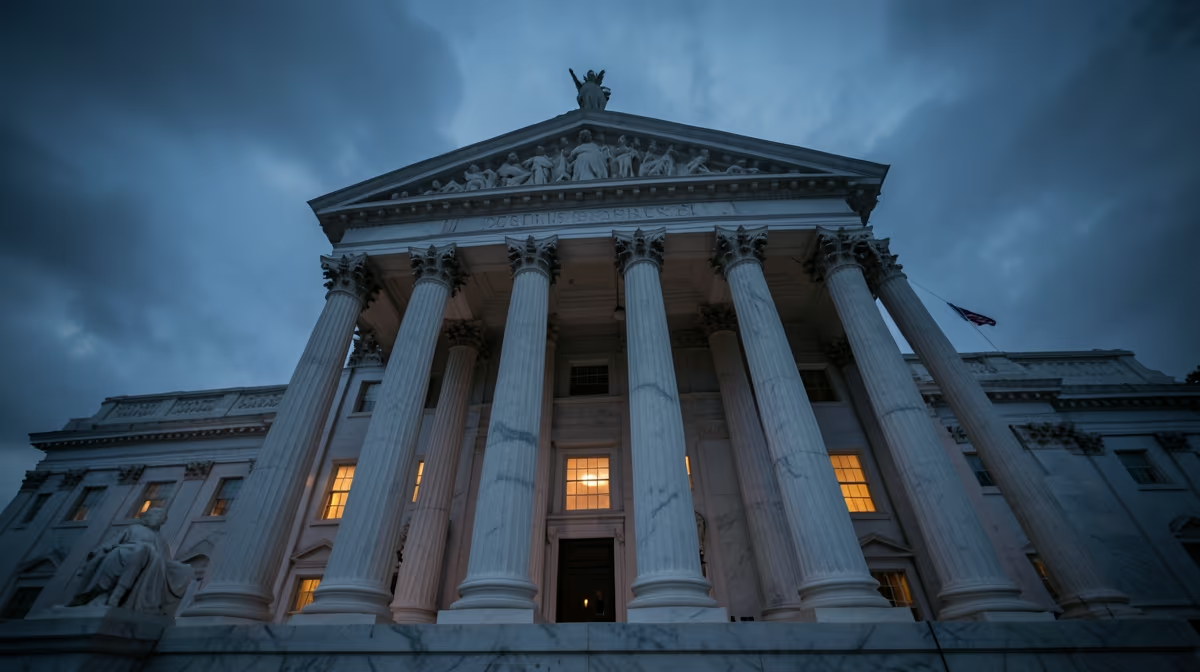
The inner workings of the nation’s highest court are rarely laid bare with such blunt institutional concern by one of its own members. When a sitting justice warns that the very mechanisms of law are becoming less restrained, the legal foundation of the country faces a moment of profound introspection regarding its consistency and transparency. Supreme Court emergency docket procedures have drawn intense public scrutiny following recent sharp criticisms from Justice Ketanji Brown Jackson, who suggests that the current trajectory of the court’s expedited rulings may be undermining the structural integrity of American jurisprudence.
Justice Jackson’s critique centers on the increasing frequency with which the court utilizes what is often called the shadow docket to resolve high-stakes legal disputes. This mechanism allows the justices to issue rapid, binding decisions without the traditional months of briefing, lower court deliberation, or public oral arguments that define the standard merit docket. By bypassing these established procedural safeguards, Jackson argues, the court risks making significant legal errors that could have been avoided through more rigorous and transparent deliberation. Despite these stark warnings, she has maintained a stance of institutional resilience, signaling a refusal to lose hope in the Supreme Court’s capacity to adhere to the rule of law.
The one sentence a reader must not miss: Justice Ketanji Brown Jackson warns that the Supreme Court has become "less restrained" in its use of the emergency docket, a shift that risks serious legal errors and threatens to diminish public trust in the judiciary.
The Mechanics of the "Shadow Docket" Controversy
The Supreme Court emergency docket was historically reserved for truly exceptional and time-sensitive circumstances. Traditionally, this fast-track process handled matters such as imminent executions or temporary stays on lower court rulings to maintain the status quo while a case moved through the regular appellate pipeline. However, in recent years, this traditional boundary has shifted significantly. Legal analysts and various media outlets, including Bloomberg Law and The Washington Post, have documented a trend where the court uses these expedited procedures to decide major, politically sensitive policy disputes that would normally require a full review.
The Procedural Shift from Restraint to Speed
Justice Jackson’s primary concern is that the court is no longer exercising the necessary restraint required for such a powerful legal tool. In her recent public remarks, she pointed out that the court’s frequent reliance on the emergency docket bypasses the thorough deliberation that has long been the hallmark of the American legal system. When significant legal questions are resolved in a vacuum of abbreviated briefings, the risk of creating inconsistent or poorly reasoned precedents increases.
This shift impacts more than just the litigants involved; it sets a nationwide standard with minimal public explanation. Unlike merit cases, which result in lengthy, signed opinions detailing the legal rationale of the majority, emergency orders are often brief and unsigned. This lack of transparency makes it difficult for lower courts and legal scholars to understand the precise reasoning behind a shift in law, leading to a landscape where the rules of the land can change abruptly and without clear justification.
Internal Friction and the Trump Mail-in Voting Order
The tension within the court became particularly visible in August 2026, when Justice Jackson issued a sharp dissent regarding an emergency order involving mail-in voting. She characterized the majority’s decision as a "serious legal error," highlighting how the expedited process failed to account for the complexities of election law and the reliance of voters on existing procedures. This specific instance serves as a case study for her broader argument: that rushing through complex constitutional questions often results in flawed outcomes that the court must then reconcile later.
| Date | Event | Key Outcome |
|---|---|---|
| August 25, 2026 | Mail-in Voting Order | Jackson critiques "serious legal error" in expedited ruling. |
| September 22, 2026 | Public Refusal to Lose Hope | Jackson emphasizes commitment to the rule of law despite concerns. |
| September 24, 2026 | Bloomberg Law Report | Reports indicate Jackson views the court as "less restrained." |
| September 25, 2026 | Broad Public Warnings | Multiple outlets report Jackson’s stance that "all is not well" on the docket. |
The critique suggests that the internal administrative strain on the court is growing. Clerkships and support staff are increasingly forced to process complex, sweeping emergency petitions at an unprecedented pace. This administrative burden, coupled with the ideological divisions among the justices, has created an environment where the "shadow docket" is no longer a rare exception but a central point of institutional friction.
Systemic Implications for Governance and Rule of Law
The expansion of the emergency docket carries implications that extend far beyond the courtroom. From an economic perspective, regulatory and corporate instability can arise when major policy shifts occur through abrupt emergency orders. Businesses and regulatory bodies rely on the predictability of long-term judicial review to plan and operate. When the Supreme Court issues a rapid ruling that halts a regulation or changes an election procedure overnight, it creates a volatile environment that can disrupt the broader economic landscape.
Global Perception of US Institutions
On a geopolitical level, international observers often monitor the stability of U.S. democratic institutions as a baseline for the rule of law. The perception that the highest court in the United States is circumventing its own deliberative processes could erode the perceived reliability of American governance. This erosion of trust is not just a domestic issue; it affects how the U.S. is viewed by allies and adversaries who look for consistency in the application of constitutional principles.
- Legal scholars worry that the shadow docket diminishes the role of lower appellate courts.
- Lawmakers are increasingly concerned about the lack of transparency in high-stakes policy decisions.
- Litigants in federal cases face uncertainty when precedents are set through expedited orders.
- The general public may perceive the judiciary as more political when decisions are made without full public debate.
Historical Parallels and Future Pressures
The current conflict over judicial procedure is not entirely without precedent. Analysts point to the New Deal era as a time when the Supreme Court faced similar institutional pressure and public scrutiny. During that period, the court’s handling of emergency economic legislation led to severe friction between the branches of government and within the court itself. The contemporary debate over the emergency docket reflects a modern version of this struggle, as the court balances the need for speed in a digital age against the timeless necessity of judicial restraint.
Jackson says all is not well on the Supreme Court emergency docket
The root cause of the current friction appears to be a deepening ideological division regarding the court's role in society. As the conservative majority utilizes expedited methods to address major legal questions, liberal justices like Jackson are pushing back, raising concerns about judicial legitimacy. This internal tug-of-war suggests that the "shadow docket" has become a primary battlefield for the soul of the institution.
What the Next 72 Hours Hold for the Judiciary
The immediate aftermath of Justice Jackson’s remarks is expected to involve continued legal commentary and media analysis. Within the next 24 hours, legal analysts will likely dissect her specific claims of "legal error" to determine how they might influence future petitions. Over the next 72 hours, broader discussions within the legal community are anticipated, focusing on potential procedural reforms and the need for increased transparency.
Experts predict an ongoing debate among legal scholars regarding the balance between rapid emergency rulings and traditional deliberation. The best-case scenario for the institution would be a constructive internal dialogue that leads to clearer criteria for what constitutes a genuine emergency. Conversely, the worst-case scenario involves deepened public and institutional friction, where the emergency docket is seen as a tool for judicial overreach rather than a necessary procedural safety valve.
The focus remains on whether the court will respond to these internal critiques by self-regulating its use of the shadow docket. While Justice Jackson's public denunciations have sparked a national conversation, the ultimate power to change the court's procedures lies with the majority of the justices themselves.
Frequently Asked Questions
What did Justice Ketanji Brown Jackson say about the Supreme Court's emergency docket?
Justice Ketanji Brown Jackson criticized the Supreme Court's frequent reliance on its emergency docket, stating that the court has become less restrained in how it handles urgent applications. She highlighted that all is not well with this process, expressing ongoing concerns about rushed decision-making.
Why does the Supreme Court's emergency docket matter?
The emergency docket allows the Supreme Court to issue rapid rulings on high-stakes legal disputes without the usual extensive briefing and oral arguments. Critics and justices alike argue that increased reliance on this shadow docket can lead to significant legal errors and reduce transparency in important national matters.
Who is affected by Justice Jackson's critique of the emergency docket?
The entire legal system, lower courts, and the public are affected by how the Supreme Court manages its emergency orders. When the highest court issues expedited rulings on major policies, it sets binding precedents nationwide with less deliberation than standard cases require.
What is the background of the Supreme Court's emergency docket controversy?
Often referred to as the shadow docket, the emergency process has historically been reserved for rare situations requiring immediate intervention, such as imminent executions or stays of lower court orders. In recent years, however, the court has increasingly used these expedited procedures to decide major controversial public policy issues.
What specific legal errors has Justice Jackson pointed out recently?
Justice Jackson has previously called out her colleagues for making serious legal errors in high-profile emergency rulings, such as decisions involving mail-in voting orders. She uses her opinions to draw attention to the flaws and potential dangers of rushing through complex constitutional questions without full review.
Conclusion
The public critique of the Supreme Court emergency docket by Justice Ketanji Brown Jackson marks a significant moment of internal transparency for the nation’s highest court. By labeling the court as "less restrained" and pointing to "serious legal errors" in expedited rulings, Jackson has placed the procedural health of the judiciary at the center of national debate. These developments underscore a growing tension between the need for rapid judicial intervention and the fundamental requirement for thorough, transparent deliberation. As legal scholars and the public continue to monitor the court's handling of future emergency petitions, the long-term impact on judicial legitimacy and the rule of law remains a critical area of concern. Whether these warnings will prompt internal reform or further entrench the current procedural divide will be a defining feature of the court's upcoming terms.
Sources
- Justice Ketanji Brown Jackson criticizes Supreme Court’s use of emergency docket — The Washington Post
- Ketanji Brown Jackson Refuses To Lose Hope In The Supreme Court — Above the Law
- Justice Jackson Denounces Supreme Court's Frequent Emergency Orders — Law.com
- Jackson says all is not well on the Supreme Court emergency docket — Courthouse News
- Jackson Says Supreme Court ‘Less Restrained’ on Emergency Docket — Bloomberg Law News
- Jackson rips into Supreme Court colleagues' 'serious legal error' on Trump mail-in voting order — Fox News


.webp)


