
Alabama Custom VR Exercises Are Reshaping How College Football Fixes Slumps
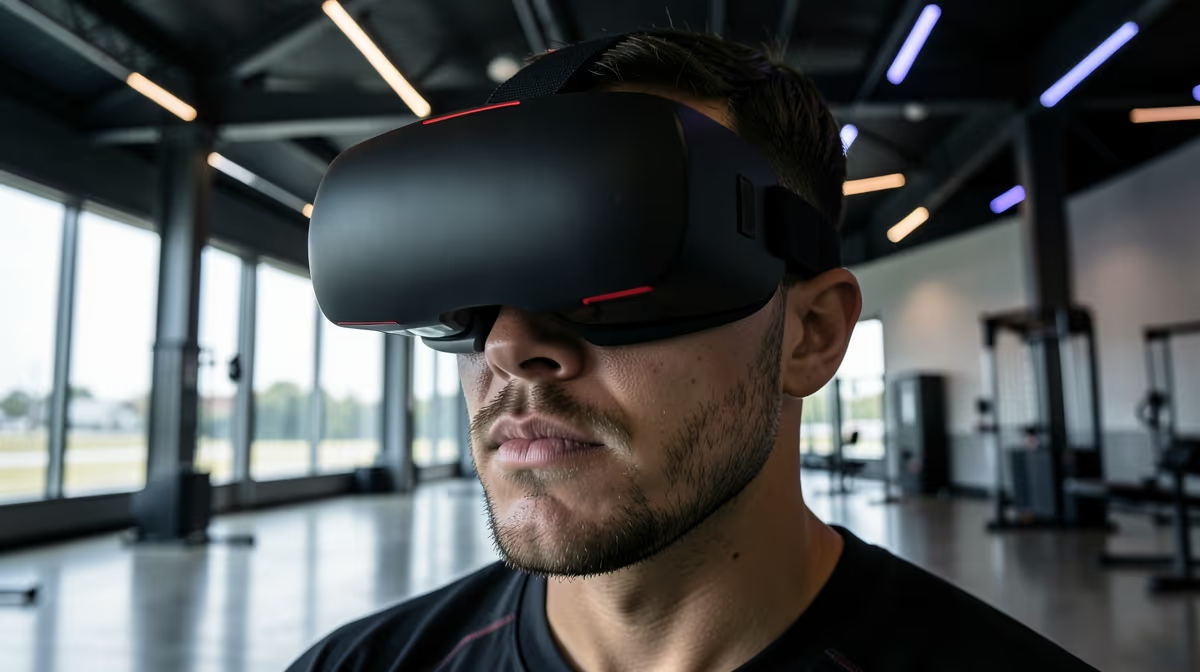
The margin between a championship drive and a stalled possession often rests on a single catch, a reality that the Alabama coaching staff is no longer leaving to chance. Alabama custom VR exercises are being deployed on the practice field to help address Ryan Coleman-Williams drop issues as the Crimson Tide prepares for upcoming matchups. This shift marks a significant departure from traditional sideline drills, moving the battle for technical perfection into a simulated, immersive environment. By utilizing covert technology to diagnose and correct mechanical flaws, the program is attempting to stabilize its offensive production through a blend of sports science and high-stakes athletic preparation.
The implementation of these virtual training modules comes at a critical juncture for the team. Earlier in the season, Coleman-Williams faced increasing scrutiny as a series of persistent dropped passes hindered the offense’s momentum. While physical talent was never in question, the consistency of his hand-eye coordination under pressure became a focal point for coaching interventions. The transition to virtual reality (VR) allowed the staff to isolate the root causes of these struggles—specifically spatial tracking and the mental processing required to secure the football in high-speed scenarios—without the physical wear and tear associated with extra on-field repetitions.
The deployment of covert VR technology suggests a broader industry trend where proprietary cognitive training regimens are treated as classified intellectual property to prevent rival programs from reverse-engineering competitive advantages.
The Digital Shift in Collegiate Athletics
The Alabama Crimson Tide football program has reportedly turned to high-tech virtual reality training to help wide receiver Ryan Coleman-Williams overcome a nagging issue with dropping passes. This move highlights how modern sports programs are increasingly blending traditional athletic coaching with cutting-edge technology like virtual reality to solve specific player slumps. In the hyper-competitive environment of the SEC, where every marginal gain is scrutinized, the use of Alabama football VR tech represents a strategic investment in cognitive performance.
The technology used is not a generic simulation but a series of custom-designed VR exercises. These simulations are tailored to mimic the specific trajectories, velocities, and game-day pressures that Coleman-Williams faces on Saturdays. By providing "mental reps," the VR software allows a player to experience the visual stimuli of a pass hundreds of times in a single session. This immersion helps in recalibrating the athlete's internal timing and tracking mechanisms, which are often the first things to falter during a technical slump or a loss of confidence.
The Mechanics of Cognitive Recalibration
The root cause of the performance dip was identified as a need to recalibrate Ryan Coleman-Williams’ spatial tracking and hand-eye coordination. In elite football, drops are rarely about a lack of physical strength; they are often the result of a microscopic breakdown in the focus required to see the ball into the hands while anticipating contact. The Alabama coaching staff sought unconventional technological interventions to address these critical moments.
Addressing Focus and Coordination
This technological approach appears to have yielded positive results. By creating a controlled environment where the "drop issues" could be analyzed frame-by-frame, the staff could show Coleman-Williams exactly where his tracking was failing. This empirical feedback loop is something that traditional film study can describe, but only VR can allow an athlete to "feel" and correct in real-time.
The Spider-Man Effect: From Practice to Performance
The results of the VR intervention became apparent almost immediately on the field. Following the implementation of the specialized training regimen, Coleman-Williams expressed a radical shift in his confidence. In a statement that quickly went viral among the fanbase, he described feeling "literally like Spider-Man" after fixing the issues that had plagued his early-season performance. This humorous comparison underscores a serious psychological breakthrough; the feeling of the ball "sticking" to his hands is the direct outcome of the cognitive sharpening provided by the VR sessions.
Recent touchdowns have carried extra meaning for both the player and the program. These scores are not just additions to the stat sheet; they are proof-of-concept for the VR training method. As Coleman-Williams maintains his improved catch rate and elevated confidence, the Alabama offense gains a more dangerous and reliable weapon downfield. This reliability is essential for the team's quarterback play, including the chemistry with players like Keelon Russell, as a dependable receiving corps allows for more aggressive play-calling and deeper vertical threats.
Economic and Political Drivers of Tech Adoption
The decision to use covert technology is not merely a coaching choice; it is influenced by the broader economic and political landscape of elite college football. There is immense internal pressure within top-tier programs to maintain competitive dominance. Coaching job security is increasingly tied to the ability to leverage proprietary technological edges. In Tuscaloosa, the multi-million dollar investments in athletic infrastructure and sports tech vendor partnerships highlight how marginal performance gains directly translate to program valuation.
The globalization and commercialization of American college football create exportable sports-technology models, as foreign leagues and Olympic federations observe U.S. collegiate methodologies for cognitive athletic training.
From an economic perspective, fixing a high-profile player’s technical issues has long-term financial implications. Reliable performance on the field increases a player’s future NFL draft capital, which in turn boosts the program’s reputation for player development. This reputation is a primary driver in recruiting elite talent like Keelon Russell and maintaining high merchandising revenue. The adoption of these VR methods is a clear signal that Alabama is treating athletic performance as a data-driven science, much like the "Moneyball" shift in Major League Baseball.
Timeline of the Technological Intervention
The timeline of Coleman-Williams’ recovery and the revelation of the VR tech suggests a rapid and effective response by the Alabama staff to a growing problem.
| Period | Key Development |
|---|---|
| Early October 2026 | Media reports surface regarding Ryan Coleman-Williams struggling with notable pass drops. |
| October 6-7, 2026 | Improved performance and crucial touchdowns signal a shift in the player's trajectory. |
| October 9, 2026 | ESPN and other outlets report that Alabama used custom VR exercises to resolve the issues. |
| October 10, 2026 | Details regarding the "covert" nature of the VR technology and player reactions are publicized. |
This sequence shows a program that identified a weakness and deployed a high-tech solution in a matter of weeks, rather than waiting for a player to "work through it" via traditional, and potentially less effective, means.
Forecasting the Future of Performance Analytics
As the success of Alabama’s intervention becomes more widely known, analysts expect an increased adoption and experimentation with custom virtual reality exercises across both collegiate and professional sports. The best-case scenario for the Crimson Tide is that Coleman-Williams maintains his current trajectory, cementing the VR training method as a groundbreaking tool for athletic skill correction. If his catch rate remains high through the remainder of the SEC schedule, other programs will likely scramble to implement similar proprietary cognitive training regimens.
However, there remains a degree of skepticism among some tech analysts. The worst-case scenario involves the technological solution proving to be a short-term psychological boost rather than a permanent mechanical fix. If pressure-induced drops return in high-stakes playoff or championship games, it may suggest that while VR can aid in skill recovery, it cannot entirely replace the organic development of a player’s "hands" under live fire. For now, the "Spider-Man" results suggest that Alabama has found a potent new weapon in the digital arsenal of sports science.
Frequently Asked Questions
How did Alabama fix Ryan Coleman-Williams' drop issues?
Alabama reportedly utilized custom virtual reality (VR) exercises and covert technology to help the receiver correct his problems with dropping passes. By simulating high-pressure game scenarios digitally, the coaching staff found an innovative way to improve his focus and catching consistency.
Why do the custom VR exercises matter for the Alabama Crimson Tide?
Addressing drop issues is crucial for maintaining an explosive offense and keeping drives alive in high-stakes SEC competition. The successful implementation of VR technology highlights how modern training methods can directly translate to on-field production and scoring.
Who is affected by Ryan Coleman-Williams fixing his drop issues?
Ryan Coleman-Williams and the entire Alabama Crimson Tide offense benefit significantly from this technical adjustment. With improved reliability in the receiving corps, the team gains a more dangerous weapon downfield.
What did Ryan Coleman-Williams say after resolving his drop problems?
Following his return to form and recent touchdown performances, Coleman-Williams humorously compared his enhanced catching abilities to being "literally like Spider-Man." This reflects his renewed confidence on the gridiron after overcoming early-season struggles.
What is the background of Ryan Coleman-Williams' recent performance struggles?
Earlier in the season, the talented receiver faced scrutiny over a series of dropped passes that hindered offensive momentum. Coaches worked behind the scenes utilizing advanced technological tools to diagnose and correct the underlying tracking or concentration issues.
What happens next for Ryan Coleman-Williams and Alabama?
With his confidence restored and his mechanics fine-tuned through VR training, Coleman-Williams is expected to play an even larger role in Alabama's game plan moving forward. The Crimson Tide will look to leverage his reliable hands as they navigate the remainder of their schedule.
Conclusion
The Alabama Crimson Tide's use of custom virtual reality exercises to address Ryan Coleman-Williams' drop issues represents a pivotal moment in the intersection of sports and technology. By identifying the root cause of the receiver's struggles as a cognitive tracking issue and addressing it through immersive simulation, the program has successfully restored the confidence and performance of a key offensive asset. The "Spider-Man" effect on the field serves as a powerful testament to the efficacy of these modern training methods. As the sports world watches the continued success of this intervention, the broader implications for player development, intellectual property in coaching, and the economic value of sports-tech partnerships will likely reshape how elite programs prepare for the future of the game. Ryan Coleman-Williams' journey from scrutiny to digital recovery may well be the blueprint for the next generation of athletic excellence.
Sources
- Alabama thinks it has found and fixed Ryan Coleman-Williams' drop issues — ESPN
- Alabama Used Covert Technology To Fix Ryan Coleman-Williams' Problem With Dropping Passes — BroBible
- Alabama Crimson Tide Just Got GREAT Ryan Williams News — Yahoo Sports
- Alabama's Ryan Coleman-Williams Says He's 'Literally Like Spider-Man' After Fixing Drop Issues — Bleacher Report
- Alabama reportedly used custom VR exercises to fix Ryan Coleman-Williams’ drop issues — Saturday Down South
- Why Ryan Coleman-Williams’ latest touchdown had extra meaning — AL.com


.webp)
