
Dow Rises More Than 500 Points As Big Money Leaves AI Trade
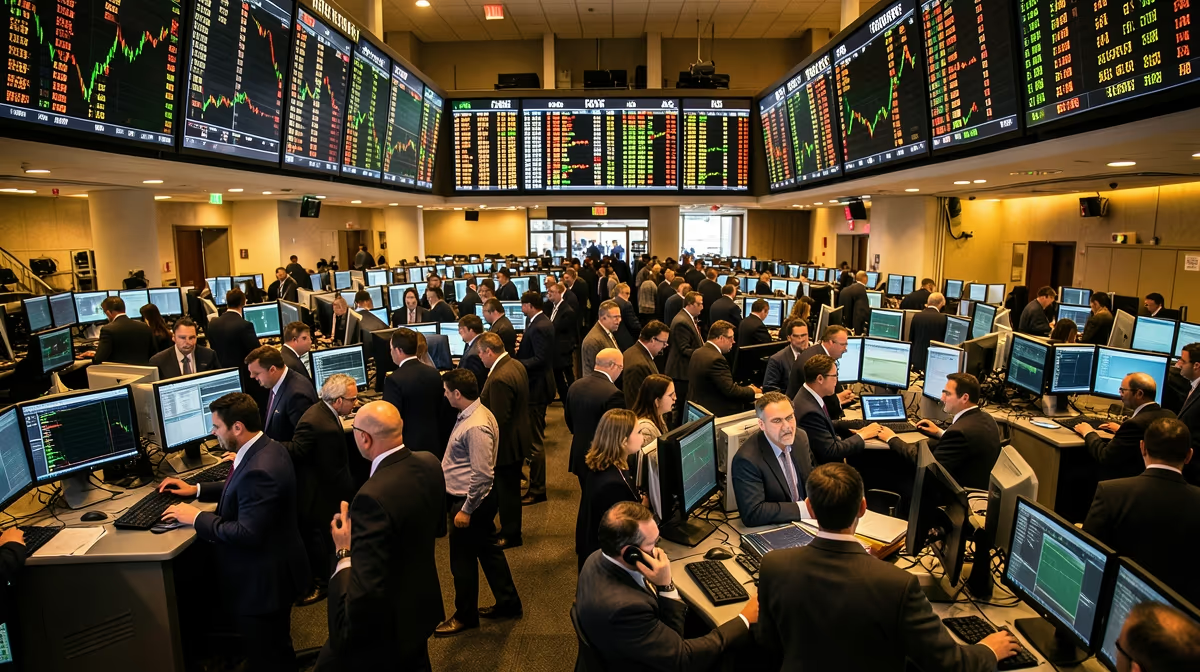
The sudden migration of billions of dollars from high-flying technology sectors into the bedrock of traditional retail signals a potential recalibration of the global financial hierarchy. Today, the Dow rises more than 500 points as a major shift occurs across global financial markets, marking a day where the industrial and retail components of the index finally stepped out of the shadow of the artificial intelligence trade. On Thursday, October 15, 2026, the Dow Jones Industrial Average experienced this significant surge as investors actively reallocated capital, suggesting that the singular focus on AI-driven growth may be facing its first true diversification test. This movement underscores a pivotal moment where the capital that once fueled the relentless ascent of high-tech firms is now finding a home in the foundational pillars of the American economy.
The sudden 500-point jump in the Dow reflects a fundamental shift where investors are prioritizing traditional blue-chip stability over speculative AI growth, suggesting a broader return to fundamentals-based investing.
The Mechanics of the 500-Point Surge
The Dow Jones Industrial Average rose more than 500 points in mid-October 2026 as investors rotated away from the artificial intelligence trade, lifting major stock indexes higher. This transition was not merely a reaction to a single day of trading but appeared to be a calculated move by institutional and retail investors alike to mitigate risks associated with the high volatility of the tech sector. While the tech-heavy indexes have dominated the headlines and market gains for a long time, the momentum on Thursday was driven by a different set of players.
Instead of pouring all their money into tech and artificial intelligence companies, investors started shifting their cash toward other areas. This kind of shift shows that investors are spreading their bets across different industries rather than relying solely on the tech sector to carry the stock market. Financial reports and live updates throughout the day confirmed that major US stock indexes closed higher as trading concluded across New York stock exchanges, proving that the appetite for equities remains strong, even if the preferred sector is changing.
Broadening the Rally Beyond Tech Giants
A key driver of the day’s performance was the notable strength of consumer-facing giants. Share gains from major traditional companies like Nike and Walmart contributed significantly to the upward movement. These blue-chip entities, often viewed as defensive or value-oriented, provided the necessary weight to push the Dow to its 500-point gain. When investors rotate away from a single dominant sector like AI and into traditional retail and consumer goods, it shows a healthier, more balanced stock market. It means that everyday companies can drive growth, which often gives a more accurate picture of the broader economy beyond just tech giants.
The rally was particularly impressive because it occurred in the face of ongoing instability elsewhere. Wall Street muscled higher overall despite continued swings and volatility in AI-related stocks. This suggests that the broader market segments are now robust enough to rally independently of the technology sector's performance. For retail investors and those with retirement accounts or index funds tied to the Dow, this diversification provides a layer of protection against the sharp corrections often seen in speculative trades.
Institutional Fatigue and the Return to Fundamentals
According to market analysts, the root cause of this shift is a significant rotation of capital away from overheated artificial intelligence sectors into more traditional defensive and value stocks. This sudden surge might indicate institutional fatigue with speculative tech valuations, quietly signaling a broader return to fundamentals-based investing across major US exchanges. After months of record-breaking runs driven by AI promises, the market appears to be reassessing whether those valuations are sustainable in the current economic climate.
This transition highlights an economic angle where investors are actively rebalancing portfolios. By capitalizing on steady gains from companies like Nike and Walmart, traders are attempting to mitigate the risks associated with the extreme price swings that have become characteristic of AI-related equities. The focus is shifting back to companies with clear revenue streams, consistent dividends, and a direct connection to the consumer economy.
Historical Context: Dot-Com Parallels and Portfolio Rebalancing
Market experts have pointed out a clear historical parallel to this current movement: the post-dot-com rotation in the early 2000s. During that era, capital moved out of speculative tech and into defensive value sectors after the initial tech bubble burst. While the current situation is not identical, the behavior of investors moving toward "safe haven" large-caps mirrors that previous cycle of market correction and stabilization.
The Macroeconomic and Geopolitical Dimension
The shift in market sentiment also carries a political and geopolitical angle. It highlights ongoing debates regarding economic stability, domestic corporate performance, and regulatory scrutiny surrounding high-flying technology giants. As global investors reassess US large-cap stability, these domestic market rotations reflect broader macroeconomic adjustments. The stability of the Dow is being viewed as a bellwether for the domestic economy amid persistent cross-border supply chain issues and ongoing technological shifts.
Sector Rotation Strategies
Stock markets frequently experience sector rotation, where investors move their money from one industry to another depending on economic conditions, valuations, or changing growth expectations. Tech and AI stocks have driven much of the market's recent gains, making periodic shifts into traditional defensive or retail stocks a common balancing act for Wall Street. This strategy helps balance portfolios and often broadens market rallies beyond just tech giants.
Mapping the Mid-October Market Shift
The following timeline details the progression of market sentiment and performance leading up to the close of New York stock exchanges on October 15, 2026.
| Date | Market Event |
|---|---|
| Tuesday, Oct 13, 2026 | S&P Global and market monitors review positioning across 30 US large-caps ahead of mid-month adjustments. |
| Thursday, Oct 15, 2026 (Morning) | Wall Street shows resilience and slight gains driven by retail and industrial components despite tech swings. |
| Thursday, Oct 15, 2026 (Afternoon) | The Dow Jones Industrial Average surges more than 500 points as the rotation away from the AI trade solidifies. |
Future Outlook: Capital Reallocation and Volatility
Looking ahead, the market is expected to remain in a state of transition. Over the next 24 hours, markets will likely continue to analyze the shift away from high-flying AI stocks toward traditional equities, keeping a close eye on the performance of companies like Nike and Walmart. Within the next 72 hours, investors will monitor broader macroeconomic indicators and quarterly data to determine if the rotation out of the tech sector represents a sustained reallocation of capital across US large-caps.
Analysts expect continued volatility in tech and AI-related stocks as capital flows into more defensive or traditional sectors of the market.
The best-case scenario involves a balanced market recovery where traditional blue-chip gains offset tech volatility, leading to steady and broad-based index growth. Conversely, the worst-case scenario could involve prolonged instability and sharp sell-offs in major indexes if AI trade corrections trigger broader market uncertainty that the retail and industrial sectors cannot fully absorb.
Frequently Asked Questions
Why did the Dow rise more than 500 points?
The Dow Jones Industrial Average surged over 500 points as investors actively rotated away from the heavily concentrated artificial intelligence trade. Money moved into other sectors of the market, such as retail and traditional equities, lifting major indexes.
What does rotating away from the AI trade mean for investors?
Rotating away from AI means investors are reallocating their portfolios out of high-flying technology stocks and into lagging or more defensive sectors. This strategy helps balance portfolios and often broadens market rallies beyond just tech giants.
Which specific companies contributed to recent stock gains?
Companies like Nike and Walmart saw notable share gains that contributed positively to the broader market's upward movement. Their performance helped support the Dow during a session characterized by continued volatility in tech and AI-related shares.
Who is affected by the shift away from artificial intelligence stocks?
Retail and institutional investors heavily concentrated in AI and tech equities are most impacted by these sudden sector rotations. Conversely, investors holding diversified portfolios containing consumer goods and traditional large-caps benefit from the rotation.
What happens next if investors continue moving away from AI?
If the trend persists, we could see sustained gains in traditional market sectors like retail, industrials, and finance while tech stocks experience continued consolidation. Market analysts will closely watch upcoming earnings reports to see if capital flight from AI is a short-term blip or a longer-term shift.
How did major US stock indexes fare overall during the recent trading session?
Major US stock indexes closed higher overall despite ongoing swings and volatility in artificial intelligence stocks. The resilience of the broader market demonstrated that buying interest extended well beyond the technology sector.
Conclusion
The surge of the Dow Jones Industrial Average by more than 500 points on October 15, 2026, marks a significant turning point in the mid-quarter market narrative. By rotating capital out of the heavily favored AI sector and into established giants like Nike and Walmart, investors have signaled a renewed interest in fundamental economic stability and portfolio diversification. While the technology sector continues to experience swings and uncertainty, the broader market's ability to muscle higher suggests a healthy broadening of the rally. Whether this investor rotation away from AI stocks into traditional equities will sustain long-term momentum remains to be seen, but for now, the shift highlights a return to a more balanced and representative economic picture on Wall Street. Markets will remain attentive to upcoming quarterly data and macroeconomic signals to judge the permanence of this capital reallocation.
Sources
- Dow rises more than 500 points as investors rotate away from AI trade: Live updates — CNBC
- Nike, Walmart Share Gains Contribute To Dow's 150-Point Jump — Moomoo
- How major US stock indexes fared Thursday 10/15/2026 — kens5.com
- Wall Street muscles higher despite more swings for AI stocks — WRAL
- Dow Jones Industrial Average Monitor postQ update – A look at 30 US large-caps — S&P Global
- New York stock exchanges close higher — Anadolu Ajansı


.webp)