
Eritrean Troops Enter Northern Ethiopia as Border Tensions Reach Critical Threshold
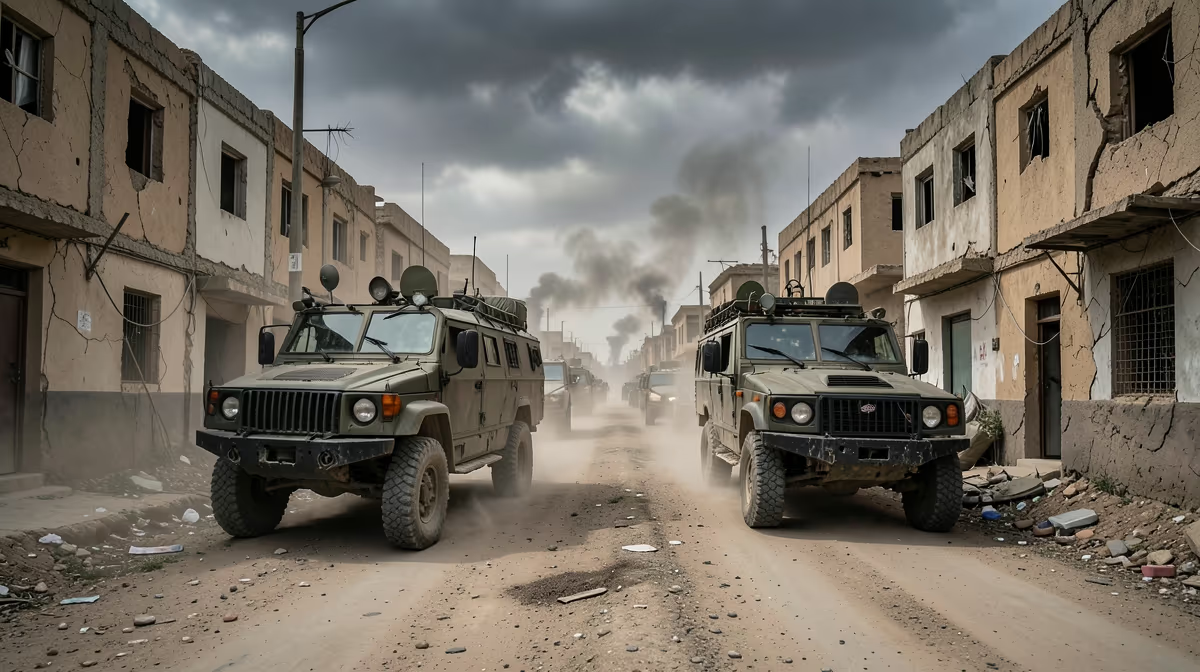
Witnesses in northern Ethiopian towns have described the sight of foreign military vehicles navigating urban streets, a physical manifestation of a rapidly deteriorating security architecture in the Horn of Africa. Recent reports confirm that Eritrean troops enter northern Ethiopia as conflict escalates across the region, threatening regional stability and forcing a sharp diplomatic response from Addis Ababa. This movement marks a significant departure from previous months of relative quiet, signaling that the friction between the two neighbors has reached a critical threshold that could redefine the geopolitical map of East Africa.
The Ethiopian government has formally accused Eritrea of an incursion and demanded an immediate withdrawal of all military forces from its sovereign territory.
This development follows a period of mounting tension and shifting alliances that have left Ethiopia increasingly isolated. The presence of Eritrean forces on Ethiopian soil is not merely a border skirmish but a strategic escalation that analysts suggest could draw in multiple regional powers. As the Ethiopian administration faces severe domestic pressure, its neighbors appear to be consolidating their positions, creating a volatile environment where a single miscalculation could trigger a wider regional war.
Escalating Tensions Along the Border
The current situation solidified on Wednesday, October 7, 2026, when witnesses reported seeing Eritrean military units driving through towns in northern Ethiopia. These movements were not subtle; they represented a clear projection of power into territory that the Ethiopian government maintains as its sovereign ground. In response to these reports, the Ethiopian government issued a formal accusation against Eritrea, categorizing the movement as a cross-border incursion. The demand for an immediate withdrawal highlights the breakdown in communication between the two states, which have a long and turbulent history of territorial disputes.
The geography of this incursion is particularly sensitive. Northern Ethiopia has already been the site of intense internal conflict, and the arrival of external troops adds a layer of complexity to an already fragile humanitarian situation. For civilians living in these border regions, the sight of foreign troops suggests that the domestic struggles of the past several years are now spilling over into an international confrontation.
Chronology of the Escalation
| Date | Event | Key Outcome |
|---|---|---|
| October 5, 2026 | Quadripartite Summit in the Region | Egypt, Sudan, Eritrea, and Somalia issue a joint declaration on Red Sea governance. |
| October 7, 2026 | Witness reports of troop movements | Eritrean troops are seen driving through northern Ethiopian towns. |
| October 7, 2026 | Ethiopian Official Demand | Ethiopia formally accuses Eritrea of incursion and demands immediate withdrawal. |
Implications for Regional Security and Abiy Ahmed
The political landscape for Prime Minister Abiy Ahmed has shifted dramatically as he begins a new term. While his administration has been focused on domestic stability and military advances in the Tigray region, the external environment has become increasingly hostile. Neighboring states are no longer observing from the sidelines; instead, they are forming blocks that appear designed to counter Addis Ababa’s regional ambitions.
The involvement of Eritrea is the most direct military challenge Ethiopia faces, but it is supported by a broader diplomatic realignment. The Ethiopian government now finds itself in a defensive posture, attempting to manage a potential two-front crisis: internal dissent and external incursion. This pressure is compounded by the economic reality of the conflict. Continued military escalation threatens to destabilize agricultural production in the north and divert scarce state funds away from national development projects toward an ever-expanding defense budget.
The Red Sea Littoral Alliance
The move by Eritrea does not exist in a vacuum. Just days before the incursion was reported, a significant diplomatic event took place involving the leaders of Egypt, Sudan, Eritrea, and Somalia. These four nations issued a joint declaration emphasizing that governance of the Red Sea should be exclusive to the states that border it—the littoral states. This declaration is a direct challenge to Ethiopia’s recent efforts to secure maritime access and its broader strategic interests in the Red Sea basin.
This new alignment suggests a collective effort to leverage the conflict in northern Ethiopia to counter the strategic ambitions of Addis Ababa. While the declaration focused on maritime security, its timing—just before the reported movement of Eritrean troops—indicates a synchronized effort to apply pressure on the Ethiopian state. The formation of this alliance introduces a volatile new front, drawing broader regional powers into a complex contest over maritime security and the dynamics of the Nile basin.
The sudden diplomatic alignment of Egypt, Sudan, Eritrea, and Somalia may be leveraging the northern Ethiopian conflict to collectively counter Addis Ababa’s strategic ambitions regarding the Grand Ethiopian Renaissance Dam.
Root Causes and Historical Parallels
To understand the current crisis, analysts point to the unresolved territorial disputes that have plagued the region for decades. The root cause of this escalation stems from shifting regional alliances surrounding the Tigray conflict and longstanding tensions over border demarcations. There is a palpable fear that the region is sliding back toward the conditions that led to the 1998-2000 Eritrean-Ethiopian War. That conflict similarly erupted from contested border territories and rapidly escalated into a full-scale conventional war that cost tens of thousands of lives.
The current escalation reflects several historical parallels: - Contested border territories being used as a catalyst for military movement. - Shifting alliances that leave one state feeling encircled by its neighbors. - The use of internal conflicts by external actors to gain a strategic foothold. - High levels of military readiness that make diplomatic de-escalation difficult.
Predicting the Fallout: The Next 72 Hours
The immediate future of the Horn of Africa depends on the diplomatic and military responses of the next 72 hours. In the short term, witnesses are likely to continue reporting troop movements as Eritrea solidifies its positions or tests the Ethiopian military's resolve. The Ethiopian government's demand for withdrawal has set a clear benchmark for success; anything less than a full retreat by Eritrean forces will likely be viewed as an act of war.
Expert predictions suggest that we are entering a phase of heightened military posturing. Analysts expect further diplomatic friction as the regional alliances led by Egypt and Somalia respond to the reported incursion. The best-case scenario involves a swift diplomatic intervention by neighboring littoral states or the African Union, preventing the situation from spiraling into a wider regional war. However, the worst-case scenario is far more dire: a full-scale military conflict between Ethiopia and Eritrea that draws in allied regional powers and destabilizes the entire Horn of Africa.
Geopolitical and Economic Risks
The stakes extend far beyond the borders of northern Ethiopia. The Red Sea is one of the world's most vital trade corridors, and any instability in the littoral states threatens the flow of global commerce. If the conflict between Ethiopia and Eritrea escalates, it could disrupt maritime security and lead to a broader internationalization of the war.
Furthermore, the humanitarian cost is expected to be severe. The border regions are already home to vulnerable populations who have suffered through years of instability. A new war would trigger mass displacement and exacerbate food insecurity, creating a crisis that would require a massive international response. Economically, the diversion of resources toward a conventional war would be catastrophic for the development goals of both nations, locking them into a cycle of debt and military spending.
Frequently Asked Questions
Why did Eritrean troops enter northern Ethiopia?
Witnesses and reports indicate that Eritrean troops drove through northern Ethiopian towns as regional tensions and conflict escalated. Ethiopia has officially accused Eritrea of an incursion and demanded an immediate troop withdrawal.
What is the background of the conflict escalation involving Ethiopia and Eritrea?
The recent escalation follows ongoing regional instability and strategic realignments in the Horn of Africa. Observers note that previous military advances in regions like Tigray created conditions where conflict could easily spill over borders.
Who are the key countries affected by the wider Red Sea geopolitical tensions?
Countries directly involved in regional diplomatic positioning include Egypt, Sudan, Eritrea, and Somalia. These nations recently issued a joint declaration emphasizing that Red Sea governance should be exclusive to littoral states.
What specific actions have African leaders taken regarding the Ethiopia conflict?
Four African leaders convened for a summit and issued a joint declaration as the war in Ethiopia intensified. The discussions covered broader regional security concerns, including Red Sea governance, Nile water issues, and relations with Ethiopia.
What does Ethiopia's government demand from Eritrea?
In response to the reported border crossings, the Ethiopian government formally accused Eritrea of an unauthorized incursion. Authorities are strongly demanding that Eritrean forces withdraw from northern Ethiopian territory immediately.
What happens next as tensions between Ethiopia and Eritrea escalate?
Diplomatic efforts are being closely watched by neighboring states and international observers to prevent a full-scale regional war. The joint stance taken by Egypt, Sudan, Eritrea, and Somalia adds a complex multilateral dimension to the ongoing crisis.
Conclusion
The entry of Eritrean troops into northern Ethiopia marks a dangerous pivot point for the Horn of Africa. What began as reports from local witnesses has quickly transformed into a formal diplomatic crisis, with the Ethiopian government demanding an immediate withdrawal of foreign forces. This military movement, set against the backdrop of a new strategic alliance between Egypt, Sudan, Eritrea, and Somalia, suggests that the conflict is no longer confined to internal Ethiopian politics. As the international community and the African Union look on, the coming days will determine whether diplomatic intervention can defuse the mounting tension or if the region will descend into a wider, more destructive conventional war. The focus now remains on the border regions, where the presence of foreign military hardware serves as a stark reminder of the fragile peace in East Africa.
Sources
- Eritrean troops drive through northern Ethiopian town, witnesses say — Reuters
- Ethiopia Accuses Eritrea of Incursion, Demands Troop Withdrawal — Bloomberg.com
- Egypt, Sudan, Eritrea and Somalia say Red Sea governance exclusive to littoral states — Sudan Tribune
- Egypt, Somalia, Eritrea and Sudan summit: Red Sea, Nile and Ethiopia — Somali Guardian
- Four African leaders issue joint declaration as Ethiopia war escalates — Al Jazeera
- As Abiy Ahmed starts new term, Ethiopia's advances in Tigray may cause conflict to spill over to Eritrea — DW.com


.webp)
