
FBI China Spy Arrest at LAX Uncovers Covert Surveillance Operation
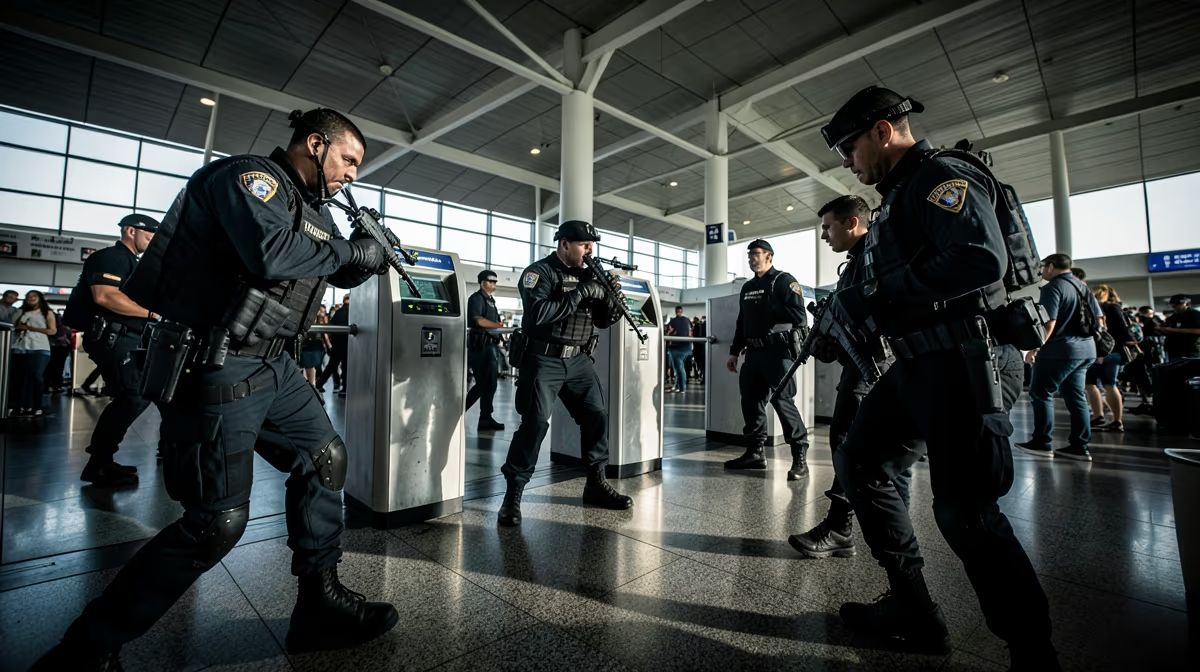
The quiet departure gates of Los Angeles International Airport became the stage for a high-stakes counterintelligence operation that may reshape perceptions of foreign influence on American soil. This enforcement action targets a sophisticated layer of surveillance directed at the highest levels of international leadership through local proxy networks. In a major national security development, the FBI China spy arrest LAX operation has led to the apprehension of an alleged foreign operative accused of monitoring one of the most sensitive political figures currently in the United States.
The arrest of a California-based realtor at LAX reveals a deepening strategy of using non-traditional civilian proxies to conduct localized surveillance on foreign officials and their families residing within the U.S.
Details of the LAX Arrest and Federal Charges
On the evening of Sunday, October 4, 2026, federal agents moved to intercept a suspect at Los Angeles International Airport (LAX) in a coordinated effort to disrupt an alleged foreign intelligence operation. The individual, identified as Wanying "Heather" Zhang, was taken into custody as she prepared to navigate the transit hub. Federal law enforcement officials have formally accused Zhang of acting as an illegal agent for the Chinese government, a charge that carries significant weight under U.S. national security statutes.
Zhang, a resident of Irvine, California, is alleged to have conducted covert activities on behalf of a foreign principal without the mandatory registration required by federal law. The operation was not a sudden occurrence but the culmination of an intensive investigation by the FBI and federal prosecutors into her activities within Southern California. The core of the government's case rests on allegations that Zhang utilized her position and local presence to facilitate intelligence gathering for Beijing, focusing specifically on individuals tied to the highest echelons of Taiwanese political power.
Targeting the Taiwanese President’s Son
The most alarming aspect of the federal complaint involves the specific target of Zhang’s alleged surveillance. Investigators state that Zhang was tasked with monitoring the movements and activities of the Taiwanese president's son while he was residing or traveling in the United States. This surveillance represents a direct extension of international political tensions into the domestic sphere of the U.S., highlighting a localized effort to track the family members of foreign leaders.
This case underscores the real and ongoing threat of transnational repression and foreign intelligence operations on U.S. soil, particularly how cross-strait tensions manifest locally.
The focus on the son of the Taiwanese president indicates a strategic interest by Chinese intelligence in the personal lives and security of Taiwan’s leadership circle. Such operations are often designed to gather leverage, understand personal vulnerabilities, or monitor the influence of foreign dissidents and political figures abroad. By surveilling a family member, the alleged operative provided Beijing with a window into the private lives of the Taiwanese executive branch, bypassing traditional diplomatic barriers.
The Profile of Wanying ‘Heather’ Zhang
Before her arrest, Wanying "Heather" Zhang appeared to be a well-integrated member of the Southern California community. A professional realtor based in Irvine, Zhang’s occupation provided a plausible cover for her presence in various neighborhoods and her interactions with a wide range of individuals. This profile is consistent with what analysts describe as a "non-traditional" operative—someone who does not hold a formal diplomatic title but is integrated into the local economy and social fabric.
The use of a real estate professional highlights a strategic economic angle in modern espionage. Real estate transactions and property management provide unique access to addresses, financial records, and the physical movements of residents. Federal officials suggest that Zhang’s role as a realtor may have been exploited to facilitate her surveillance activities, allowing her to monitor targets under the guise of commercial interests. This integration into the community makes detection by traditional counterintelligence methods significantly more challenging, as the operative operates in plain sight within the Chinese-American community.
Transnational Repression and Intelligence Tactics
The FBI China spy arrest LAX case is a prime example of what law enforcement calls "transnational repression." This occurs when a foreign government reaches across borders to silence, intimidate, or monitor people in another country. In this instance, the surveillance of a foreign leader's relative serves as a clear indicator of Beijing’s persistent efforts to gather intelligence on Taiwanese political leadership through localized proxy networks.
Proxy Networks and Community Integration
Historical Parallels
Regional and Geopolitical Fallout
The arrest comes at a time of heightened friction between Washington and Beijing, with the status of Taiwan remaining the primary point of contention. US-China relations are frequently tested by such incidents, and the revelation that a Chinese agent was actively surveilling the Taiwanese president’s son on American soil is expected to lead to significant diplomatic strain.
Impact on US-China Relations
Taiwanese Security Concerns
Operational Timeline of the FBI Investigation
The investigation into Zhang’s activities was a multi-phased effort that moved from initial suspicion to a targeted arrest.
| Phase | Activity |
|---|---|
| Surveillance Phase | Wanying ‘Heather’ Zhang allegedly engages in surveillance targeting the Taiwanese president's son. |
| Investigative Phase | Federal authorities and the FBI investigate the Irvine realtor, building a case regarding her ties to Chinese intelligence. |
| Arrest Phase | FBI agents intercept and arrest Zhang at LAX on charges of acting as an unregistered foreign agent. |
The Shifting Landscape of Foreign Espionage
The emergence of the Wanying Heather Zhang arrested story marks a shift in how counterintelligence is conducted in the 21st century. As foreign governments become more aggressive in their intelligence-gathering efforts, federal law enforcement must adapt to monitor individuals who do not fit the traditional "spy" mold. This case emphasizes that national security threats can emerge from within local business networks and suburban communities.
Furthermore, the legal consequences for failing to register as a foreign agent are severe. Under U.S. law, anyone acting on behalf of a foreign principal must disclose their relationship to the government. This transparency is intended to prevent covert influence operations. When individuals like Zhang bypass these laws, they face federal prosecution and significant prison sentences, reflecting the gravity with which the United States views unregistered foreign interference.
Future Outlook and Legal Proceedings
The legal battle following the Chinese intelligence US operation at LAX is only beginning. Over the next 24 hours, federal authorities are expected to provide more comprehensive details regarding the specific evidence against Zhang, and an initial court appearance is likely to be scheduled in a California federal court.
Within the next 72 hours, the investigation will likely expand to determine if Zhang was part of a larger network. Analysts suggest that investigators will probe her communications, financial records, and local associates in Irvine and the broader California area to see if other non-traditional operatives are active in the region.
The best-case scenario for diplomatic relations would see the case treated as an isolated counterintelligence matter. However, the worst-case scenario involves the discovery of a broader espionage network, which could lead to a severe escalation in tensions between Washington, Beijing, and Taipei. Regardless of the outcome, this arrest has already placed a spotlight on the hidden front lines of global geopolitics unfolding in the suburbs of California.
Frequently Asked Questions
What happened during the FBI arrest at LAX involving a Chinese agent?
FBI agents arrested Wanying "Heather" Zhang, a California resident from Irvine, at Los Angeles International Airport (LAX). She is accused of acting as an illegal agent of the Chinese government and conducting surveillance activities.
Who was the specific target of the surveillance conducted by the alleged Chinese agent?
Federal officials stated that the California woman targeted and surveilled the son of the Taiwanese president. The operation highlights ongoing concerns regarding foreign intelligence gathering within the United States.
Who is Wanying "Heather" Zhang?
Wanying "Heather" Zhang is a California realtor based in Irvine who has been accused by federal authorities of spying for China. Her arrest at LAX brought significant public attention to alleged covert operations targeting foreign officials' relatives on US soil.
Why does this FBI arrest matter for US-China relations and national security?
This case underscores heightened federal scrutiny regarding transnational repression and espionage efforts by foreign governments inside the United States. It emphasizes the risks faced by family members of foreign leaders residing or traveling abroad.
What legal charges or consequences does the Irvine woman face?
While specific details regarding her full indictment continue to unfold, individuals accused of acting as unregistered foreign agents face severe federal charges. Prosecutors typically pursue significant prison sentences upon conviction for espionage-related offenses.
What happens next in the case against the California realtor?
The suspect is expected to face formal federal court proceedings in California to address the allegations brought forward by the Department of Justice. Investigators will likely continue probing her communications and potential associates involved in the intelligence-gathering network.
Conclusion
The arrest of Wanying "Heather" Zhang at LAX serves as a stark reminder of the complexity of modern counterintelligence. By allegedly using her position as a local realtor to surveil the son of the Taiwanese president, Zhang represents a new breed of non-traditional operative that intelligence agencies must now actively monitor. As federal prosecutors move forward with the case, the focus will remain on the extent of the surveillance network and the broader implications for US-China-Taiwan relations. The coming days will reveal more about the evidence gathered by the FBI and how this development will impact the safety of foreign nationals living within the United States. In the interim, this operation stands as a significant victory for U.S. counterintelligence in its ongoing effort to combat transnational repression.
Sources
- FBI arrests alleged Chinese agent at LAX after she allegedly surveilled son of Taiwanese president — CBS News
- Who Is Wanying ‘Heather’ Zhang? California Realtor Accused of Being China Agent — Newsweek
- California woman arrested for spying for China and surveilling Taiwanese president’s son, officials say — CNN
- Irvine woman accused of spying for China arrested by FBI agents at LAX — ABC7 Los Angeles
- US accuses California woman of spying for China, surveilling Taiwan president's son — Reuters
- FBI arrests Irvine woman accused of acting as Chinese agent at LAX, feds say — NBC Los Angeles


.webp)
