
James Webb Telescope Pins Down Ancient Radio Signal From Deep Space
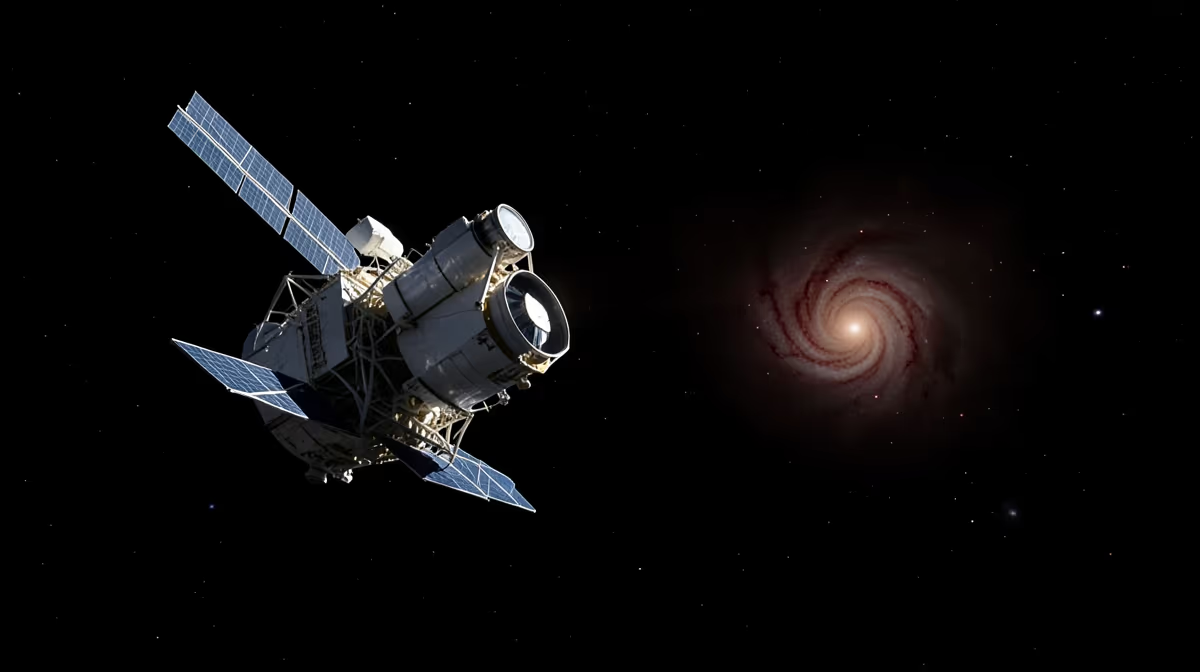
A pulse of energy that began its journey through the void 10 billion years ago has finally revealed its point of origin to a lens orbiting a million miles from Earth. This singular flash, lasting only a fraction of a millisecond, carries the signature of a universe in its infancy, long before the formation of our own solar system. Astronomers utilizing the **James Webb telescope pinpoints most distant fast radio burst** data have successfully identified the source of the most distant radio signal ever recorded, marking a transformative moment in our quest to map the edges of the known cosmos. By tracing this ancient universe cosmic mystery back to its host galaxy, researchers have opened a new window into the physical conditions that existed when the universe was only a fraction of its current age.
The precise identification of this host galaxy allows scientists to use fast radio bursts as cosmic probes to map the distribution of matter across the early universe.
Tracing a 10-Billion-Year-Old Echo
Fast radio bursts, or FRBs, are among the most enigmatic phenomena in modern astronomy. These are intense, extremely brief flashes of radio waves from deep space that discharge enormous amounts of energy in just a fraction of a millisecond. While these bursts occur frequently across the sky, their fleeting nature makes them notoriously difficult to track. This specific signal, however, was unique due to its immense travel time. Having journeyed for more than 10 billion light-years to reach terrestrial detectors, it originated from an era when the universe was approximately 3 billion years old.
The identification of the host galaxy for this record-breaking signal represents a significant JWST astronomy breakthrough. Identifying where these signals come from is essential for understanding the extreme astrophysical events that generate them. Prior to this discovery, locating the source of such a distant, high-energy event was a challenge that pushed the limits of existing technology. The successful pinpointing of this galaxy provides a vital data point in the study of how the first structures in the universe formed and evolved.
How JWST Traced the Ancient Radio Signal
The success of this mission relied on the unprecedented sensitivity of the James Webb Space Telescope. While initial detection of the fast radio burst was achieved through a network of radio observatories, those arrays could only provide a general region of the sky for the signal's origin. To narrow down the exact location, astronomers required the infrared vision of the JWST. Because the universe is expanding, light from distant galaxies is stretched into longer, redder wavelengths—a process known as redshift. This ancient signal had been shifted so far into the infrared spectrum that only the James Webb telescope could resolve the details of its home.
By observing the specific coordinates provided by radio data, the telescope was able to peer through cosmic dust and distance to find a small, faint galaxy. This pinpointing process involved a complex coordination between ground-based radio astronomy and space-based infrared observation. The resulting data confirmed that the signal was not a local anomaly but a genuine transmission from the deep past, originating from a galaxy that existed billions of years before the Earth had even begun to coalesce.
The Role of International Collaboration
This discovery was not the result of a single institution but a global effort involving several key players:
- International astrophysics research teams
- James Webb Space Telescope operators
- Global networks of radio observatories
- Peer-reviewed confirmation from multiple astronomical institutions
Unlocking the Secrets of Distant Galaxies
The most startling aspect of this discovery was not just the distance of the signal, but the nature of the galaxy it called home. Astronomers have noted that the characteristics of the host galaxy differ significantly from what many scientific models previously anticipated for such distant, high-energy events. In many theories, FRBs are expected to originate in environments with specific star-formation rates or magnetic conditions. However, the host galaxy identified by the JWST has surprised researchers, suggesting that our understanding of where and how these bursts are produced may need to be revised.
This discrepancy highlights a gap in current cosmological models. If the environments that produce FRBs are more diverse than originally thought, it could mean that the mechanisms behind them—such as magnetars or other extreme stellar remnants—are more common or more varied than previously suspected. The discovery forces a re-evaluation of the relationship between galaxy evolution and the transient signals that emerge from them.
Deciphering the Cosmic Web
Beyond the origin of the signal itself, this discovery has profound implications for how we perceive the structure of the universe. Because these bursts travel billions of light-years through the void, they act as cosmic beacons. As the radio waves pass through the intergalactic medium, they interact with the sparse matter located between galaxies. This material is normally invisible to our telescopes, but it leaves a subtle imprint on the radio signal.
By analyzing how the signal has changed during its 10-billion-year journey, scientists can map the distribution of matter across the so-called cosmic web. This helps solve one of the biggest mysteries in cosmology: where the "missing" baryonic matter of the universe is hidden. Each distant FRB detected and located by instruments like the JWST provides another thread in the map of the universe's large-scale structure.
Analytical Perspective: Technology and Geopolitics
The root cause of this achievement is the relentless advancement of deep-space observation technology. The integration of the James Webb Space Telescope's infrared capabilities with advanced radio astronomy arrays has created a new paradigm for detecting transient cosmic phenomena. This synergy allows scientists to bridge the gap between different parts of the electromagnetic spectrum, turning brief flashes into detailed galactic profiles.
The increasing sensitivity of deep-space detectors to transient signals may soon force international bodies to establish new frameworks for distinguishing natural cosmic phenomena from potential anomalous signals.
From an economic perspective, the heavy public and private investments in next-generation space telescopes like the JWST are yielding monumental scientific returns. These projects drive technological spin-offs in data processing, optics, and sensor engineering that eventually find applications beyond the scientific community. Furthermore, space observation infrastructure has increasingly become a matter of national prestige and soft power. Nations that lead in major astronomical discoveries decode the origins of the universe, positioning themselves at the forefront of human knowledge and technological capability.
Historical Parallels and Scientific Evolution
This breakthrough draws a clear historical parallel to the deployment of the Hubble Space Telescope in 1990. Hubble fundamentally shifted humanity's understanding of cosmic distance scales and the age of the universe. Similarly, the JWST is now redefining our understanding of the early universe's transient events. Each era of astronomy is defined by its ability to see further and more clearly; the pinpointing of this 10-billion-year-old signal marks the beginning of the "FRB era" of cosmology.
| Discovery Milestone | Significant Impact |
|---|---|
| 1990: Hubble Launch | Redefined cosmic distance and the age of the universe |
| 2026: JWST FRB Pinpointing | Identified host galaxy of 10-billion-year-old signal |
| Future: Cosmic Mapping | Using FRBs to chart the distribution of invisible matter |
Future Outlook and Predictive Analysis
As we look toward the immediate future, the next 24 to 72 hours will likely see an increase in discussions among astronomical institutions and media outlets. Researchers and astrophysicists are expected to release further data analysis regarding the signal's specific properties and the precise composition of the host galaxy. Analysts expect that future observations will be targeted specifically at this distant galaxy to uncover the exact mechanisms that generated such a powerful and distant signal.
The best-case scenario for this research is that the precise identification of this host galaxy will lead to the discovery of more ancient FRBs, allowing us to build a comprehensive map of the early universe's matter distribution. However, there is a worst-case scenario where the signal's unique properties prove difficult to replicate in subsequent observations. If this event remains a one-off anomaly, it may leave lingering questions about the exact origin and nature of these ancient bursts that remain unanswered for years.
Timeline of a Breakthrough
- The initial detection of the record-breaking fast radio burst occurred via ground-based radio observatories.
- Targeted follow-up observations were conducted by the James Webb Space Telescope to locate the specific host galaxy.
- Peer-reviewed confirmation was achieved, placing the signal's origin at more than 10 billion light-years away.
- Data analysis revealed that the host galaxy did not match existing predictive models for such high-energy events.
Frequently Asked Questions
What exactly is a fast radio burst?
A fast radio burst is an intense, extremely brief flash of radio wave energy that typically lasts only a fraction of a millisecond and originates from deep space.
How far away is the galaxy identified in this study?
The James Webb Space Telescope pinpointed the source to a host galaxy located more than 10 billion light-years away from Earth.
Why is the James Webb Space Telescope necessary for this discovery?
Because of the distance, the light and radio signals are shifted into the infrared spectrum. The JWST’s advanced infrared vision is the only tool capable of resolving such faint, distant host galaxies.
What did the signal tell us about the early universe?
The signal traveled from a time when the universe was only about 3 billion years old, providing a "cosmic beacon" that helps scientists map the distribution of matter in the ancient cosmos.
Conclusion
The successful identification of a **distant galaxy radio signal** from over 10 billion years ago represents a landmark achievement for the James Webb Space Telescope and the global scientific community. By pinpointing the home of the most distant fast radio burst ever recorded, astronomers have not only broken a record but have also challenged existing models of how galaxies and high-energy phenomena evolved in the early universe. As research continues, the focus will shift to analyzing the specific mechanisms within that host galaxy that could produce such a staggering amount of energy. While many mysteries remain regarding the physical drivers of these bursts, the ability to find their home among the stars ensures that we are closer than ever to understanding the fundamental nature of the ancient universe. This discovery reinforces the value of international scientific collaboration and the necessity of high-sensitivity space observation in our ongoing effort to decode the history of the cosmos.
Sources
- A Mysterious Signal Reached Us From When The Universe Was Just 3 Billion Years Old. Its Home Galaxy Surprised Astronomers. — ScienceAlert
- Astronomers identify host galaxy of most distant fast radio burst — CGTN
- Scientists Detect Record-Breaking Radio Signal from the Ancient Universe — 404 Media
- Scientists trace radio burst to a 10 billion-year-old distant galaxy — The Independent
- Astronomers detect mysterious burst of energy from a galaxy far, far away — The Guardian
- James Webb telescope pinpoints the most distant 'fast radio burst' ever seen, more than 10 billion light-years away — Live Science


.webp)
