
Supreme Court Delhi CJP Protests Intervention Triggers Major Showdown
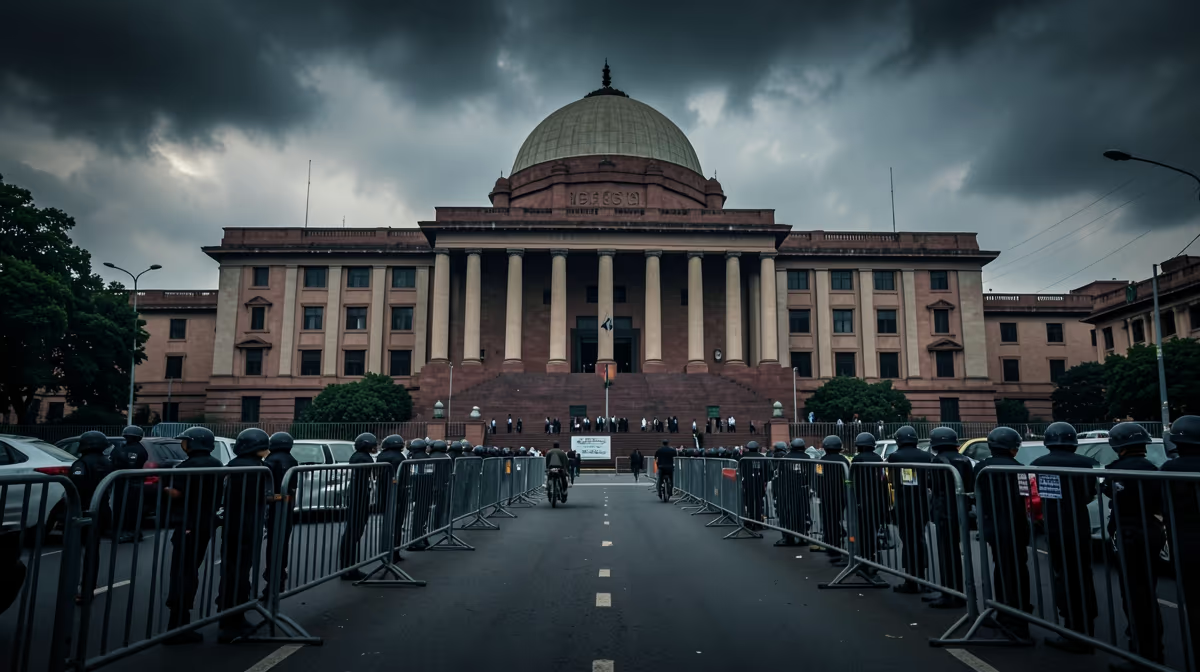
The silent hum of a digital blackout in the nation’s capital was broken not by a technical fix, but by a judicial gavel. The Supreme Court Delhi CJP protest detentions have forced a critical reassessment of state power and fundamental rights in the face of widespread civil unrest. As metro stations remained shuttered and mobile screens stayed blank, the intervention of the apex court signaled a definitive check on the administrative measures deployed to contain a movement that leaders have characterized as an "emergency-like" crisis.
The situation in Delhi escalated rapidly over the weekend, transitioning from localized demonstrations into a full-scale constitutional confrontation. The Supreme Court’s decision to step into the fray came amidst reports of hundreds of protesters being swept into custody, alongside the systematic suspension of telecommunications and public transit—a combination of tactics that analysts suggest has become a standardized bureaucratic playbook for suppressing dissent.
The Supreme Court Mandate for Restoration
The judicial scrutiny also extended to the physical barriers that have compartmentalized the capital. The Supreme Court directed the Centre and law enforcement agencies to remove barricades across the city unless they were explicitly warranted by clear security requirements. This directive addresses the friction imposed on daily urban life and the perceived overreach of using heavy infrastructure to block peaceful assembly.
| Directive Area | Supreme Court Instruction |
|---|---|
| Detentions | Immediate cessation of all illegal detentions of protesters. |
| Communications | Restoration of internet services across affected Delhi zones. |
| Transit | Restoration of Delhi Metro services to ensure public mobility. |
| Infrastructure | Removal of barricades unless specifically warranted by security. |
Chronology of a Crisis: From Streets to Courts
- Hundreds of CJP protesters, including high-profile legal figures, were detained in Delhi amidst mounting tension and viral documentation of clashes.
- Lower courts were approached for immediate relief, but a Delhi court rejected a specific plea for an FIR against police officials involved in the detention of legal head Ratna Singh.
- As reports of assaults on women and students surfaced via viral videos, the Supreme Court took notice, leading to a comprehensive intervention to halt illegal detentions and restore city services.
The timeline reflects a shift from a localized law-and-order issue to a national judicial priority. While the lower courts initially maintained a more cautious stance regarding police accountability, the apex court’s intervention has repositioned the narrative around the protection of fundamental rights.
The 'Emergency-Like' Characterization and Historical Parallels
The use of this historical parallel underscores the severity of the current situation. Leaders of the movement have urged citizens to continue their protests despite the threat of detention, signaling a resolve to challenge what they perceive as an era of restrictive governance. This political angle highlights a growing friction between institutional authority and citizen-led dissent, where the judiciary is increasingly called upon to serve as the final check against administrative overreach.
Legal Thresholds and Police Accountability
Evidence of aggressive law enforcement action has been widespread on social media. Specifically, the arrest of four men followed the circulation of a viral video showing the assault of women and students during the CJP demonstrations. These incidents have fueled the public outcry and provided the backdrop for the Supreme Court's firm instructions regarding the use of barricades and the cessation of unauthorized custody.
The Role of Legal Observers
Infrastructure of Control: Digital and Physical Blockades
This development highlights the crucial balancing act between maintaining public order and protecting citizens' fundamental rights to assembly and free expression.
The economic impact of these shutdowns is substantial. Severe disruptions to internet services and transit systems impose immediate friction on urban commerce, digital services, and daily economic mobility for millions of residents. Beyond the immediate financial loss, these measures suggest a reliance on infrastructure-level suppression that forces a judicial pushback to restore the functionality of the capital.
Geopolitical and Democratic Implications
From a geopolitical perspective, the ability of the Indian judiciary to act as an independent check on executive and police power is a vital signal of institutional health. The Supreme Court's intervention reinforces judicial oversight over communications blackouts, a tactic that is increasingly scrutinized globally as a potential violation of human rights.
Predicting the Shift: The Next 72 Hours
Immediate Implementation
Long-term Monitoring
The Supreme Court's intervention in the Delhi CJP protests marks a pivotal moment where judicial authority was used to dismantle a state-led digital and physical blockade, reaffirming that administrative security measures cannot bypass constitutional protections of assembly and movement.
Frequently Asked Questions
Why did the Supreme Court intervene in the Delhi CJP protest detentions?
The Supreme Court stepped in to stop what it deemed illegal detentions of protesters during the CJP demonstrations in Delhi. Alongside ordering the release of detained individuals, the court directed authorities to restore internet and metro services that had been disrupted.
What specific orders did the Supreme Court give regarding barricades and police action?
The Supreme Court instructed the Centre and police forces to remove barricades unless explicitly warranted by security needs. This directive follows widespread public outcry and reports of aggressive actions against demonstrators and students during the protests.
Who is affected by the Supreme Court's latest orders on the Delhi protests?
The orders directly impact citizens, students, and CJP leaders who were subjected to detentions, transport disruptions, and internet blackouts during the demonstrations. Additionally, law enforcement agencies and the Centre must comply with the court's strict directives regarding public movement and barricades.
What is the current status of legal actions involving CJP leaders and police officials?
Legal battles are ongoing following the protests, including a Delhi court's rejection of a plea filed by CJP legal head Ratna Singh for an FIR against police officials involved in her detention. Meanwhile, authorities have made arrests in connection with viral videos showing assaults on women and students during the unrest.
Why are the CJP protests happening in Delhi?
The demonstrations erupted in response to controversial government actions and subsequent crackdowns, leading CJP leaders to describe the prevailing situation as emergency-like. Protesters have vowed to continue their agitation despite mass detentions and heavy police deployment across the capital.
What happens next for the protesters and the detained individuals?
With the Supreme Court ordering the cessation of illegal detentions and the restoration of normal civic services like internet and metro lines, the immediate pressure on the detained protesters is easing. CJP leaders have encouraged citizens to maintain their resolve, signaling that grassroots protests and legal challenges will continue.
Conclusion
The intervention by the Supreme Court has fundamentally altered the trajectory of the Delhi CJP protests. By ordering the cessation of illegal detentions and the restoration of essential city services, the apex court has reinforced the principle that public order cannot be maintained at the total expense of civil liberties. While the immediate crisis of the digital and transit blackout is being addressed, the underlying political and legal tensions remain. The next few days will be critical as authorities work to comply with judicial mandates, even as CJP leaders and protesters maintain their resolve to continue their agitation. The case serves as a landmark reminder of the judiciary's role as the final arbiter of constitutional rights during times of domestic friction.
Sources
- Anti-CEC protest LIVE updates: Supreme Court stops illegal detention, orders restoration of Internet and metro services; CJP leaders call situation ‘emergency-like’ — The Hindu
- Why have hundreds of 'cockroach' protesters been detained in Delhi — BBC
- CJP Protest Live: 'We will not go back' - CJP asks citizens to continue protests — The Times of India
- 'Remove Barricades Unless Warranted': Supreme Court To Centre Amid CJP Protest — NDTV
- CJP protests: Delhi court rejects legal head Ratna Singh's plea for FIR against police officials who detained her — Bar and Bench
- 4 men arrested after viral video shows assault on women, students during CJP protest — India Today


.webp)
