
Karim Khan Legal Storm Signals a Massive Shift in Global Power Politics
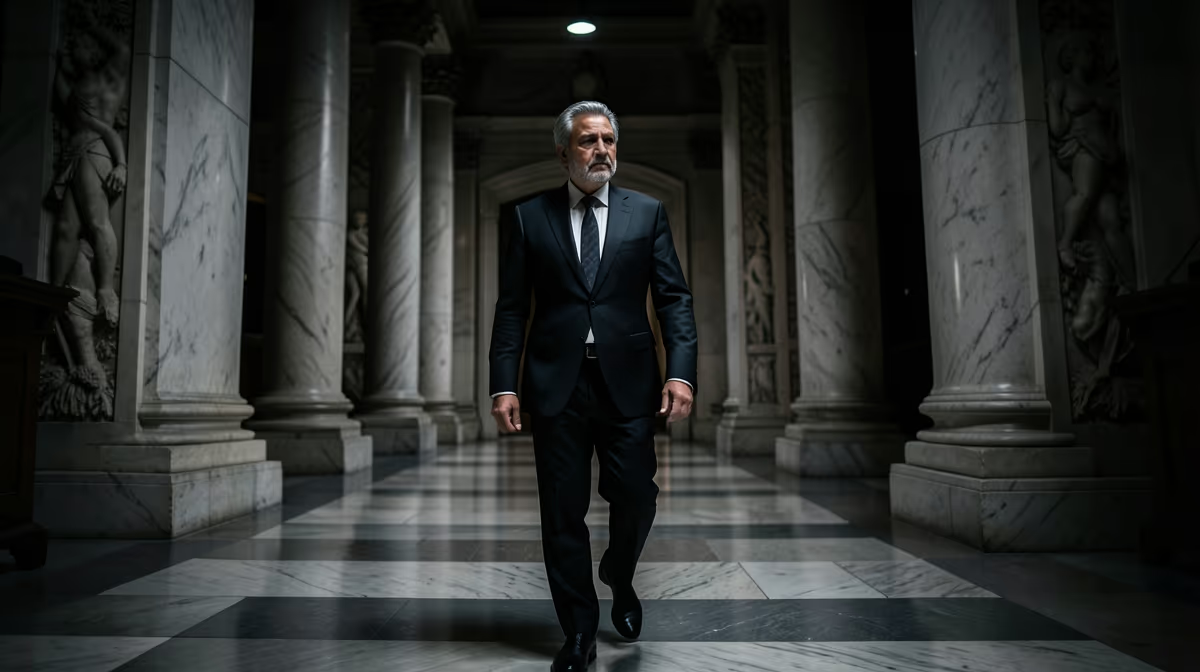
The actions of ICC Prosecutor Karim Khan continue to shape global headlines, as the International Criminal Court remains at the center of critical geopolitical investigations. By challenging the traditional boundaries of international sovereignty, the Office of the Prosecutor is forcing a long-overdue confrontation between the mandate for universal accountability and the entrenched geopolitical realities of the modern era.
The Man Behind the Mandate
Karim Khan is a British lawyer who currently serves as the Chief Prosecutor for the International Criminal Court. Elected in 2021 for a non-renewable nine-year term, he brings a background as a dedicated human rights lawyer and former United Nations official to one of the most high-stakes positions in international law. His role is to lead investigations into the world most serious crimes, including genocide, war crimes, and crimes against humanity. Khan operates from The Hague, Netherlands, leading a court that functions independently of the United Nations as a final resort for justice when national systems are unwilling or unable to prosecute. His career, including his previous work at the International Criminal Tribunal for the former Yugoslavia and the Special Court for Sierra Leone, underscores a professional life defined by the pursuit of accountability for high-ranking political and military figures.
The Current Impasse
In May 2024, the legal landscape shifted dramatically when Khan officially requested arrest warrants for Israeli Prime Minister Benjamin Netanyahu and Defense Minister Yoav Gallant, alongside leaders of Hamas. This request, currently under review by the ICC Pre-Trial Chamber, alleges the commission of war crimes and crimes against humanity. The move has triggered a profound diplomatic rift. The United States, which is not a signatory to the Rome Statute, has voiced sharp condemnation. Secretary of State Antony Blinken has indicated that the administration is prepared to coordinate with Congress on appropriate responses to the court actions. Meanwhile, proponents of the court argue that Khan is simply fulfilling his duty under the Rome Statute, which mandates that the law must be applied equally to all persons, regardless of their political standing or state affiliation.
Roots of the Legal Friction
The fundamental tension driving this crisis lies in the clash between the ICC assertion of jurisdictional authority and the Westphalian framework of sovereignty, which the United States has historically defended. This conflict is not new; it mirrors a long-standing power struggle between international legal mechanisms and the doctrine of American Exceptionalism. Historically, the United States has maintained a protective stance over its own military personnel and those of its key allies, a posture codified in the 2002 American Service-Members Protection Act. When the ICC previously investigated conflict in Afghanistan, the US responded with sanctions under the Trump administration, highlighting the fragility of the relationship between Washington and The Hague. Today, the debate centers on whether the court is overreaching its mandate or whether it is finally achieving the intended goals of the 1998 Rome Statute in a fragmented global order.
Political and Legislative Pressures
The domestic response within the United States has been swift and bipartisan. Members of Congress have introduced legislative proposals aimed at curbing ICC funding and imposing sanctions on officials involved in these investigations. This legislative push creates a complex environment for the Biden administration, which must balance its commitment to established international institutions against intense domestic pressure to protect strategic allies. The potential for the US to move toward formal visa bans or financial restrictions against ICC personnel represents a worst-case scenario that could lead to a permanent breakdown in cooperation. Conversely, a best-case scenario involves a quiet diplomatic de-escalation, where procedural concerns regarding jurisdiction are handled through existing channels without severing the fragile ties that exist between Washington and the court.
The Global Impact and Future Outlook
The implications of this standoff extend well beyond the individuals currently named in the warrant applications. For the Global South, the perception of selective application of international law by the US-led order is increasingly a point of friction. If the ICC is perceived as being neutralized by political pressure, the legitimacy of the entire international legal system may suffer, potentially driving nations toward alternative diplomatic alignments. Over the next 24 to 72 hours, observers expect increased diplomatic maneuvering, with internal White House deliberations focusing on the official public posture toward the court. As the Pre-Trial Chamber reviews the evidence, the path forward remains fraught with legal and political uncertainty. The institutional integrity of the ICC is being tested against the reality of power politics, and the outcome will likely dictate the role of international law in global conflicts for years to come.
Frequently Asked Questions
Who is Karim Khan?
Karim Khan is a British lawyer and King's Counsel who currently serves as the Prosecutor of the International Criminal Court (ICC). He assumed this role in June 2021 after a long career as an international criminal law and human rights attorney.
What is Karim Khan's role at the International Criminal Court?
As the ICC Prosecutor, Karim Khan is responsible for leading the Office of the Prosecutor in investigating and prosecuting individuals for genocide, crimes against humanity, war crimes, and the crime of aggression. He oversees ongoing investigations worldwide and decides when to seek arrest warrants from the court.
What is Karim Khan's nationality?
Karim Khan is a British national. He was born in Edinburgh, Scotland, and has extensive experience practicing law within the United Kingdom's legal system before transitioning to high-level international roles.
What high-profile cases has Karim Khan been involved in?
Throughout his career, Karim Khan has been involved in several significant international cases, including those at the International Criminal Tribunal for the former Yugoslavia and the Special Court for Sierra Leone. More recently, he has garnered global attention for his investigations into alleged war crimes in Ukraine and the Middle East.
How long is Karim Khan's term as ICC Prosecutor?
Karim Khan was elected to a nine-year term as the Prosecutor of the International Criminal Court. This term is non-renewable, as dictated by the Rome Statute, ensuring the independence of the prosecutor's office.
Where did Karim Khan study law?
Karim Khan studied law at King's College London. After completing his studies, he was called to the Bar of England and Wales in 1992 and eventually built a distinguished career as a specialist in international criminal law.
Conclusion
The confrontation between the ICC Prosecutor and US lawmakers marks a pivotal moment in the history of international humanitarian law. With the ICC Pre-Trial Chamber currently evaluating the evidence for arrest warrants, the international community watches as the court attempts to assert its jurisdiction over complex, high-stakes geopolitical conflicts. Whether this results in a fundamental restructuring of US-ICC relations or a long-term impasse depends on the pending judicial outcomes and the degree to which legislative threats of sanctions are actualized. The situation remains a defining test of whether international legal institutions can operate effectively in an era of deep political division.


.webp)


.webp)
