
Moonshot Projects Are Now Defining the Future of US Strategic Power
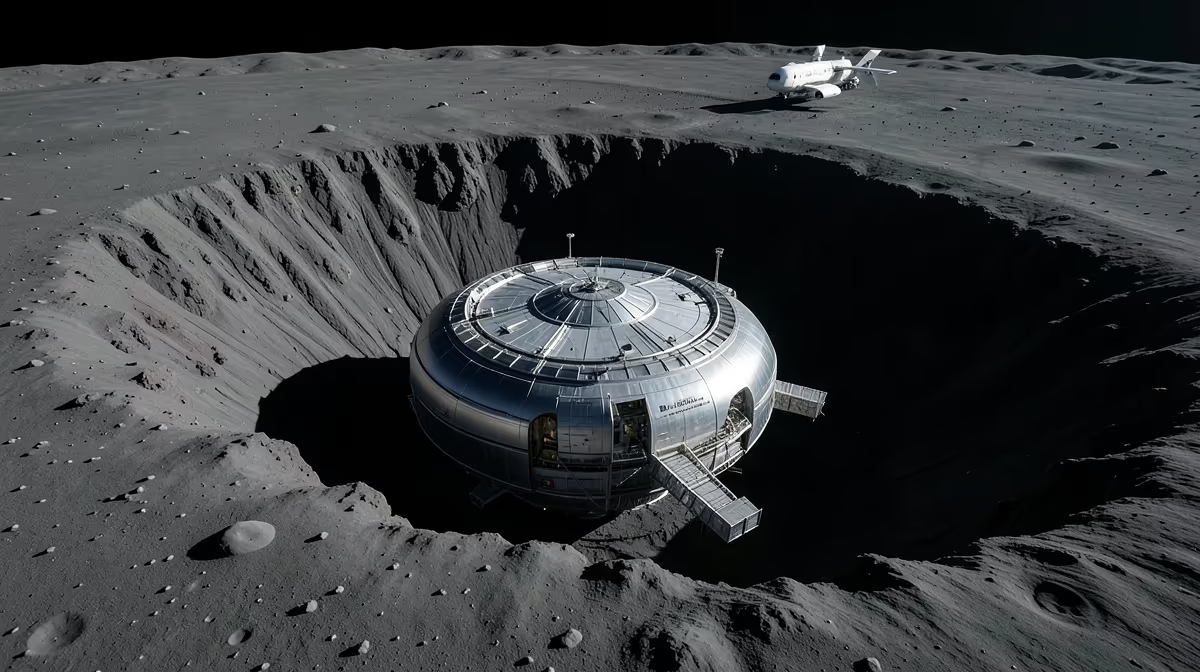
The United States is entering a new era of lunar exploration as NASA’s Artemis program intensifies efforts to return humans to the lunar surface by late 2026. As global industries pivot toward rapid advancement, the concept of a moonshot project has become the benchmark for transformative success in the future of innovation.
Defining the Modern Mission
A moonshot is a term used to describe an ambitious, experimental project that aims to solve a massive problem by using radical, breakthrough technology. Much like the original mission to land astronauts on the moon in 1969, these projects start with a high risk of failure but offer the potential for game-changing rewards if they succeed. In today's context, these initiatives are usually led by major tech companies or government research agencies, focusing on tackling tasks once deemed impossible—such as creating unlimited clean energy or reshaping how we live.
These projects aim for a ten-fold improvement rather than a small, incremental change. While the term originates from the 1960s Space Race, it is now applied across diverse industries to describe big-bet innovation strategies. While most moonshots do not reach their original goal, the research they generate often leads to new, useful products for the general public, pushing the boundaries of human knowledge and technological capability.
The Artemis Strategy
NASA’s Artemis III mission remains the focal point of the agency’s current lunar ambitions, marking the first time humans will land near the lunar south pole. This region is of particular scientific interest due to the presence of water ice within permanently shadowed craters, which could potentially be converted into oxygen and rocket propellant. The agency is currently coordinating with private sector partners, most notably SpaceX, to develop the Human Landing System required for the touchdown.
Technological hurdles continue to dominate the program’s timeline, with significant focus on the development of next-generation spacesuits and the integration of the Orion spacecraft with the Space Launch System rocket. Despite previous setbacks regarding thermal protection systems and docking maneuvers, NASA maintains that the mission architecture is evolving to prioritize crew safety and mission reliability over aggressive target dates. This modern moonshot represents a strategic shift toward establishing a sustainable long-term presence on the Moon, serving as a critical testing ground for eventual crewed missions to Mars.
Geopolitical and Economic Drivers
The root cause of this renewed intensity is the necessity to maintain absolute technological hegemony in low-earth orbit and cislunar space to preempt potential dominance over strategic lunar resources like Helium-3 and water ice. Bipartisan support for the Artemis program serves as a vehicle for industrial policy, funneling federal research and development contracts into manufacturing hubs to consolidate support while projecting national prestige.
The transition from a cost-plus government procurement model to a public-private partnership creates a new space-based economy, shifting the balance of power from traditional defense contractors to commercially agile entities that monopolize space infrastructure. This has created a new Great Game, where lunar sovereignty claims serve as a proxy for establishing the legal and normative framework for the future of orbital governance. Furthermore, the dual-use nature of this technology allows for the advancement of autonomous satellite interceptors and deep-space surveillance capabilities under the guise of scientific exploration.
Anticipated Market Shifts
Over the next 24 hours, market observers anticipate increased public and media discourse following recent private sector lunar mission telemetry updates and regulatory filings. Within 72 hours, this is expected to evolve into a shift in market sentiment regarding aerospace stocks and renewed legislative debate over NASA's Artemis budget allocations.
Industry experts predict that the sector will see a transition from experimental development to sustained logistical infrastructure planning as private lunar partnerships become the primary growth engine. The best-case scenario involves the successful alignment of public-private partnerships, leading to reduced mission costs, accelerated lunar base development, and sustained political support. Conversely, the worst-case scenario warns that technical setbacks or funding shortfalls could result in mission cancellations, triggering a significant sell-off in space-tech equities and a stagnation of national lunar timelines.
Key Facts and Operational Reality
The Artemis III mission is currently targeted for a 2026 launch window and will utilize the SpaceX Starship vehicle for the lunar landing portion. Beyond the hardware, the initiative relies on the Artemis Accords, which have been signed by over 40 nations to guide civil space exploration. While NASA has confirmed the use of the Space Launch System rocket and Orion capsule, and that the Artemis II mission will precede the landing attempt, the finalized flight readiness dates for Artemis III remain subject to ongoing testing of docking mechanisms and the certification of next-generation Extravehicular Activity suits.
Frequently Asked Questions
What is a moonshot in business?
A moonshot in business refers to an ambitious, exploratory, and ground-breaking project undertaken without any expectation of near-term profitability or success. It often involves solving a massive problem using a radical solution and breakthrough technology.
Where does the term moonshot come from?
The term originates from the 1969 Apollo 11 mission that landed the first humans on the moon. It was used as a metaphor for the immense challenge and technological leap required to achieve a goal that once seemed impossible.
What is the difference between a moonshot and a business goal?
While a standard business goal focuses on incremental improvements or achievable targets, a moonshot aims for a ten-fold improvement rather than a ten percent gain. Moonshots are high-risk, high-reward ventures that require fundamentally different thinking than traditional corporate strategies.
What are examples of moonshot projects?
Famous examples include Google's self-driving car project, the development of reusable rockets by SpaceX, and various initiatives to cure rare diseases. These projects aim to fundamentally transform how society functions through innovative engineering and scientific research.
Why do companies invest in moonshot projects?
Companies invest in moonshots to disrupt entire industries, stay ahead of technological curves, and solve complex global challenges. While risky, successful moonshots can create entirely new markets and provide a massive competitive advantage.
How do you identify a good moonshot idea?
A good moonshot idea identifies a huge problem, proposes a radical solution, and utilizes a breakthrough technology to make it feasible. It must be transformative in nature and have the potential to change the lives of millions or billions of people.
Conclusion
The pursuit of lunar exploration has evolved from a historical demonstration of ideological superiority into a multi-billion dollar industrial and diplomatic priority. With NASA’s Artemis program focusing on sustainable infrastructure and private sector integration, the mission to the lunar south pole stands as the definitive technological test for the coming years. Success in this venture depends on the resolution of complex engineering hurdles and the continued stability of public-private financial frameworks. As 2026 approaches, the focus remains firmly fixed on the integration of landing systems and the establishment of a long-term, viable presence in deep space.


.webp)


.webp)
