
Offshore Wind Power Faces a Critical Turning Point in US Energy Policy
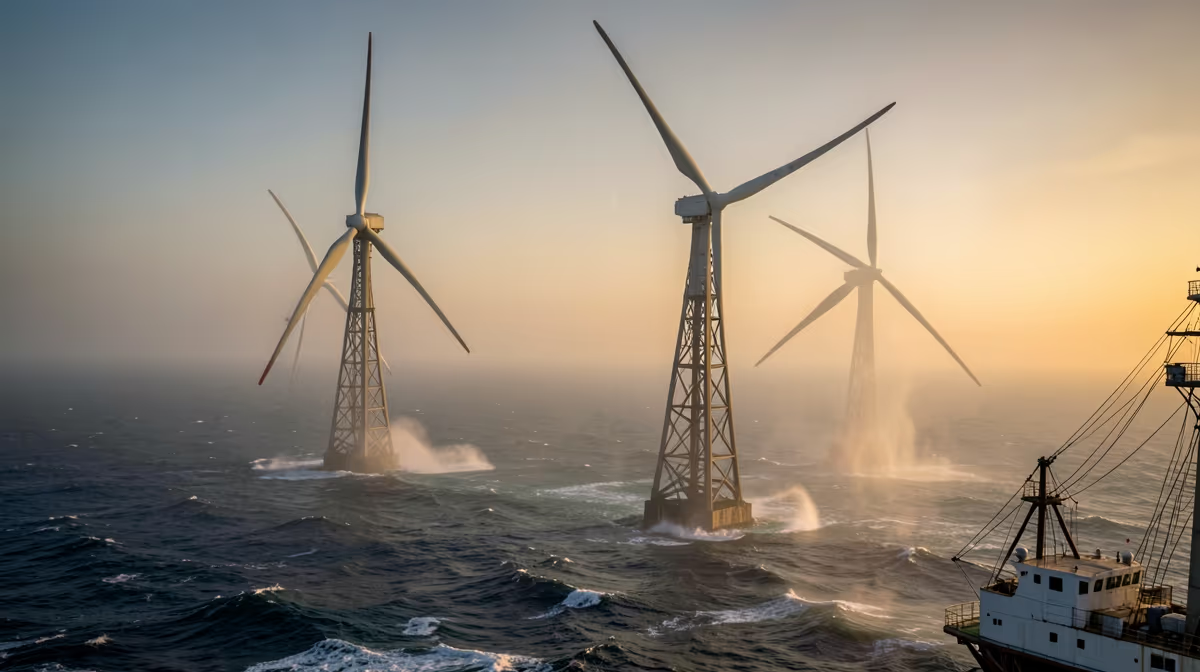
As the United States accelerates its renewable energy transition, offshore wind power has emerged as a central pillar of the national grid strategy. While these massive turbines rising from the Atlantic horizon promise a future of clean energy independence, the path toward achieving a carbon-free grid by 2035 is currently entangled in a complex web of economic, political, and logistical challenges.
Understanding the Offshore Infrastructure
Offshore wind power involves building massive wind turbines in the ocean, where winds are stronger and more consistent than on land. These structures capture the kinetic energy of ocean gusts and convert it into electricity, which is then transmitted to the mainland through sophisticated subsea cable networks. Because these turbines are often situated miles from the coast, they remain largely invisible to beachgoers while providing a steady, reliable source of power.
The technical scale of this operation is significant. These turbines are substantially larger and more powerful than their land-based counterparts, allowing for a higher volume of electricity production. To harness this power, the United States has set a target to deploy 30 gigawatts of offshore wind energy by 2030. This initiative is not merely about sustainability; it is a critical component of replacing aging fossil fuel plants and lowering long-term energy costs for millions of households.
The Economic and Political Climate
The structural requirement to transition industrial energy baseloads away from domestic fossil fuel dependency has forced the U.S. into a difficult jurisdictional space. The federal government, led by the Bureau of Ocean Energy Management, continues to open vast tracts of the outer continental shelf for development. However, the industry is currently grappling with a potent mix of economic volatility. High interest rates and supply chain bottlenecks have significantly disrupted project financing, leading to the cancellation or renegotiation of several high-profile Power Purchase Agreements in the Northeast.
Politically, the landscape is equally fraught. The Biden administration’s ambitious climate goals face mounting pressure from local "NIMBY" resistance and shifting bipartisan sentiment regarding the high cost of the energy transition. Furthermore, a tactical alliance between domestic commercial fishing interests and conservative think tanks has utilized legal challenges to stall regulatory progress, creating a environment of uncertainty for energy investors and utility companies.
Strategic Imperatives and Supply Chain Shifts
Beyond the domestic energy needs, there is a clear geopolitical motive driving this expansion. The United States is working to neutralize the global dominance of external powers in turbine manufacturing and rare-earth mineral processing. By fostering a domestic manufacturing hub along the Atlantic seaboard, the federal government hopes to ensure energy infrastructure security.
The current strategy relies heavily on the Inflation Reduction Act, which provides essential tax credits to keep capital-intensive projects viable. This federal intervention serves as a lifeline for developers struggling with inflationary pressures. Despite these aids, the industry remains in a period of consolidation. Experts suggest that the near-term deployment will likely be slower than initially anticipated, forcing developers to shift toward larger-scale turbine technology to improve long-term viability and efficiency in a high-cost environment.
The Path Forward and Immediate Outlook
In the next 24 hours, stakeholders expect to see ongoing mobilization for Atlantic coastal lease surveys and critical federal coordination meetings regarding tax credit guidance. As we look toward the next 72 hours, the focus will likely sharpen on port infrastructure upgrades and potential legal developments regarding pending projects in New York and New Jersey.
The industry currently stands at a crossroads. The best-case scenario involves a significant reduction in supply chain bottlenecks supported by federal funding and the stabilization of interest rates, which would allow stalled projects to finalize their power purchase agreements. Conversely, the worst-case scenario entails further withdrawals of major developers due to persistent cost overruns, which could result in a multi-year delay of national capacity targets. The historical parallel to the 1970s nuclear power push serves as a reminder that regulatory and legal hurdles often prove as challenging as the engineering obstacles themselves.
Frequently Asked Questions
What is the status of offshore wind power in the US?
The US offshore wind industry is rapidly expanding, with several large-scale projects under construction along the Atlantic coast. The federal government has set ambitious goals to deploy 30 gigawatts of offshore wind capacity by 2030 to help achieve a carbon-free power grid.
Where are the primary locations for offshore wind farms in the US?
Most current offshore wind development is concentrated along the US Atlantic coast, particularly off the shores of Massachusetts, New York, New Jersey, and Virginia. There is also emerging interest and leasing activity on the Pacific Coast and in the Gulf of Mexico.
How does offshore wind power impact the environment?
Offshore wind provides a clean, renewable energy source that significantly reduces greenhouse gas emissions compared to fossil fuels. Developers are required to conduct extensive environmental impact assessments to mitigate risks to marine life and migratory bird patterns.
Are offshore wind turbines visible from the shore?
Visibility depends on the project location and distance. Most developers place wind farms 15 to 20 miles offshore, where they appear as small, distant objects on the horizon.
Why is offshore wind energy considered better than onshore wind?
Offshore wind offers stronger and more consistent wind speeds, leading to higher efficiency. Additionally, offshore installations can use much larger turbines closer to major coastal population centers where energy demand is highest.
How do floating offshore wind turbines work?
Floating technology uses buoyant platforms anchored to the seabed, allowing for installations in deeper waters where traditional fixed-bottom foundations are not feasible.
Conclusion
The rapid expansion of offshore wind in the United States remains a central pillar of national energy policy, yet the sector is navigating a volatile period marked by economic headwinds and regulatory complexity. While federal lease auctions and tax incentives continue to drive forward momentum, the timeline for achieving the 30-gigawatt goal by 2030 remains subject to shifting project economics and infrastructure readiness. As the industry moves toward more consolidated supply chains and larger-scale technological deployments, the focus will remain on balancing the urgent need for a renewable transition with the realities of project feasibility and regional stakeholder engagement.


.webp)


.webp)
