
Skyroot Aerospace Vikram 1 Launch Signals a Massive Shift for India
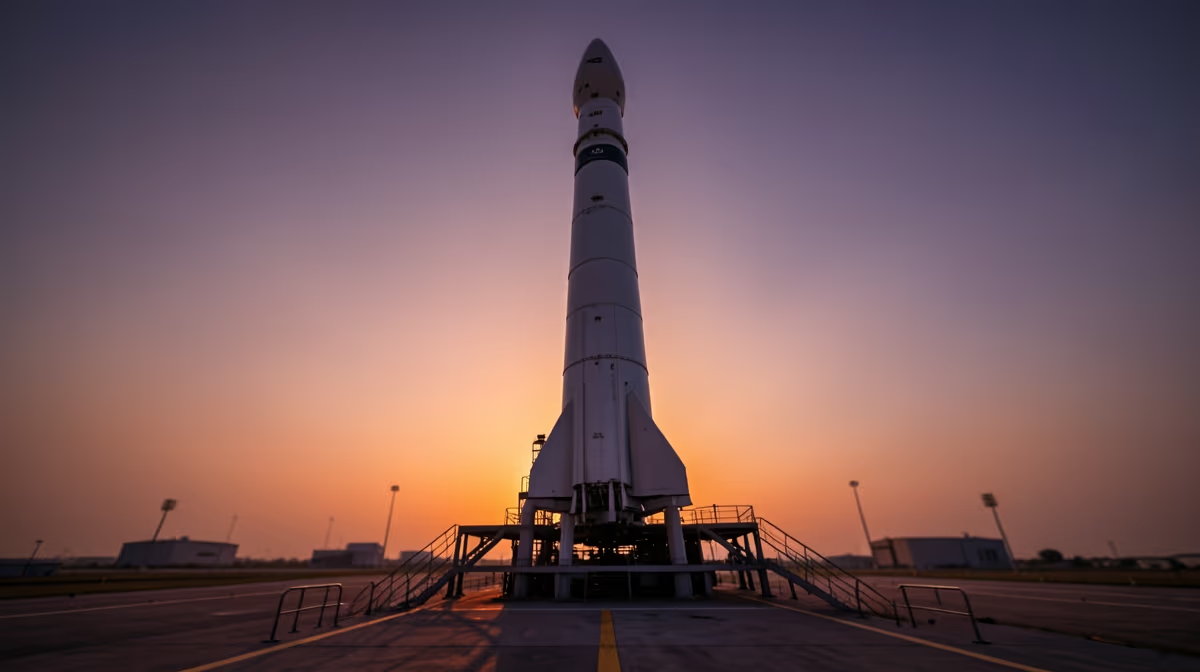
The silhouette of a new era in space exploration is rising from the sands of Sriharikota, where the Skyroot Aerospace Vikram 1 launch stands poised to fundamentally alter the economics of orbital access. As the Indian private space sector matures under the regulatory guidance of IN-SPACe, this mission represents far more than a single flight; it is a calculated challenge to the established heavyweights of global launch services.
Strategic Shift to Orbital Autonomy
The root cause of this transition lies in the strategic necessity to move beyond the traditional state-led dependency on the Indian Space Research Organisation (ISRO). For decades, India’s space capabilities were defined by government-controlled operations. However, the rise of Skyroot Aerospace, founded by former ISRO engineers in 2018, signals a shift toward an agile, commercially viable ecosystem. By leveraging the government’s Atmanirbhar Bharat policy, the company is positioning India as a global space superpower, shifting the narrative from state-exclusive operations to a private-led space economy. This evolution mirrors the 1990s United States transition, where the dominance of national space agencies gave way to a new, competitive landscape for commercial launch providers.
Technological Edge of the Vikram 1
At the heart of this mission is the Vikram 1, a multi-stage rocket engineered for precision and efficiency. Unlike conventional launch vehicles, it utilizes advanced carbon-fiber-reinforced polymer structures and 3D-printed propulsion systems. This modular manufacturing approach allows for significantly faster integration and shorter launch cycles, which is critical for the burgeoning small-satellite market. The rocket is designed to carry payloads of up to 480 kg into low Earth orbit, providing a flexible launch window that addresses the specific, rapid-deployment needs of modern satellite operators. By reducing the cost per kilogram of orbital delivery, the vehicle acts as an enabling technology for businesses, researchers, and global telecommunications firms seeking reliable, frequent access to space.
The Road to the Launchpad
The mission trajectory has been defined by careful, sequential milestones. Following the successful sub-orbital flight of the Vikram-S in November 2022, which served as the "Prarambh" or beginning of private Indian space flight, the current mission is the final validation of the company's orbital-class capability. In the immediate 24-hour window, teams at the Satish Dhawan Space Centre are conducting final mission rehearsals, rigorous weather monitoring, and internal safety audits. If telemetry verification confirms all systems are nominal, the 72-hour window will see the initiation of the launch countdown. This period is critical, as it requires perfect synchronization between launch vehicle readiness and atmospheric stability, serving as the final barrier between development and operational success.
Geopolitical and Economic Implications
The success of this launch carries profound geopolitical weight. As nations in the Global South and Western commercial entities seek to hedge against supply chain disruptions and look for alternatives to established launch services, India is emerging as a reliable, cost-effective partner. By attracting foreign direct investment and venture capital into the domestic deep-tech sector, the mission aims to solidify India's competitive edge. Furthermore, there is a distinct dual-use technology potential in these developments. The mastery of orbital trajectory control and propulsion capabilities, while civilian-focused, provides a robust foundation that inherently strengthens the country's broader aerospace and defense technology infrastructure.
Assessing Mission Outcomes
Industry analysts view the maiden test flight of the Vikram 1 as a defining moment. A best-case scenario involves successful orbit insertion and accurate payload deployment, which would trigger immediate investor confidence and accelerate future contract acquisitions for the Hyderabad-based startup. Conversely, a worst-case scenario—such as an engine ignition anomaly or ascent failure—would necessitate a prolonged investigation phase, potentially delaying the production schedule. Regardless of the immediate outcome, the program has already successfully validated the scalability of private infrastructure in India, demonstrating that the collaboration between private startups and established bodies like ISRO is not only feasible but essential for future growth.
Defining the Market Opportunity
The commercial rationale for the Vikram 1 is clear. With the global demand for satellite constellations—ranging from internet connectivity to agricultural monitoring—skyrocketing, the market requires more than just infrequent, expensive launches. The Vikram 1 offers a modular solution that is optimized for small satellite operators who cannot wait for the launch windows of larger, government-heavy vehicles. By consolidating its position as a primary contributor to India's private space ecosystem, Skyroot Aerospace is effectively filling a gap in the global market, providing a template for how emerging space nations can transition to a robust, private-led industry that drives both scientific innovation and economic expansion.
Frequently Asked Questions
When is the Vikram 1 rocket expected to launch?
Skyroot Aerospace is preparing for the maiden orbital launch, with expectations set for the near future. The company is currently conducting final testing phases to ensure mission readiness.
What is the primary purpose of the Vikram 1 launch?
The mission aims to demonstrate the capability of a privately developed vehicle to deliver small satellites into low Earth orbit, providing a cost-effective and reliable service for global customers.
Is Vikram 1 a multi-stage rocket?
Yes, it is a multi-stage vehicle featuring solid propulsion stages and a liquid-fueled upper stage designed for precise orbit insertion.
Has Skyroot Aerospace already launched a rocket?
Yes, the company successfully launched the Vikram-S in November 2022, marking India's first private suborbital space flight.
Where will the Vikram 1 launch take place?
The launch is scheduled at the Satish Dhawan Space Centre in Sriharikota, under the oversight of ISRO and IN-SPACe.
What makes Vikram 1 unique among Indian rockets?
It is entirely developed by a private startup, utilizing advanced technologies such as 3D printing and carbon-fiber composites to allow for faster, more flexible, and lower-cost launches.
Conclusion
The impending Skyroot Aerospace Vikram 1 launch stands as a culmination of years of engineering rigor and regulatory reform. By successfully transitioning from sub-orbital test flights to an orbital-class vehicle, the company is setting a new precedent for the Indian space sector. While the next 72 hours will determine the immediate success of this maiden flight, the broader impact of the program is already manifest: a more competitive, agile, and commercially oriented space industry. As Skyroot continues to refine its launch cadences and propulsion technologies, it remains a central figure in the transformation of India into a global hub for small-satellite launch services, ensuring that the next generation of space-based technology has a reliable and efficient pathway to orbit.


.webp)


.webp)
