
Birthright Citizenship Ruling Triggers a Massive National Legal Battle
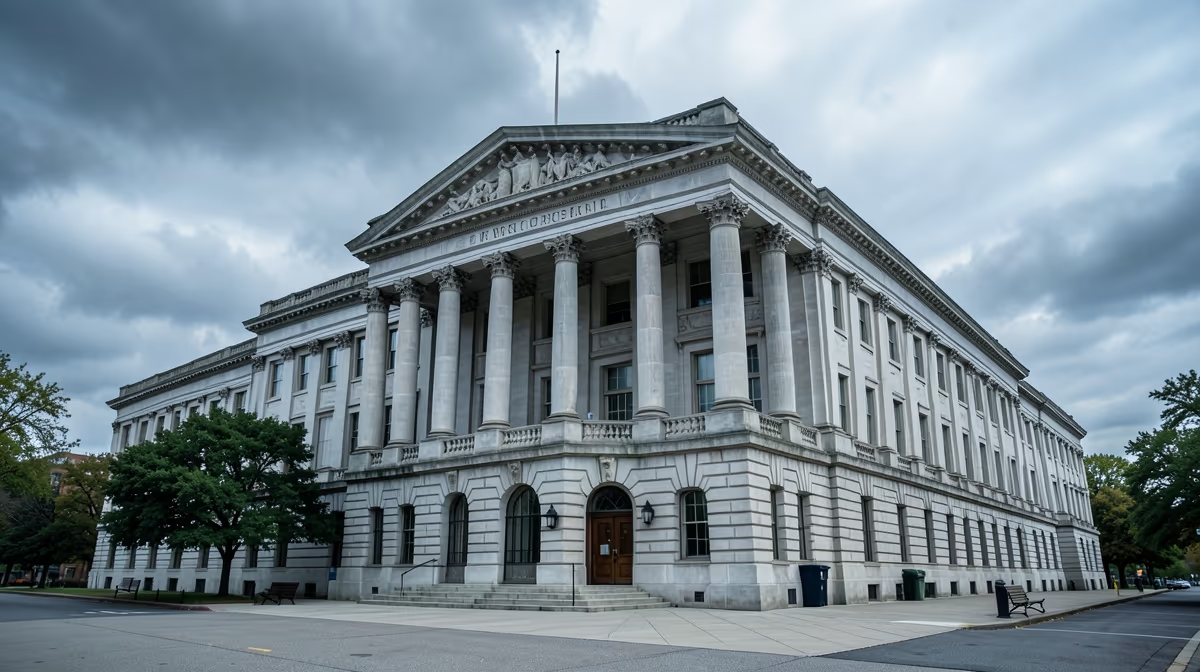
A federal court has issued a critical birthright citizenship ruling that could reshape the national debate on immigration policy across the United States. A federal district court in Texas on Tuesday blocked a sweeping executive order aimed at ending birthright citizenship for the children of undocumented immigrants, ruling that the directive violates the Fourteenth Amendment of the U.S. Constitution.
Legal Developments And Court Action
U.S. District Judge Fernando Rodriguez granted a nationwide preliminary injunction, halting the administration's policy just hours before it was scheduled to take effect. The policy sought to deny automatic U.S. citizenship to newborns whose parents are not U.S. citizens or lawful permanent residents, a direct challenge to long-standing legal precedent established by the 1898 Supreme Court case United States v. Wong Kim Ark. Legal scholars and civil rights organizations immediately filed multiple lawsuits following the administration's announcement last month, arguing that the executive branch lacks the constitutional authority to reinterpret the Citizenship Clause of the Fourteenth Amendment through executive action alone. Plaintiffs contended that the rule would create an unprecedented class of stateless children and disrupt vital federal and state administrative systems. Justice Department attorneys defended the order, arguing that the original intent of the Fourteenth Amendment has been misinterpreted and that the executive branch holds the authority to address immigration enforcement loopholes. The administration is expected to immediately appeal Tuesday's ruling to the Fifth Circuit Court of Appeals, setting up a likely eventual showdown at the U.S. Supreme Court.
Understanding The Constitutional Context
Birthright citizenship is the long-standing rule that almost anyone born on U.S. soil automatically becomes an American citizen, no matter where their parents are from. This principle, known legally as jus soli, was firmly established in the United States by the Fourteenth Amendment in 1868, following the Civil War, primarily to ensure that formerly enslaved people were recognized as full citizens. The Fourteenth Amendment of the U.S. Constitution guarantees birthright citizenship. Recent legal challenges aim to limit citizenship for children born to undocumented immigrants. Critics of the current system argue it encourages illegal immigration. Supporters of birthright citizenship say it is a core American value rooted in equality. The Supreme Court has not yet made a final, definitive ruling on these new challenges. The root cause of these ongoing debates stems from the ambiguous phrasing of the Citizenship Clause in the Fourteenth Amendment, specifically regarding the interpretation of subject to the jurisdiction thereof, leaving an opening for ideological contestation over national identity and sovereignty.
Broader Societal And Economic Impacts
This ruling or ongoing debate matters because it strikes at the very definition of who is considered an American. If birthright citizenship is restricted, millions of future children could face statelessness or uncertain legal status, fundamentally changing American society and immigration policy. Undocumented immigrants, children born in the U.S. to non-citizen parents, hospitals, and state governments responsible for issuing birth certificates and identification documents are directly affected by these legal maneuvers. The policy changes threaten the disruption of labor markets, a potential reduction in the tax base, and increased administrative costs for social services and documentation enforcement. Furthermore, the disproportionate impact on multi-generational mixed-status families risks the creation of a permanent underclass of stateless individuals within the domestic economy. On a geopolitical scale, altering long-standing citizenship interpretations could erode the United States normative soft power as a beacon of universal rights, potentially triggering reciprocal restrictive citizenship policies in other immigrant-receiving nations.
Political Dimensions And Historical Parallels
The current legal battles reflect the weaponization of constitutional originalism by conservative factions to shift demographic power balances, mobilize base voters, and reshape the federal judiciary. This dynamic mirrors historical moments such as the 1898 Wong Kim Ark Supreme Court ruling which affirmed birthright citizenship for children of Chinese immigrants, following decades of racially motivated exclusion acts. The timeline of this issue spans from the 1868 ratification of the Fourteenth Amendment through the late twentieth century rise of modern anchor baby political rhetoric, leading to the current coordinated legal and legislative pushes to test the Fourteenth Amendment via federal court challenges.
Anticipated Legal Trajectory
In the next 24 hours, emergency legal challenges are expected to be filed by civil rights groups seeking injunctions in federal district courts. Over the next 72 hours, the Department of Justice will prepare defense filings while state attorneys general divide along partisan lines. Key players in this unfolding legal drama include Federal District Court Judges, the Department of Justice, the ACLU, and State Attorneys General, who will navigate impact areas across constitutional law, immigration policy, and federal-state relations. Legal experts predict the ruling will face an immediate nationwide injunction, leading to a multi-year appeals process ultimately destined for the Supreme Court. The best-case scenario envisions a swift and unambiguous appellate ruling that provides clarity, reaffirming established constitutional interpretations and reducing societal panic. Conversely, the worst-case scenario involves prolonged legal ambiguity causing immediate administrative chaos at vital state agencies, impacting millions of families and deepening political polarization.
Frequently Asked Questions
What is birthright citizenship in the US?
Birthright citizenship is the legal right that grants United States citizenship to anyone born on U.S. soil, regardless of their parents' citizenship or immigration status. This principle is codified in the Fourteenth Amendment of the U.S. Constitution. It ensures that children born within the nation's jurisdiction automatically become American citizens at birth.
Is the 14th Amendment birthright citizenship currently under challenge?
Yes, the Fourteenth Amendment's citizenship clause frequently faces political debate and legal challenges from lawmakers proposing executive orders or legislation to end it. However, any attempt to abolish birthright citizenship through these methods would likely trigger massive constitutional battles in federal courts. Most legal scholars agree that ending birthright citizenship would require a constitutional amendment, which is a notoriously difficult process.
Does the US have unconditional birthright citizenship?
The United States generally practices unconditional birthright citizenship under the jus soli doctrine for individuals born on its territory. The only major historical exception outlined in the Fourteenth Amendment applies to children born to foreign diplomats on official duty. Aside from this specific diplomatic exemption, the rule has broadly applied to millions of individuals over the last century and a half.
Can executive orders end birthright citizenship?
An executive order alone cannot legally end birthright citizenship because the principle is explicitly guaranteed by the Fourteenth Amendment of the U.S. Constitution. Any presidential directive attempting to alter this constitutional right would immediately face injunctions and lawsuits for exceeding executive authority. The judicial branch would ultimately have to decide the constitutionality of such an order against established Supreme Court precedent.
What did the Supreme Court rule in United States v. Wong Kim Ark?
In the landmark 1898 case United States v. Wong Kim Ark, the Supreme Court ruled that a child born in the United States to Chinese citizen parents was a U.S. citizen by birth. The Court affirmed that the Fourteenth Amendment applies broadly to children born on U.S. soil to foreign nationals, with very few exceptions. This ruling remains the foundational legal precedent supporting modern birthright citizenship.
What countries offer birthright citizenship?
Dozens of countries, primarily located in North and South America, offer unconditional birthright citizenship, commonly known as birthright citizenship by soil. Notable examples include the United States, Canada, Mexico, and Brazil. In contrast, most European and Asian nations primarily grant citizenship based on ancestry rather than place of birth.
Conclusion
The federal district court's decision to issue a nationwide preliminary injunction has successfully halted the birthright citizenship executive order, temporarily preserving long-standing constitutional precedents while litigation proceeds. Confirmed developments show that the Justice Department intends to pursue an immediate appeal to the Fifth Circuit Court of Appeals, paving the way for a protracted legal battle. As civil rights organizations, state attorneys general, and federal judges prepare for subsequent filings, the future of the Fourteenth Amendment's citizenship guarantees remains tied to the federal court system. Realistic next steps involve emergency appellate defense strategies and ongoing judicial reviews that will ultimately determine whether these executive actions withstand constitutional scrutiny.


