
Nifty 50 Index Surges to Historic Heights Amid Heavy Market Shifts
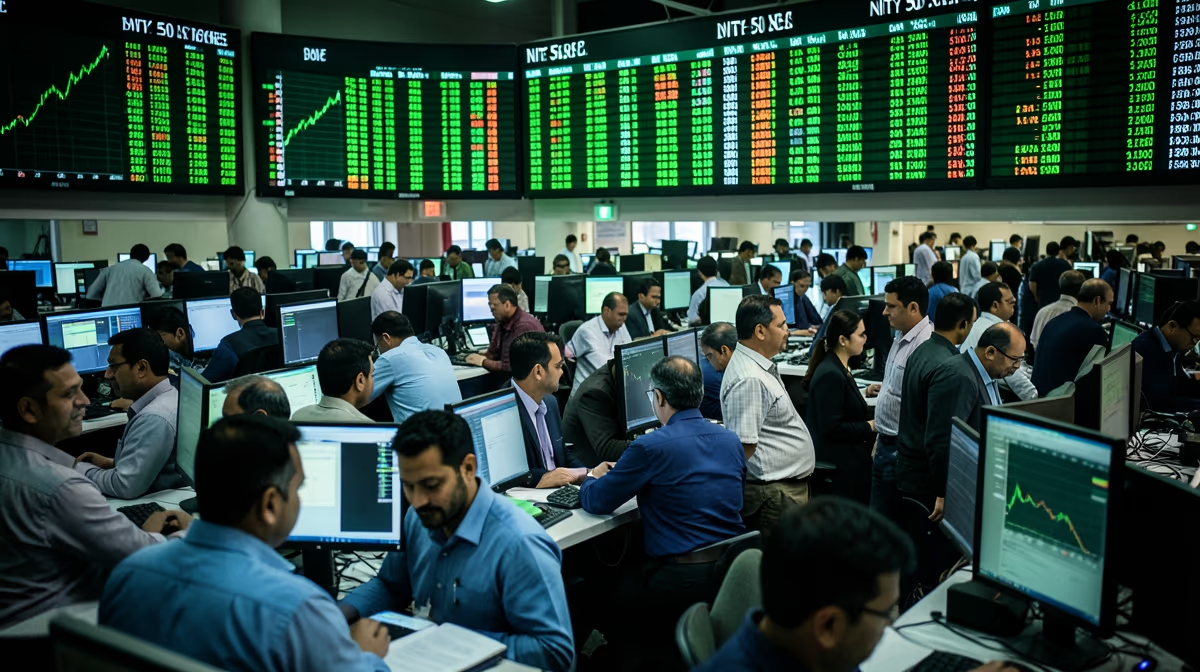
Stay updated with the latest nifty 50 trends, major stock movements, and crucial financial insights as the trading session unfolds. India's benchmark stock index, the Nifty 50, surged to a record high on Tuesday, driven by strong quarterly earnings and robust foreign institutional investor inflows, reflecting a complex interplay of domestic resilience and global liquidity dynamics.
The Mechanics of the National Stock Exchange Benchmark
Imagine the Indian stock market as a giant supermarket, and the Nifty 50 is a basket containing the 50 biggest and most successful companies in India, such as Reliance, TCS, and HDFC Bank. Instead of looking at thousands of individual company stocks, people look at this index to get a quick snapshot of how the overall stock market is doing. If the index goes up, it generally means most of these top companies are having a good day and growing in value.
Created in 1996 by India Index Services and Products Ltd, the index tracks the top 50 companies listed on the National Stock Exchange of India. These companies belong to 13 different economic sectors, including IT, finance, energy, and consumer goods. It operates as a free-float market capitalization-weighted index, meaning bigger companies have more influence on its movement. While investors cannot buy the benchmark directly, they can invest in mutual funds or exchange-traded funds that mimic it.
What Unfolded During the Trading Session
The National Stock Exchange's flagship gauge climbed 1.2 percent to close at 22,502.30 on Tuesday, surpassing its previous peak achieved earlier this year. Heavyweight stocks in the banking, IT, and energy sectors led the market rally, absorbing persistent geopolitical headwinds and global economic uncertainties. Market analysts attribute the surge to sustained domestic retail participation through systematic investment plans and optimism surrounding upcoming macroeconomic data releases. Foreign portfolio investors turned net buyers this week, injecting over $500 million into Indian equities, providing a substantial liquidity cushion. Despite the positive momentum, sector experts have cautioned investors to maintain a defensive stance amid potential volatility ahead of general election results. Valuations remain stretched across several mid-cap and small-cap segments, prompting regulatory warnings from the Securities and Exchange Board of India regarding speculative froth.
Macroeconomic Catalysts and Structural Shifts
The structural growth story of the Indian economy remains supported by strong corporate balance sheets and resilient domestic consumption. At the root of this current market architecture is a structural shift in domestic retail capital displacing foreign institutional investor dominance, transforming Indian equity markets into an insulated consumption-driven proxy. This trend features systemic risk concentration in high-beta domestic mutual funds and systematic investment plan inflows, decoupling valuations from global liquidity cycles.
Simultaneously, India has emerged as a primary non-China destination for passive capital flows, leveraging decoupling narratives to extract premium valuations. The political angle reflects regime legitimation through perpetual market highs, weaponizing retail wealth creation as a macroeconomic referendum on central governance stability. Meanwhile, a hidden angle involves the quiet monetization of rural distress through financialization, where lower-income brackets subsidize urban consumption-led corporate earnings, drawing historical parallels to the Japanese asset price bubble of the late 1980s driven by aggressive domestic liquidity and national pride in corporate champions.
Why This Index Matters to the Wider Economy
The index acts as a national economic barometer. When it rises, it reflects business confidence, corporate growth, and economic health in India, often attracting more investment from both local and global players. Conversely, a sharp fall can signal economic trouble, affecting retirement funds, mutual investments, and overall market sentiment. Retail investors, mutual fund holders, pensioners, employees of top corporations, and anyone with exposure to the Indian financial markets are directly or indirectly impacted by these daily movements.
Outlook and Near-Term Market Trajectory
Over the next 24 hours, market participants can expect consolidation near crucial support levels accompanied by high volatility driven by global cues and foreign institutional investor activity. Looking toward the next 72 hours, a directional breakout will likely depend on macroeconomic data releases and quarterly corporate corporate updates. Key players such as Reliance Industries, HDFC Bank, and ICICI Bank will dictate momentum across banking, financial services, information technology, and fast-moving consumer goods sectors. Expert prediction indicates that cautious sentiment prevails with institutional investors adopting a wait-and-watch approach amid global uncertainties. The best-case scenario involves a strong rebound led by heavyweight banking stocks pushing the index past immediate resistance levels, while the worst-case scenario points to a sharp breakdown below support due to continuous foreign capital outflows and negative global market sentiments.
Frequently Asked Questions
What is the Nifty 50 and how does it work?
The Nifty 50 is the flagship benchmark index of the National Stock Exchange of India. It tracks the weighted average performance of 50 of the largest and most liquid Indian companies across various sectors.
Which companies are included in the Nifty 50?
The index comprises top-tier blue-chip Indian companies like Reliance Industries, TCS, HDFC Bank, Infosys, and ICICI Bank. These stocks represent roughly 65% of the total market capitalization of the NSE.
How often is the Nifty 50 index rebalanced?
The index is reconstituted semi-annually by the Index Maintenance Sub-Committee of NSE Indices Limited. Changes are typically implemented twice a year in March and September based on six-month average data.
Can I invest directly in the Nifty 50?
Investors cannot buy the index directly as it is just a benchmark. However, you can invest in it through Nifty 50 Exchange Traded Funds, index mutual funds, or by trading futures and options contracts.
What is the difference between Sensex and Nifty 50?
The Sensex is the benchmark index of the Bombay Stock Exchange and consists of 30 stocks. In contrast, the Nifty 50 represents the National Stock Exchange and includes 50 stocks, offering a slightly broader market representation.
What factors affect the movement of the Nifty 50?
The index is influenced by macroeconomic indicators such as inflation, GDP growth, interest rate decisions by the RBI, and foreign institutional investor flows. Global market trends and corporate earnings reports also play a major role.
Conclusion
The Nifty 50 has demonstrated significant resilience by closing at a record high of 22,502.30, supported by robust institutional inflows and sustained domestic participation. While banking, IT, and energy sectors continue to drive positive momentum, market participants remain watchful of stretched valuations and regulatory cautions regarding speculative segments. As capital markets navigate near-term consolidation and global economic uncertainties, tracking corporate earnings updates, macroeconomic indicators, and institutional capital flows will remain essential for assessing the trajectory of Indian equities.


.webp)

