
Partial Lunar Eclipse August 2026 Brings Rare 96 Percent Umbral Shift
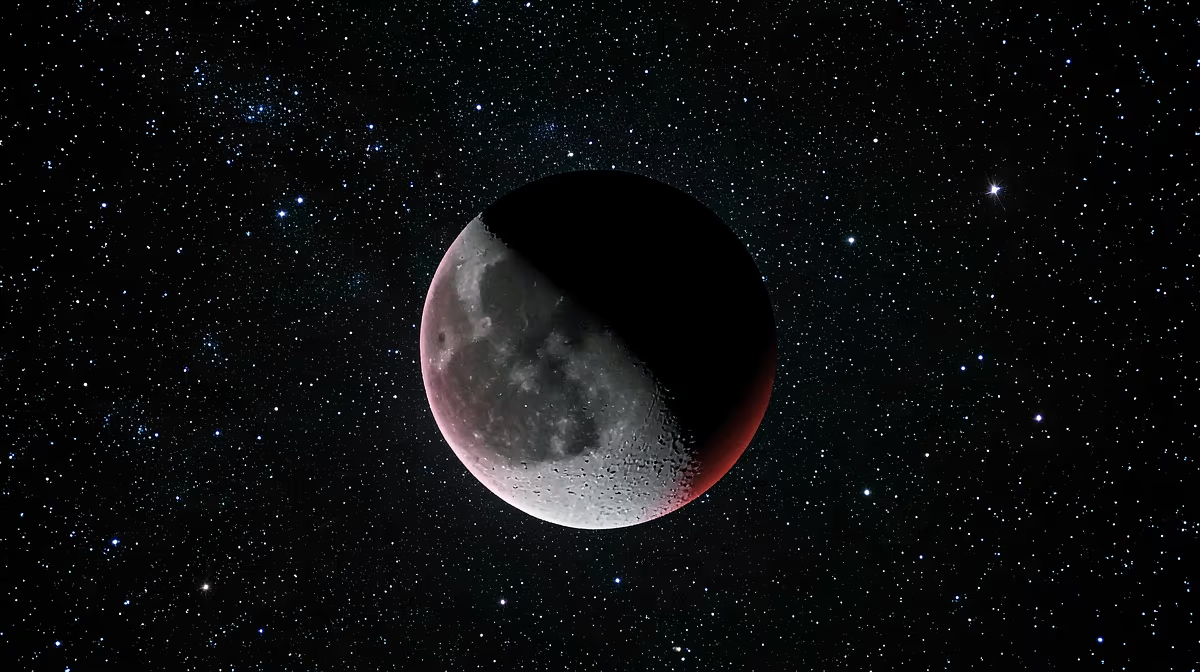
Stargazers around the globe are preparing for the upcoming partial lunar eclipse August 2026, a major astronomical event that will captivate skywatchers everywhere. A deep partial lunar eclipse, reaching nearly complete coverage of the moon's umbra, is approaching for late August 2026, offering skywatchers a striking nearly-total celestial event.
Global Visibility and Timing for the Eclipse
Astronomical observers and publications are preparing for the upcoming deep partial lunar eclipse scheduled for August 27 and 28, 2026. The celestial event will feature a significant alignment, with sources reporting an umbral coverage of approximately 93 to 96 percent, making it an 'almost total' lunar eclipse.
Skywatchers around the world are getting ready for a remarkable celestial event as this deep partial lunar eclipse approaches. This eclipse will be nearly total, with a massive chunk of the Moon slipping into Earth's darkest shadow, known as the umbra. During this event, about 93 to 96 percent of the Moon's face will be covered by Earth's shadow. Observers in the right regions will see the familiar lunar surface darken dramatically, taking on an eerie, shadowed appearance that comes just shy of a full total lunar eclipse.
- The deep partial lunar eclipse is scheduled to take place on August 27-28, 2026.
- Approximately 93% to 96% of the Moon will pass through the Earth's umbra shadow.
- The event is frequently described by astronomers as an 'almost total' lunar eclipse.
- Major space and astronomy publications like Space, Sky & Telescope, and Universe Today are providing live updates and viewing guides.
- The eclipse offers a spectacular near-total visual experience without requiring special eye protection.
Scientific Mechanics and Media Coverage
Astronomical outlets including Space, Sky & Telescope, and Universe Today have begun publishing viewing tips, live updates, and coverage details for enthusiasts looking forward to the late August event. The high percentage of umbral coverage means a large portion of the moon will pass through the Earth's dark central shadow, creating dramatic visual effects for observers in visible regions.
The root cause of this phenomenon lies in the recurring orbital mechanics of the Earth-Moon-Sun system bringing the Moon into alignment with Earth's umbral shadow, resulting in a near-total partial lunar eclipse. A lunar eclipse occurs when the Earth moves directly between the Sun and the Moon, blocking sunlight from reaching the lunar surface. A partial lunar eclipse happens when only a portion of the Moon enters the darkest part of Earth's shadow, while a total eclipse covers the entire lunar disc.
| Timeline Milestone | Activity / Focus |
|---|---|
| August 19-22, 2026 | Major science and astronomy publications release initial viewing guides and visibility maps. |
| August 27-28, 2026 | The deep partial lunar eclipse reaches its peak of roughly 93% to 96% umbral coverage. |
| Post-Eclipse 2026 | Analysis of observation data and public engagement metrics by global astronomical communities. |
Broader Industry and Societal Impacts
Major astronomical alignments like a deep partial lunar eclipse offer a wonderful opportunity to engage the public in science and astronomy. Events like this inspire curiosity about our solar system, encourage people to look up at the night sky, and provide accessible educational moments for families and students alike.
Stargazers and astronomy enthusiasts across the globe who experience nighttime during the August 27-28 window will be able to witness the event, depending on local weather conditions and visibility. Beyond public engagement, analysts note several broader dimensions surrounding the event:
- Economic angle: Boost in the astro-tourism sector, optical equipment sales, and digital streaming platforms covering live celestial updates.
- Political angle: Scientific diplomacy and public engagement initiatives funded by global space agencies and educational ministries to promote STEM awareness during major astronomical events.
- Geopolitical angle: Cross-border collaboration and synchronized observation campaigns among international astronomical associations across visible regions.
- Hidden angle: The increasing reliance on private space news outlets and digital aggregators for real-time scientific reporting, shifting the public dissemination of astronomy away from traditional state-backed institutions.
Outlook and Observation Forecasts
As the date approaches, stargazers and astronomy enthusiasts are turning their attention to regional visibility charts and weather forecasts to ensure optimal viewing conditions. Live updates and guides are expected to remain active as the community prepares for the midnight spectacle.
Over the next 24 hours, media coverage and anticipation will build regarding the upcoming deep partial lunar eclipse scheduled for late August 2026, with science outlets continuing to publish viewing guides, timing details, and visibility maps. Looking further ahead into the next 72 hours, astronomical publications and news sites will ramp up countdowns, live update preparations, and educational articles explaining the mechanics of the nearly total 93% to 96% umbral eclipse.
Experts and analysts expect high public interest and robust online viewership of live updates due to the unusually high umbral coverage of nearly 96% for a partial eclipse. The best-case scenario features clear skies globally across key viewing regions, allowing millions of enthusiasts to safely observe and document the near-total lunar eclipse without obstruction. Conversely, the worst-case scenario involves widespread cloud cover or poor weather conditions obscuring the event for major population centers, dampening live-viewing engagement.
A deep partial lunar eclipse with about 93% to 96% umbral coverage provides a near-total visual experience for global skywatchers on August 27–28, 2026.
The deep partial lunar eclipse on August 27-28, 2026, offers an unprecedented near-total viewing experience with up to 96% umbral coverage, engaging millions of skywatchers worldwide.
Frequently Asked Questions
When is the partial lunar eclipse in August 2026?
A deep partial lunar eclipse is scheduled to take place on August 27–28, 2026. This upcoming celestial event offers skywatchers a dramatic view just before the end of the month.
What percentage of the Moon will be covered during the August 2026 lunar eclipse?
This event is an 'almost total' or deep partial lunar eclipse, with sources noting about 93% to 96% of the Moon entering the Earth's umbra. This high coverage creates a striking visual effect across the lunar surface.
Where will the partial lunar eclipse be visible from?
Visibility depends on your geographic location relative to the night side of Earth during the August 27–28 window. Observers in regions with clear night skies will have the best opportunity to watch the progression of the eclipse.
Why is this deep partial lunar eclipse significant?
Because nearly the entire lunar disk falls within the Earth's shadow, it provides a near-total eclipse experience without being fully total. It serves as a major event for astronomy enthusiasts and casual stargazers alike.
How can I watch the August 2026 lunar eclipse safely?
Unlike solar eclipses, lunar eclipses are entirely safe to view with the unaided eye, requiring no special eye protection. Binoculars or telescopes can enhance the experience by offering a closer look at the shadowed craters.
What happens next after the August 2026 lunar eclipse?
Following the live updates and peak viewing of the August 27–28 eclipse, astronomers and space news outlets will begin tracking upcoming lunar and solar alignments for later in the year. Stargazers can continue to monitor astronomical calendars for the next planetary conjunctions or meteor showers.
Conclusion
The upcoming deep partial lunar eclipse on August 27–28, 2026, stands as a major celestial event characterized by its exceptionally high umbral coverage of 93% to 96%. With science media outlets providing comprehensive viewing guides, visibility maps, and live updates, observers worldwide are preparing for the midnight spectacle. As the astronomical community and digital platforms continue tracking local weather forecasts and visibility zones, the event highlights ongoing public enthusiasm and engagement with space science.
Sources
- Partial lunar eclipse August 2026 — Where will it be visible from? — Space
- Next Up! A Deep Partial Lunar Eclipse on Aug. 27–28 — Sky & Telescope
- Catching An 'Almost Total' Lunar Eclipse on August 28th — Universe Today
- Partial lunar eclipse August 28 2026 with about 93% umbra — NewsBytes
- Partial lunar eclipse live: Latest news, viewing tips and live updates from Aug. 27-28 eclipse — Space
- A 96% partial lunar eclipse is just 1 week away: Here's what you need to know — Space


.webp)
