
Partial Lunar Eclipse August 2026 Timing and Visibility Will Shock You
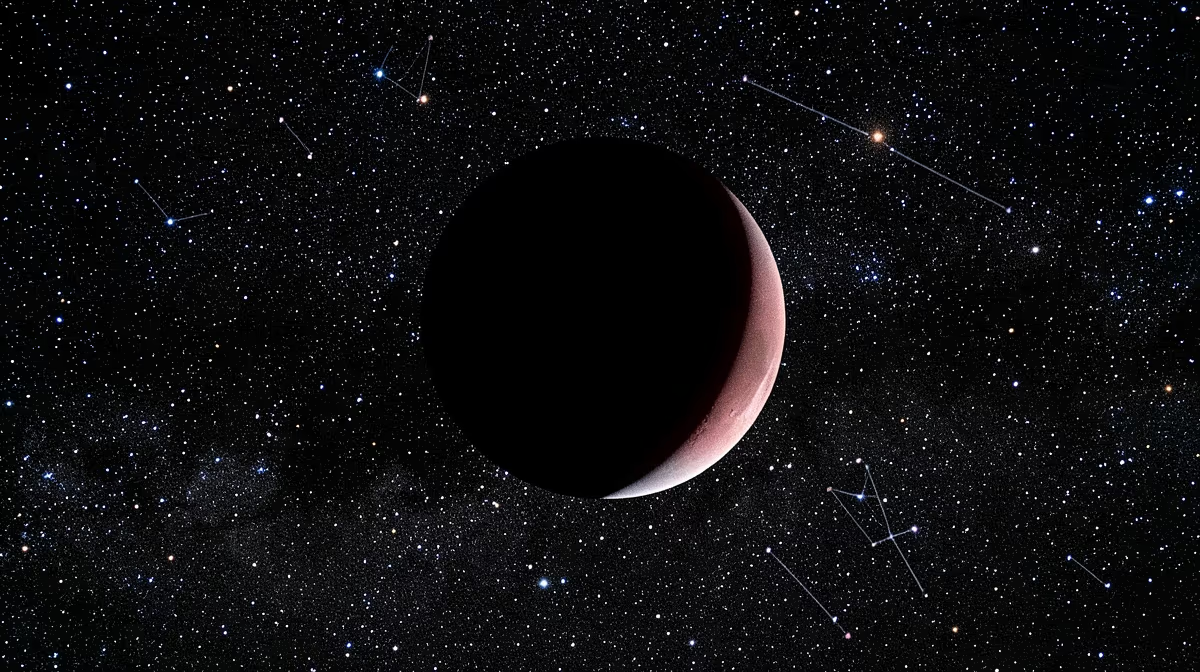
Get ready for an upcoming celestial spectacle with the partial lunar eclipse August 2026 event lighting up the night sky. A deep partial lunar eclipse is approaching on August 27–28, 2026, offering stargazers around the world a view of an almost total lunar occultation. Stargazers and astronomy enthusiasts are preparing for a deep partial lunar eclipse scheduled for August 27 and 28, 2026. Publications including Space, Sky & Telescope, and Universe Today have reported that the upcoming celestial event will feature a remarkably high umbral coverage, described in various reports as ranging from approximately 93% to nearly 96%.
Because the moon will pass deeply through Earth's shadow without achieving a complete total eclipse, observers will witness a dramatic darkening across the lunar disk. Outlets such as NewsBytes note that the substantial umbra percentage will make the event particularly striking compared to standard partial eclipses. Astronomical platforms are rolling out viewing tips, live updates, and scheduling details as the event draws closer. Observers worldwide are encouraged to check local visibility maps and timing details to catch the 'almost total' lunar display.
Understanding the Celestial Alignment
Skywatchers around the world are getting ready for a fascinating celestial event: a deep partial lunar eclipse happening on the night of August 27 to August 28, 2026. During this event, the Earth will move directly between the sun and the moon, casting its shadow across the lunar surface and creating a striking visual spectacle.
This particular eclipse is notable because it is an "almost total" or deep partial eclipse, with about 93 to 96 percent of the moon slipping into the Earth's darkest central shadow, known as the umbra. Viewers in regions where the moon is above the horizon during the event will see a dramatic darkening of the lunar disk, turning a significant portion of it a deep, shadowy grey or reddish hue.
A lunar eclipse occurs exclusively during a full moon when the Earth moves directly between the sun and the moon, blocking sunlight from directly striking the lunar surface. Depending on the alignment, these eclipses can be total, partial, or penumbral, with partial eclipses showing a distinct shadowed bite taken out of the moon.
Key Facts and Observations
- The deep partial lunar eclipse will take place on August 27 to August 28, 2026.
- Approximately 93% to 96% of the moon will enter the Earth's umbra, making it an almost total eclipse.
- The celestial event is widely covered by prominent science and astronomy outlets including Space, Sky & Telescope, and Universe Today.
- Observers will witness a dramatic darkening across the lunar surface as the Earth moves between the sun and the moon.
- The eclipse offers a prime viewing opportunity for astronomy enthusiasts and casual skywatchers alike depending on their geographic location.
Major celestial alignments like deep partial lunar eclipses spark widespread public interest in astronomy and space science. They provide accessible opportunities for people of all ages to step outside, look up, and engage directly with the wonders of our solar system without needing expensive equipment. Stargazers and astronomy enthusiasts located in regions where the moon is visible during the night of August 27–28, 2026, will be able to experience and observe the eclipse firsthand.
Timeline of Events and Media Coverage
The timeline surrounding the astronomical phenomenon illustrates a steady ramp-up in scientific communication and public engagement:
- August 19-22, 2026: Major scientific publications and media outlets begin releasing viewing guides and countdown coverage for the upcoming eclipse.
- August 27-28, 2026: The deep partial lunar eclipse peaks, offering a nearly total umbral coverage visible across multiple regions.
- Post-August 2026: Analysis of public engagement metrics and educational outreach success following the global celestial event.
Media outlets and science platforms are actively ramping up coverage and viewing guides for the upcoming deep partial lunar eclipse scheduled for late August 2026. Astronomical organizations and space news websites continue to publish updates, optimal viewing tips, visibility maps, and timing details for the ~93% to 96% umbral eclipse.
Broader Implications and Public Engagement
The root cause of this excitement is the celestial alignment of the Sun, Earth, and Moon resulting in a deep partial lunar eclipse, bringing widespread public and scientific engagement with astronomical phenomena. Governments and public space agencies can utilize major celestial events to foster STEM education, public science literacy, and international scientific collaboration.
Economically, such events provide a boost to the astro-tourism sector, educational instrument sales, and digital media platforms providing live coverage and viewing guides for millions of enthusiasts worldwide. Geopolitically, shared celestial events represent global astronomical synchronization, transcending national borders and diplomatic tensions to unite international observers under common scientific curiosity.
There is also an increased public reliance on private satellite constellations and commercial space news aggregators for real-time scientific data, which may subtly shift public space awareness away from state-run space agencies. Historically, lunar eclipses carry a long tradition of being used to study Earth's shadow and atmospheric properties, dating back to ancient astronomers mapping celestial mechanics.
Viewing Outlook and Forecast Scenarios
Analysts expect high public interest and robust engagement with live updates and viewing guides as the deep partial lunar eclipse approaches. However, viewing success depends heavily on atmospheric conditions on the ground.
- Best Case: Clear weather conditions globally allow millions of observers to witness the nearly total lunar eclipse without obstruction.
- Worst Case: Widespread cloud cover or poor weather conditions obstruct viewing opportunities for major populations in the visibility zones.
Frequently Asked Questions
When is the partial lunar eclipse in August 2026?
The deep partial lunar eclipse is scheduled to take place on August 27–28, 2026. This celestial event features an almost total obscuration of the moon by Earth's shadow.
What percentage of the moon will be covered during the August 2026 eclipse?
Depending on specific tracking updates, reports note that approximately 93% to 96% of the moon will enter Earth's umbra. This makes it an exceptionally deep partial lunar eclipse that closely mimics a total eclipse.
Where will the partial lunar eclipse be visible from?
Visibility for the August 28, 2026 lunar eclipse spans various regions across the globe depending on nighttime hours during the event. Observers situated in areas facing the moon at the correct time will be able to catch the almost total alignment.
Why is this upcoming lunar eclipse significant?
This eclipse is particularly noteworthy because nearly the entire lunar disk passes through the dark central part of Earth's shadow. Such a high percentage of umbral coverage offers stargazers a dramatic visual experience without being a full total eclipse.
Who can view the deep partial lunar eclipse?
Anyone located in the geographic regions where the moon is above the horizon during the night of August 27–28, 2026, can view the event. No special eye protection is required to safely watch a lunar eclipse.
What happens next after observing the partial lunar eclipse?
Following the peak of the eclipse, the moon will gradually exit Earth's umbral shadow and return to its full brightness. Stargazers can continue to monitor astronomical updates for upcoming lunar and solar eclipses later in the year.
Conclusion
The deep partial lunar eclipse scheduled for August 27–28, 2026, stands as a prominent celestial event offering observers a dramatic view of the moon passing through roughly 93% to 96% of Earth's umbral shadow. With verified reports and viewing guides published across leading scientific platforms like Space, Sky & Telescope, Universe Today, and NewsBytes, public interest and engagement continue to grow. Stargazers and astronomy enthusiasts are advised to check local visibility maps, monitor regional weather forecasts, and prepare to observe the almost total lunar alignment as the event unfolds.
Sources
- Partial lunar eclipse August 2026 — Where will it be visible from? — Space
- Next Up! A Deep Partial Lunar Eclipse on Aug. 27–28 — Sky & Telescope
- Catching An 'Almost Total' Lunar Eclipse on August 28th — Universe Today
- Partial lunar eclipse August 28 2026 with about 93% umbra — NewsBytes
- Partial lunar eclipse live: Latest news, viewing tips and live updates from Aug. 27-28 eclipse — Space
- A 96% partial lunar eclipse is just 1 week away: Here's what you need to know — Space


.webp)
