
Indian stock market crash erases trillions as Nifty and Sensex plunge
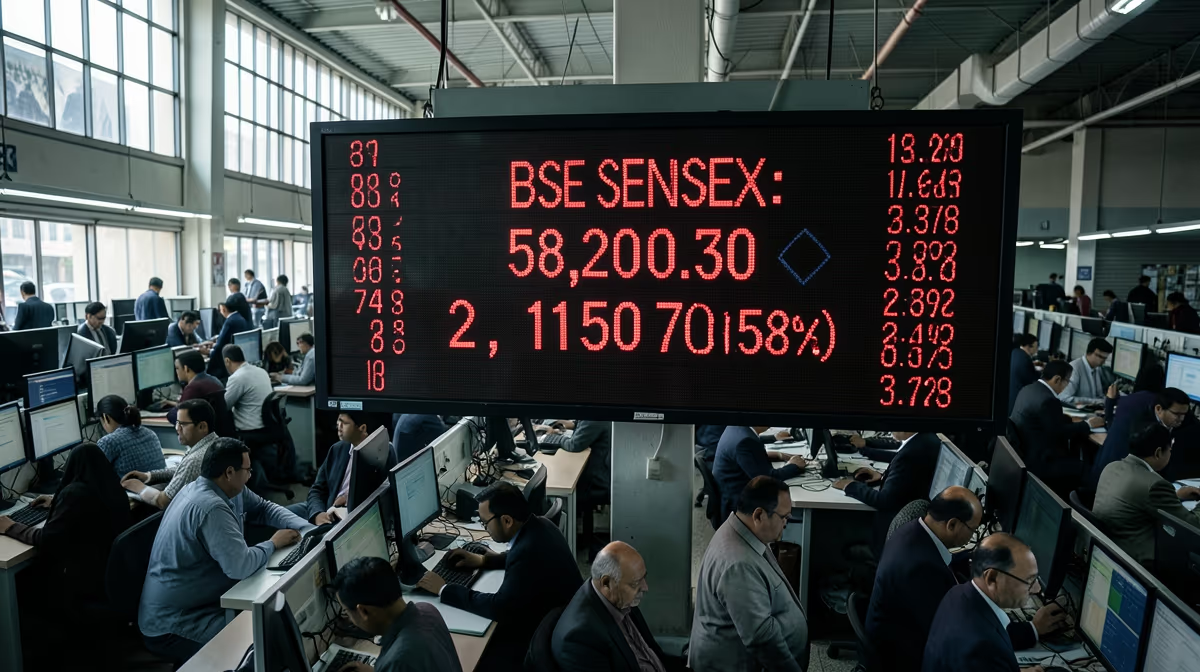
Trillions of rupees in investor wealth vanished within hours as a wave of intense selling pressure transformed Dalal Street into a zone of high-stakes volatility. The suddenness of the Indian stock market crash has forced financial analysts to look past surface-level fluctuations and examine the deeper structural shifts currently rattling the nation’s equity markets. As the BSE Sensex plummeted over 600 points in a single session—following even steeper drops of 1,064 points previously—investors faced a harsh reality where psychological support levels for the Nifty50, such as 23,000 and 22,650, were breached with alarming speed.
Investors faced massive losses as the Indian stock market crash sent shockwaves through Dalal Street, wiping out nearly Rs 7.5 lakh crore in market capitalization during the most severe stretches of the downturn. This correction is not an isolated event but the culmination of several factors, including aggressive foreign institutional investor (FII) sell-offs and a tepid reaction to international cues from Wall Street.
The sharp market correction wiped out trillions of rupees in investor wealth, with the Nifty50 logging its seventh straight weekly loss as heavyweight financial stocks faced severe selling pressure.
The anatomy of a market sell-off
Technical thresholds breached
- The BSE Sensex recorded a single-day tumble of over 1,064 points.
- Nifty50 dropped below key supports at 23,000 and 22,650.
- Market capitalization erosion reached approximately Rs 7.5 lakh crore during peak sell-offs.
- The Nifty50 index has logged seven consecutive weekly losses, indicating a persistent downward trend.
The institutional exodus and global cues
The Wall Street connection
The steady sequence of weekly losses despite occasional intraday rebounds could indicate systemic repositioning by institutional players anticipating broader macroeconomic structural shifts.
Sectoral impact and heavyweight losses
| Index/Stock | Performance Detail | Impact Level |
|---|---|---|
| BSE Sensex | Tumbled over 600 points | Severe |
| Nifty50 | Below 22,650 threshold | Critical |
| Market Cap | Rs 7.5 lakh crore wiped out | Massive |
| Bajaj Finance | Identified as a top loser | Sectoral Drag |
| Kotak Mahindra | Significant selling pressure | Sectoral Drag |
The steep correction in these banking and financial services stocks highlights the economic angle of the crash. When top-weighted equities falter, it underscores persistent bearish trends that can dampen consumer confidence and tighten financial conditions across the broader economy. This is particularly concerning for retail investors and mutual fund participants who have seen their portfolio values erode during this period of high BSE market volatility.
Macroeconomic pressures and political implications
Geopolitical and structural shifts
The path ahead for investors
Best-case and worst-case scenarios
- Best-case scenario: The indices find strong support at these multi-month low levels, triggering a technical rebound. This would stabilize investor confidence and allow selling pressure to ease as buyers return to seek value in corrected stocks.
- Worst-case scenario: If institutional selling continues unabated, indices could fall deeper into correction territory. This would lead to a further erosion of market capitalization and could potentially trigger heightened panic among retail participants.
Investors are advised to keep a close watch on overnight international cues and domestic economic data releases, as these will dictate whether the market can snap its streak of weekly losses.
Frequently Asked Questions
Why did the Indian stock market crash recently with Sensex and Nifty dropping sharply?
The Indian stock market witnessed a massive sell-off triggered by a combination of weak global cues, continuous FII activity, and broader macroeconomic concerns. The BSE Sensex tumbled over 600 to 1,000 points, and the Nifty50 dropped below key psychological levels like 23,000 and 22,650.
What is the background of the Nifty50's recent performance?
Prior to the severe single-day crashes, the Nifty50 had already been struggling to maintain upward momentum, logging seven straight weeks of losses. The index touched several multi-month lows as negative sentiment rippled across various trading sessions.
How much investor wealth was wiped out during the recent market drop?
The sharp market correction wiped out trillions of rupees in investor wealth, with specific sessions recording capital losses running into approximately Rs 7.5 lakh crore.
Who are the most affected by the Sensex and Nifty decline?
Retail investors and mutual fund holders with heavy exposure to equities bore the brunt of the volatility. Specific sectoral heavyweights like Bajaj Finance and Kotak Mahindra Bank faced severe selling pressure, leading the list of market losers.
What should investors monitor before trading when the stock market crashes?
Traders are advised to watch overnight Wall Street cues, foreign institutional investor (FII) buying or selling patterns, and domestic economic data releases. Keeping an eye on technical support levels for Sensex and Nifty can also help manage risk.
What happens next for the Sensex and Nifty50 after hitting recent lows?
Markets typically experience heightened volatility and attempts at recovery following steep crashes. While some sessions may see minor rebounds, sustained recovery relies on stabilizing international markets and renewed buying confidence from institutional players.
Conclusion
The Indian stock market remains in a state of flux as it grapples with a sharp valuation correction that has hit multi-month lows. With the BSE Sensex and Nifty50 breaching critical thresholds, the erosion of Rs 7.5 lakh crore in market capitalization serves as a stark reminder of the current volatility. While occasional rebounds like the 315-point bounce for the Sensex offer brief moments of relief, the overarching trend of seven straight weekly losses for the Nifty suggests that the market is still searching for a definitive floor. The coming days will be crucial as investors watch FII activity and global cues to determine if the market can stabilize or if further corrections are on the horizon. Management of retail sentiment and institutional fund flows will be the deciding factors in whether Dalal Street can regain its upward momentum.
Sources
- Stock Market Today Live Updates: BSE Sensex tumbles over 600 points, Nifty50 below 22,650 after hitting 6-month low in previous session — The Times of India
- Sensex Today Live: Sensex Crashes 1,064 Points, Nifty Falls Below 23,000 And Rs 7.5 Lakh Crore Market Cap Wiped Out; Why Is Indian Stock Market Falling Today? Check 5 Key Reasons — The Sunday Guardian
- BSE SENSEX Today: Sensex Rebounds 315 Points to 73,895.74 but Nifty Logs Seventh Straight Weekly Loss — BBN Times
- Sensex Today Tanks 695 Points | Nifty Below 22,600 | Bajaj Finance & Kotak Mahindra Top Losers — Equitymaster
- Sensex, Nifty opening: Will stock market crash or open higher today? — India Today
- NIFTY50, SENSEX today: Wall Street cues, FII activity, key things to know before markets open on September 29 — Upstox


.webp)

