
Saturn South Pole Decagon Discovery Stuns Planetary Scientists
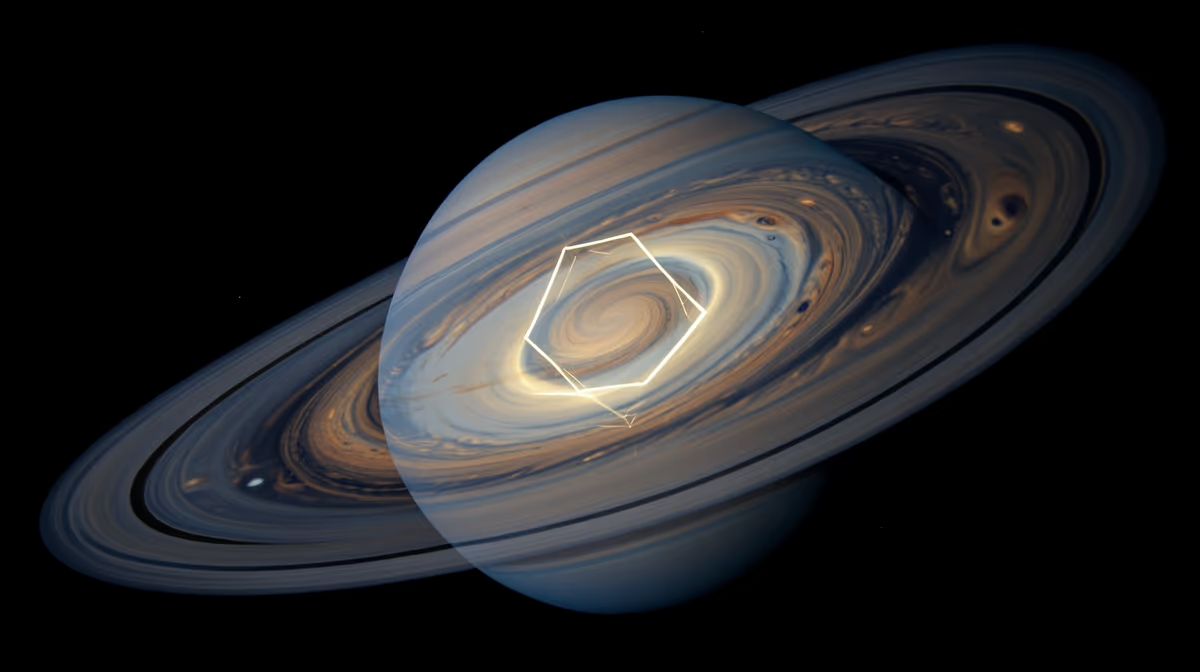
Recent space observations have revealed a bizarre atmospheric formation known as the Saturn south pole decagon, baffling scientists across the globe. Astronomers using new Hubble images have discovered a mysterious 10-sided cloud structure swirling over Saturn's south pole, revealing a bizarre decagon and wave pattern in the planet's atmosphere.
Unveiling the Ten Sided Polar Vortex on Saturn
The unusual weather phenomenon, characterized by a massive 10-sided wave pattern, has surprised researchers studying Saturn's complex atmospheric dynamics. While Saturn's north pole is famously known for its persistent hexagonal storm, the newly discovered decagon at the south pole introduces an entirely different geometric structure to the gas giant's polar regions. Scientists made the observation utilizing recent imaging data from the Hubble Space Telescope, highlighting unexpected differences between the planet's two poles. The findings offer new avenues of research into how planetary waves and atmospheric circulation form and maintain such precise geometric shapes across different hemispheres. Researchers are continuing to analyze the data to understand the underlying physical mechanisms driving this ten-sided formation.
Astronomers analyzing new images from the Hubble Space Telescope have uncovered a bizarre and unexpected feature on Saturn: a massive, 10-sided cloud structure swirling right over the planet's south pole. This geometric wonder forms a giant decagon wave pattern in the atmosphere, leaving scientists fascinated by the complex weather systems of the gas giant. While Saturn's north pole is already famous for its persistent six-sided hexagonal storm, finding a 10-sided structure in the south is entirely new. Researchers are studying these atmospheric waves to understand how such precise geometric shapes can form and stabilize in planetary atmospheres.
- Astronomers discovered a mysterious 10-sided cloud structure at Saturn's south pole.
- The findings are based on new images captured by the Hubble Space Telescope.
- The phenomenon appears as a huge 10-sided wave pattern or decagon swirling in the clouds.
- Saturn is already well-known for the famous hexagonal six-sided storm located at its opposite, north pole.
- Reports on this planetary discovery were published by scientific news outlets in September 2026.
What Planetary Atmospheric Waves Tell Us About Gas Giants
Discoveries like this push the boundaries of planetary science and fluid dynamics, helping researchers understand how complex weather patterns and atmospheric waves form not just on Saturn, but across gas giant planets throughout the universe. Gas giants like Saturn and Jupiter frequently exhibit complex atmospheric banding and persistent vortex storms due to their rapid rotation and lack of solid surfaces. The most famous example is Saturn's north pole hexagon, a stable six-sided wave pattern discovered decades ago by the Voyager spacecraft and later studied extensively by Cassini.
Planetary scientists, astrophysicists, and space enthusiasts following discoveries in our solar system are directly affected by these findings. The root cause of this phenomenon lies in advanced atmospheric fluid dynamics and planetary wave phenomena operating under unique conditions at Saturn's south pole, as captured by high-resolution Hubble imaging.
Historical Context and Underlying Physics
The timeline of polar discoveries on the ringed planet spans decades of deep-space observation:
- Voyager missions discover the northern hexagon pattern
- Cassini spacecraft provides long-term monitoring of Saturn's polar vortices
- Hubble Space Telescope reveals a new 10-sided decagon wave structure at the south pole
Public funding and political support for space agencies rely heavily on captivating, highly visual astronomical discoveries to maintain taxpayer enthusiasm and legislative budgets. Meanwhile, investments in space telescope infrastructure and deep-space observation programs yield valuable technological spinoffs and drive public-private aerospace partnerships. Planetary exploration fosters international scientific collaboration and data-sharing agreements, transcending terrestrial geopolitical tensions through joint cosmic curiosity. The discovery of complex polygonal wave structures on gas giants may also hint at universal fluid dynamic principles that could improve climate modeling and atmospheric prediction models on Earth.
Future Outlook and Expert Analysis
Astronomical data from Hubble will continue to be analyzed by researchers globally, leading to increased public interest and deeper examination of the newly discovered decagon wave pattern. Planetary scientists and atmospheric researchers are expected to release preliminary computer simulations or hypotheses regarding the formation mechanisms of the 10-sided cloud structure at Saturn's south pole.
Analysts would likely expect further archival data comparisons with Cassini mission findings to determine if this 10-sided structure is a transient phenomenon or a semi-permanent atmospheric feature similar to Saturn's north pole hexagon.
The best case scenario provides groundbreaking insights into gas giant atmospheric dynamics, unlocking new models for polar vortex wave patterns across the solar system. In the worst case, the feature proves difficult to model with current fluid dynamics simulations, leaving researchers with prolonged uncertainty regarding how such a precise geometric wave pattern is maintained.
The discovery provides groundbreaking insights into gas giant atmospheric dynamics, unlocking new models for polar vortex wave patterns across the solar system.
Frequently Asked Questions
What did astronomers recently discover at Saturn's south pole?
Astronomers discovered a mysterious 10-sided cloud structure, also known as a decagon, swirling in the atmosphere above Saturn's south pole. This bizarre wave pattern was revealed through new images captured by the Hubble Space Telescope.
Why is the discovery of Saturn's 10-sided cloud important?
This finding provides scientists with new insights into the complex atmospheric dynamics and weather patterns of gas giants. Understanding these unique polar formations helps researchers compare planetary behaviors across our solar system.
Who is affected by this astronomical finding?
While it does not directly impact everyday life on Earth, planetary scientists, astrophysicists, and researchers studying planetary atmospheres are deeply affected as they update their models of Saturn's climate. It also captivates space enthusiasts and the broader scientific community.
What happens next in the study of Saturn's south pole?
Scientists plan to conduct further analysis of the Hubble data and compare this southern decagon with Saturn's famous northern hexagon. Future observations will likely focus on how these persistent wave patterns form and maintain their geometric shapes.
What is the background of weather patterns on Saturn?
Saturn is well known for its extreme and unusual atmospheric phenomena, most notably the long-standing hexagonal storm system located at its north pole. The newly revealed 10-sided structure at the south pole adds another layer of complexity to our understanding of the planet's dual-polar dynamics.
How many sides does the newly discovered wave pattern have?
The newly discovered wave pattern swirling in the clouds over Saturn's south pole features precisely 10 sides, forming a rare decagon structure. This geometric precision continues to puzzle researchers studying the planet's upper atmosphere.
Conclusion
New Hubble images have successfully confirmed a 10-sided cloud structure and wave pattern at Saturn's south pole, marking a significant milestone in planetary science. As researchers continue to study how this decagon forms and is maintained in comparison to the northern hexagon, global scientific teams will analyze archival data and run advanced computer simulations to unlock the physical mechanisms driving this unusual polar vortex.


