
Wall Street Rebounds After Fed Rate Hike as New Market Pressures Mount
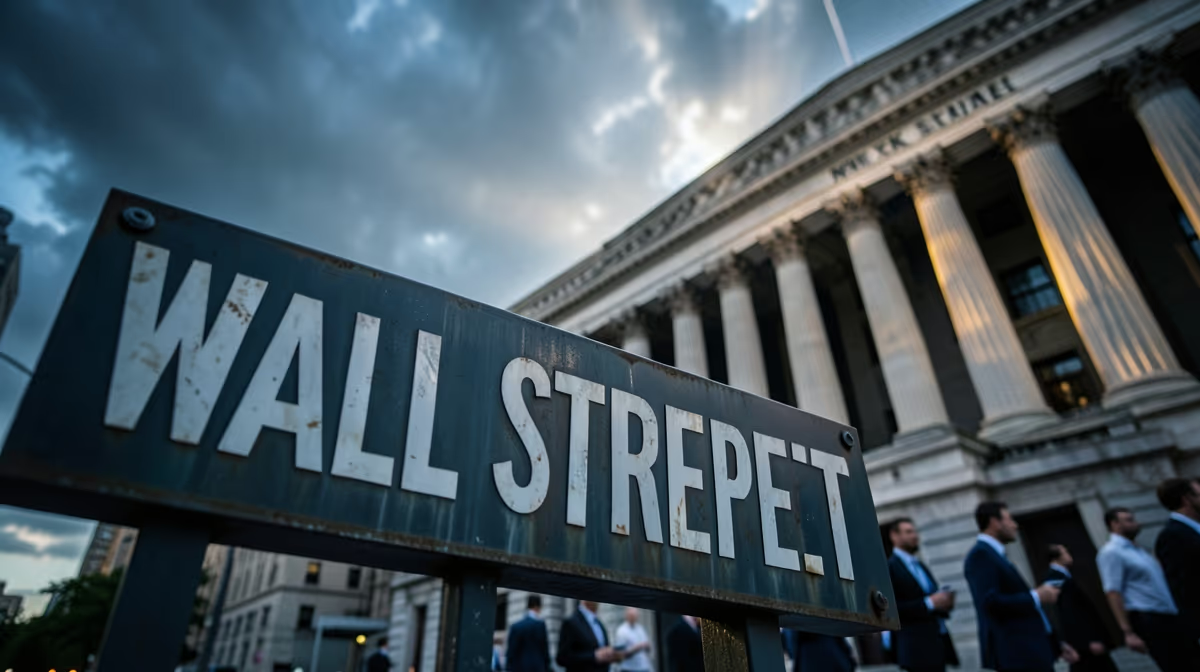
Financial markets frequently behave counterintuitively when central banks take aggressive policy action, turning potential systemic stress into immediate upside momentum. Following a period of market losses and inflation anxieties, Wall Street rebounds after Fed rate hike decisions as investors digest the Federal Reserve’s hawkish monetary policy trajectory.
Wall Street’s post-hike recovery highlights how immediate drops in Treasury yields and oil prices can temporarily overshadow deeper corporate earnings worries.
Understanding the Post-Fed Policy Shift
The monetary policy shift by the Federal Reserve brought an aggressive policy stance back into focus, triggering a sharp repositioning across global asset classes. Leading up to the central bank's announcement, baseline equity futures reflected considerable market anxiety. Investors faced persistent fears regarding rising borrowing costs, inflationary pressures, and sector-specific headwinds.
When the monetary policy adjustment was confirmed, initial market jitters gave way to a broad equity recovery. Benchmark indices posted gains across the board as market participants evaluated the central bank's long-term economic outlook. Reports from Reuters, Barron's, and Investor's Business Daily confirmed positive upward momentum across equities following the central bank's announcement.
- Major benchmark indices, including the Dow Jones Industrial Average, the S&P 500, and the Nasdaq, all reversed earlier declines to trade higher.
- A simultaneous dip in Treasury yields helped reduce systemic pressure on equity valuations, offering relief to growth-oriented equities.
- Crude oil prices pulled back during the trading session, mitigating immediate fears regarding energy-driven consumer cost spikes.
This relief rally demonstrates how swiftly market sentiment can pivot once policy uncertainty is resolved. While the central bank's hawkish turn on inflation establishes a tighter monetary environment, the market's immediate reaction centered on short-term stability rather than long-term policy friction.
Key Market Drivers and Corporate Movers
The broader equity recovery was driven by key corporate movers across several distinct industries, reflecting a mixed but resilient backdrop for equities. Technology, retail, and industrial leaders posted substantial activity as market liquidity adjusted to the revised policy framework.
A sudden drop in Treasury yields and energy prices provided the necessary relief to lift major indices despite hawkish central bank guidance.
| Market Benchmark / Asset | Policy Reaction Direction | Primary Market Drivers |
|---|---|---|
| Dow Jones Industrial Average | Upward Rebound | Broad industrial resilience and easing bond yield pressures |
| S&P 500 Index | Upward Rebound | Relief across mega-cap equities and consumer discretionary sectors |
| Nasdaq Composite | Upward Rebound | Recovery in major technology components following initial volatility |
| Treasury Yields | Downward Dip | Easing short-term rate anxiety and repositioning in fixed income |
| Crude Oil Prices | Downward Dip | Reduced commodity price pressure softening inflation expectations |
Specific corporate entities played a central role in shaping the trading session's outcome:
- Semiconductor manufacturers such as Micron and Intel experienced dynamic trading activity as investors balanced broader tech gains against sector-specific demand concerns.
- E-commerce and retail giant Amazon contributed significantly to consumer discretionary index momentum during the trading rebound.
- Industrial and energy technology providers like Generac saw heightened volume as capital recalibrated across major corporate sector movers.
Despite these notable individual gainers, Bloomberg.com highlighted that the recovery occurred alongside persistent underlying worries surrounding chipmakers dealing with artificial intelligence slowdown concerns.
Economic Pressures and Sector Vulnerabilities
A comprehensive analysis of the market rally reveals notable structural divergences beneath headline index numbers. While major stock indexes celebrated immediate rate action relief, the underlying divergence between booming mega-cap momentum and cautious semiconductor supply chains suggests deeper structural vulnerabilities in corporate earnings.
The Federal Reserve interest rate impact stretches far beyond equity exchanges, creating direct real-world effects across the economic spectrum:
- Borrowing costs for variable-rate loans rise, directly impacting household balance sheets and enterprise credit facilities.
- Retirement accounts, pension funds, and retail mutual fund balances remain exposed to ongoing market volatility as asset values fluctuate.
- Corporate hiring plans and strategic capital investments face closer scrutiny as financial conditions tighten under a hawkish central bank stance.
Historically, this pattern of market volatility followed by a relief rally mirrors mid-cycle Fed policy adjustments observed during the 1990s. During those historical periods, markets initially absorbed central bank policy tightening with sharp fluctuations before recalibrating around core economic indicators and yield stabilization.
Geopolitical and Policy Dimensions
The policy decisions of the Federal Reserve carry far-reaching consequences that extend well beyond domestic trading floors. International financial systems remain tightly linked to American monetary policy shifts, ensuring that domestic rate changes ripple globally.
Global Capital Flow Dynamics
When central bankers adjust interest rates to counter inflation, cross-border capital flows undergo rapid realignments. International investors adjust their exposure to US assets based on evolving yield differentials, which directly impacts emerging market currency stability and sovereign debt pricing. Furthermore, international commodity pricing—particularly oil prices—reacts swiftly to shifts in US monetary policy.
Domestic Policy Pressures
On the domestic front, political pressure mounts as central bankers attempt to balance persistent inflation anxieties with broader economic stability ahead of fiscal policy decisions. Federal policy makers face continuous evaluation from market participants, corporate leaders, and consumer advocacy groups regarding interest rate adjustments. The US stock market inflation response underscores how tightly fiscal expectations are bound to central bank actions.
Near-Term Financial Trajectory
Looking ahead, financial markets face a critical period of evaluation as participants digest the full implications of the central bank's hawkish stance. The interaction between Treasury yields impact on stocks and shifting sector fundamentals will dictate whether the post-hike rally can sustain its momentum.
Over the next 24 hours, markets will continue to react to the Federal Reserve's rate decision, monitoring ongoing movements in oil prices and Treasury yields as indices like the Dow, S&P 500, and Nasdaq adjust to the newly established monetary policy environment.
Over the next 72 hours, investors and analysts will parse corporate updates and sector movements—particularly among major movers like tech, retail, and chipmakers—to gauge how broader market sentiment stabilizes following the recent rebound.
Market analysts expect continued volatility as markets digest the implications of the Fed's latest policy shift alongside sector-specific headwinds like AI slowdown concerns.
- Best-Case Scenario: Equities build on the recent rebound with sustained gains across major indices as falling Treasury yields and stabilizing oil prices ease broader economic anxieties.
- Worst-Case Scenario: Renewed jitters over inflation policy and lingering worries surrounding tech and chipmaker valuations trigger a sharp reversal of the market's gains.
Frequently Asked Questions
Why did Wall Street rebound after the Federal Reserve rate hike?
Wall Street rebounded following the Federal Reserve's rate hike as key market pressures eased, with oil prices and Treasury yields dipping. Major indices including the Dow, S&P 500, and Nasdaq all experienced upward movement.
What does a Federal Reserve rate hike mean for the stock market?
A Federal Reserve rate hike often introduces initial market volatility and jitters regarding inflation and borrowing costs. However, subsequent market sessions can see strong rebounds as investors digest the central bank's policy path and broader economic indicators.
Who is affected when the Fed takes a hawkish turn on inflation?
Investors across various sectors—ranging from major tech stocks like Amazon, Intel, and Micron to energy and financial markets—are directly affected by the Fed's stance. Treasury yield shifts and monetary policy adjustments influence asset valuations and borrowing costs throughout the economy.
What happens next for stock market movers following the Fed decision?
Investors and analysts continue to monitor specific market movers and sector performance, such as chipmakers dealing with AI slowdown worries and consumer discretionary giants. Markets remain sensitive to incoming economic data and corporate earnings reports.
How did major indices perform during the market rebound?
During the post-rate-hike rebound, benchmarks such as the Dow Jones Industrial Average, S&P 500, and Nasdaq all posted gains. This recovery helped offset earlier losses as trading activity picked up across major exchanges.
What specific detail drove market optimism alongside the rate hike?
Alongside the central bank's policy adjustments, a noticeable dip in oil prices and Treasury yields provided vital relief to equities. This combination helped alleviate some of the immediate pressure on growth stocks and broader market sentiment.
Conclusion
Major U.S. stock indices successfully rebounded following the Federal Reserve's rate decision, supported by dips in crude oil prices and Treasury yields. Gains across key corporate movers like Micron, Intel, Generac, and Amazon helped offset earlier market losses and inflation jitters reported across financial media. However, market participants remain cautious as upcoming corporate updates and economic data shape the next phase of monetary policy digestion. Financial analysts will closely watch whether falling bond yields and commodity stabilization can sustain equity momentum or if lingering sector concerns will reintroduce market volatility.
Sources
- Market Rebounds After Fed Losses; Five Stocks To Watch — Investor's Business Daily
- Stock Market Today: Dow, S&P 500, Nasdaq Rise; Micron, Intel, Generac, Amazon, More Movers — Barron's
- Wall St rebounds after Fed's first rate hike in years as oil, Treasury yields dip — Reuters
- Stocks Fall as AI Slowdown Worries Hit Chipmakers: Markets Wrap — Bloomberg.com
- US Stock Market Today: S&P 500 Futures Edge Higher As Fed Rate Jitters Build — simplywall.st
- US futures climb after Fed takes a hawkish turn on inflation — ABC News - Breaking News, Latest News and Videos


.webp)


