
Anti-CEC Protest Delhi Triggers Preventive Arrests of Top CJP Leaders
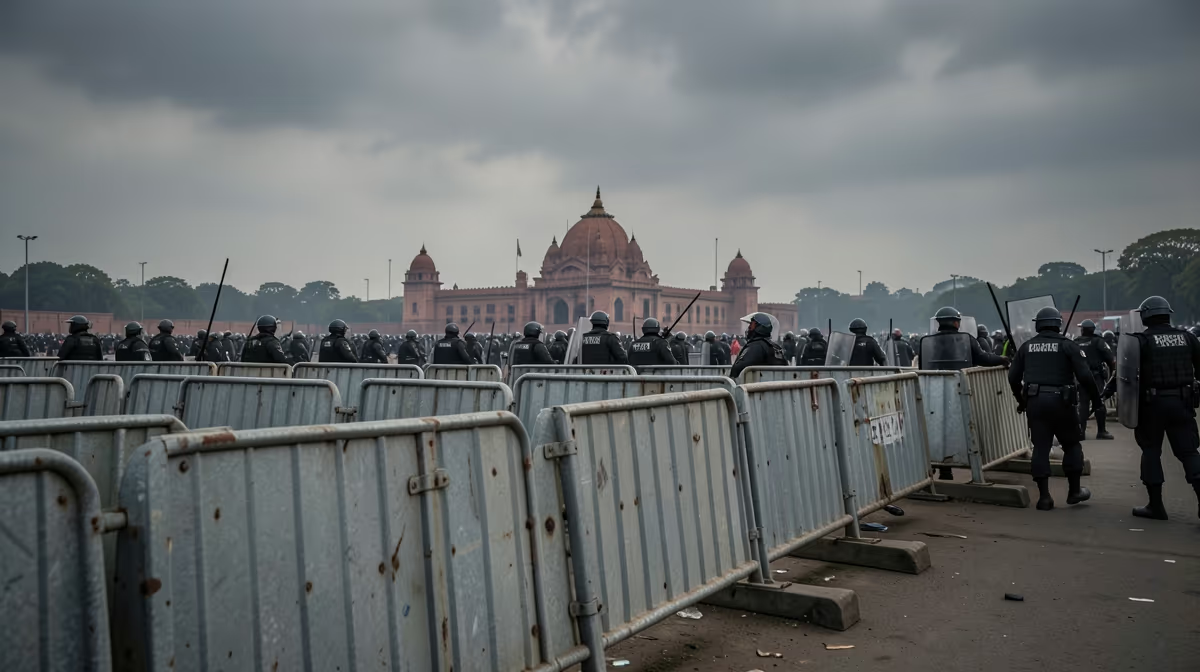
The barricades surrounding Jantar Mantar represent more than a security measure; they mark a deepening divide in India’s administrative landscape. The recent anti CEC protest Delhi has drawn significant attention following the preventive detention of prominent CJP leaders near Jantar Mantar. These developments signal an escalating friction between civil advocacy groups and the state’s management of public dissent.
Thousands of security personnel have been mobilized across the national capital to manage what has become a high-stakes standoff. The Citizens for Justice and Peace (CJP) movement, which called for a fresh round of 'Chalo Jantar Mantar' demonstrations, found its top leadership neutralized by police action before the protests could reach full momentum. This preemptive strategy by law enforcement reflects a growing tension regarding the limits of freedom of assembly in sensitive urban zones.
The deployment of thousands of security personnel alongside preventive arrests of CJP leadership signals a shift toward preemptive state management of decentralized, digital-first civil mobilizations.
Heavy Security Deployment and Preventive Arrests at Jantar Mantar
The security landscape in New Delhi transformed rapidly as authorities braced for the planned mobilization. Thousands of security personnel were deployed at critical points, creating a formidable presence intended to curb unauthorized gatherings and maintain public order. The primary focus of this deployment was the historic protest site of Jantar Mantar, which has once again become the epicenter of political friction.
Under the banner of the 'Chalo Jantar Mantar' call, the CJP movement sought to voice its opposition to current Central Election Commission (CEC) policies. However, the movement faced a significant setback when key leaders were taken into custody. Abhijeet Dipke, Ashutosh Ranka, and Saurav Das were placed under preventive arrest, a move that authorities justified as a necessary step to prevent potential disruptions to public safety.
- Abhijeet Dipke: CJP leader placed under preventive arrest.
- Ashutosh Ranka: CJP leader placed under preventive arrest.
- Saurav Das: CJP leader placed under preventive arrest.
The arrests were not limited to the leadership. Reports indicate that hundreds of individuals associated with the protest were detained across the city. This massive law enforcement response underscores the administration's determination to prevent the demonstration from escalating into a larger civil unrest event.
The Mechanics of Dissent: Understanding the CJP Movement
The CJP, often referred to in connection with 'cockroach' group protest tactics, represents a modern iteration of civil advocacy. The term 'cockroach' group, as noted in reports, suggests a decentralized and resilient organizational structure that can survive even after its primary leadership is targeted. By utilizing digital-first organizing strategies, these groups aim to mobilize large numbers of people quickly, often bypassing traditional hierarchical structures.
The root cause of this specific unrest lies in escalating governance friction triggered by public discontent over CEC policies. Protesters argue that these policies impact the transparency and integrity of the electoral process, though the state views the mobilization as a challenge to public order. The preventive arrest of leaders like Dipke, Ranka, and Das highlights an aggressive state management of dissent, straining the relationship between civic advocacy groups and the ruling political apparatus.
| Key Individual | Affiliation | Current Legal Status |
|---|---|---|
| Abhijeet Dipke | CJP Leader | Under preventive arrest; scheduled for magistrate production |
| Ashutosh Ranka | CJP Leader | Under preventive arrest; scheduled for magistrate production |
| Saurav Das | CJP Leader | Under preventive arrest; scheduled for magistrate production |
Legal Friction and the Supreme Court’s Intervention
While the streets of Delhi saw physical confrontations and barricades, a parallel battle is unfolding in the nation’s highest courts. The Supreme Court of India is scheduled to hear a contempt plea concerning the earlier Delhi transit shutdown. This legal development is a direct response to the administrative decisions that restricted movement across the capital in anticipation of the protests.
The judicial scrutiny centers on whether the state’s response—specifically the transit shutdowns and widespread detentions—constitutes an overreach of authority. Activists and legal experts are closely watching the outcome of the contempt plea, as it may set a precedent for how future protests are managed in the capital. The detained CJP leaders, including Dipke, Das, and Ranka, are also set to be produced before a local magistrate, which will determine the next steps in their legal journey.
The preventive detention of CJP leadership and the subsequent legal challenges highlight a critical junction for civil liberties and state authority in India's national capital.
The Role of the Magistrate Hearing
The production of the CJP leaders before a magistrate is a procedural necessity following preventive arrest. This hearing will provide the first opportunity for the legal representatives of the CJP to challenge the grounds of the detention. The court’s decision will likely influence whether the 'Chalo Jantar Mantar' movement continues to gain traction or begins to subside under legal pressure.
Socio-Economic Disruptions and Urban Mobility
The impact of the anti-CEC protest and the government’s response extends beyond political circles, affecting the daily lives of thousands of Delhi residents. The widespread disruptions and heavy security deployments have imposed localized economic losses on commerce and transport networks. Transit shutdowns, implemented to prevent protesters from congregating, have left commuters stranded and impacted daily wage earners who rely on mobility for their livelihoods.
- Widespread transit shutdowns impacting urban mobility.
- Localized economic losses for business owners near Jantar Mantar.
- Disruptions to daily wage earners and transport networks.
- Heavy police presence creating a climate of high tension for residents.
The administrative restrictions have drawn judicial scrutiny precisely because of these broad socio-economic impacts. When transit networks are shut down to manage dissent, the cost is often borne by the general public, leading to debates about the proportionality of the state’s security measures.
State-Citizen Relations: A Historical and Political Perspective
The current situation in Delhi draws unavoidable historical parallels to the 1975-1977 Emergency period, a time characterized by large-scale civil disobedience and subsequent heavy-handed administrative responses. While the context of 2026 is different, the core tension remains the same: the struggle between central administrative authority and the right of citizens to assemble and protest.
On a geopolitical level, while this is primarily an internal domestic affair, the crackdowns on prominent civil rights groups in a major global capital draw international scrutiny. The health of a democracy is often measured by its state-citizen relations and the degree to which freedom of assembly is protected. The use of preventive policing frameworks to preemptively disrupt decentralized organizing suggests a shift in how modern states view and manage digital-age dissent.
The Road Ahead: Judicial Reviews and Potential Escalation
The next 24 to 72 hours will be decisive for the trajectory of the 'Chalo Jantar Mantar' movement. As the detained leaders are produced before the magistrate, the legal fallout will dictate whether the protests escalate or calm down.
Immediate Outlook (Next 24 Hours)
Short-Term Projection (Next 72 Hours)
Expert predictions suggest that the deployment of heavy transit shutdowns alongside preventive arrests indicates that authorities are utilizing predictive policing frameworks. These frameworks are designed to disrupt the 'cockroach' protest tactics that rely on decentralized, digital organizing.
Frequently Asked Questions
Why were CJP leaders placed under preventive arrest in Delhi?
CJP leaders including Abhijeet Dipke, Ashutosh Ranka, and Saurav Das faced preventive arrest during the anti-CEC 'Chalo Jantar Mantar' demonstrations. Authorities deployed heavy security personnel and detained numerous protesters associated with the group to maintain order.
What is the background of the 'Chalo Jantar Mantar' protest in Delhi?
The protest, organized by the CJP or 'cockroach' group, led to widespread transit disruptions and a heavy security lockdown across the national capital. Thousands of security personnel were deployed ahead of the planned demonstrations.
Who are the key CJP leaders detained during the Delhi anti-CEC protests?
Prominent leaders such as Abhijeet Dipke, Ashutosh Ranka, and Saurav Das were taken into preventive custody. They were scheduled to be produced before a local magistrate in Delhi following their detention.
What happens next for the detained CJP leaders and protesters?
The detained leaders are being produced before a magistrate in Delhi for further legal proceedings following their preventive arrest. Meanwhile, the legal fallout continues as courts address related petitions concerning transit shutdowns.
How did authorities manage the security situation during the Delhi protest?
The administration deployed thousands of security personnel across critical points in Delhi to handle the anticipated 'Chalo Jantar Mantar' march. This massive deployment aimed to curb unauthorized gatherings and maintain public order.
Why does the anti-CEC protest and subsequent arrest matter?
The protests highlight rising political tensions and the state's heavy-handed response to public dissent regarding election commission policies. It has also triggered judicial scrutiny concerning transit shutdowns and civil liberties.
Conclusion
The situation in Delhi remains fluid as the legal and political consequences of the anti-CEC protest unfold. The preventive arrest of CJP leaders Abhijeet Dipke, Ashutosh Ranka, and Saurav Das has temporarily neutralized the leadership of the 'Chalo Jantar Mantar' movement, but the underlying discontent over CEC policies persists. With thousands of security personnel still deployed and the Supreme Court set to review transit shutdown contempt pleas, the coming days will determine whether the capital moves toward a peaceful resolution or further escalation. The production of the detained leaders before the magistrate serves as the next critical step in a sequence of events that continues to test the boundaries of civil rights and national security in India.
Sources
- Anti-CEC protest LIVE updates: Dipke, Das and Ranka to be produced before magistrate in Delhi as CJP calls for another round of 'Chalo Jantar Mantar' — The Hindu
- Delhi CJP Protest News Live Updates: CJP leaders Abhijeet Dipke, Ashutosh Ranka, Saurav Das under preventive arrest — The Indian Express
- 'Cockroach' group leaders among hundreds detained in Delhi protest — BBC
- Anti-CEC protest LIVE updates: CJP calls for 'Chalo Jantar Mantar' protest today; Supreme Court to hear contempt plea against Delhi transit shutdown — The Hindu
- Thousands of security personnel deployed as Delhi braces for ‘cockroach’ protest — BBC
- CJP Protest LIVE | Jantar Mantar — The Economic Times


.webp)
