
Bimol Akoijam JNU Termination Sparks Massive Political Fallout
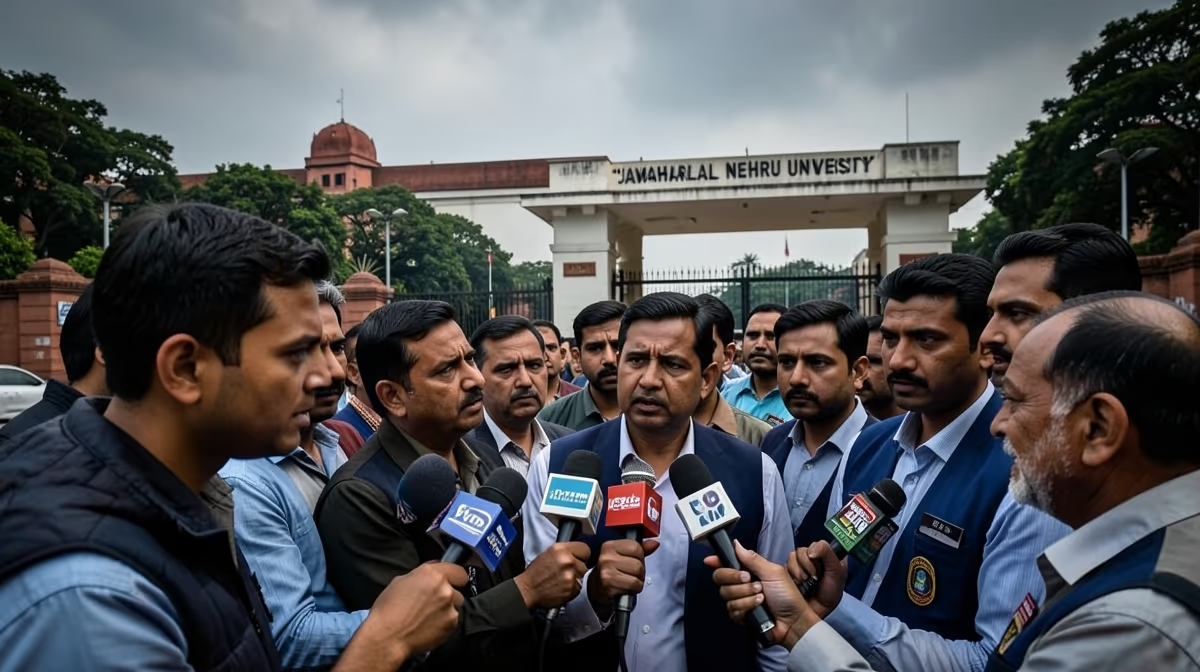
The intersection of parliamentary status and academic discipline has created a volatile atmosphere within one of India’s most prestigious central universities. The recent Bimol Akoijam JNU termination has triggered a massive political controversy across India, raising critical questions about institutional integrity and the accountability of public figures.
As a sitting Member of Parliament for the Congress party, Angomcha Bimol Akoijam’s dismissal from his professorship at Jawaharlal Nehru University (JNU) represents a rare and high-profile collision between university governance and national politics. The university’s decision to sack the parliamentarian following an internal inquiry into sexual harassment allegations has not only disrupted the academic environment but has also ignited a fierce partisan debate that shows no signs of subsiding.
The dismissal of a sitting MP from a premier central university following student-led allegations marks a significant shift in the enforcement of institutional disciplinary standards against high-profile public figures.
The Institutional Sacking and the Internal Inquiry
The primary catalyst for this national controversy is the formal dismissal of Angomcha Bimol Akoijam from his role as a professor at Jawaharlal Nehru University. This action was taken following an exhaustive internal inquiry conducted by the university’s disciplinary bodies. The investigation focused on allegations of sexual harassment brought forward by students, a matter that is handled with extreme sensitivity within Indian central universities under established legal and academic frameworks.
Details of the Student Allegations
The scale of the accusations played a significant role in the university's decision-making process. According to reports from major news outlets, including The Indian Express and India Today, a total of 11 students came forward to level sexual harassment charges against the professor. These complaints prompted JNU to initiate a formal inquiry, which eventually led to the termination of his services.
- The university inquiry focused on the conduct of the professor in his academic capacity.
- Multiple student testimonies formed the basis of the internal report.
- The university formally concluded its investigation by sacking the MP on October 9, 2026.
The Charge of 'Sex for Marks'
The nature of the allegations has been characterized by rival political factions as a "sex for marks" scandal. This specific framing suggests an abuse of academic power where grades or academic advancement were allegedly leveraged. While the university has focused on the disciplinary violations identified in its inquiry, the public narrative has been heavily influenced by these serious charges, leading to widespread concern regarding student safety and faculty ethics at the institution.
Political Witch-Hunt vs. Institutional Integrity
In the immediate aftermath of the JNU administration's decision, the controversy transitioned from an academic disciplinary matter to a national political standoff. Congress MP Bimol Akoijam has proactively and strongly contested the university’s move. He has publicly denied all allegations, characterizing the entire disciplinary process and his subsequent dismissal as a political witch-hunt.
The Parliamentarian’s Defense
Bimol Akoijam alleges that the termination is not rooted in genuine institutional concerns but is instead a politically motivated strike aimed at his standing as a member of the opposition. By framing the inquiry as a witch-hunt, the MP suggests that the university’s administrative mechanisms have been co-opted to target political dissent. This defense seeks to shift the focus from the 11 student complainants to the broader political dynamics between the ruling party and the opposition.
Protests and Partisan Friction
The BJP has moved quickly to capitalize on the university’s findings, organizing public protests against the Congress MP. Protesters have demanded accountability, emphasizing the gravity of the "sex for marks" charges and the need to protect the welfare of students. These demonstrations, covered extensively by NDTV and other platforms, highlight how institutional disciplinary actions can be weaponized for broader narrative dominance in the political sphere.
This case sits at a sensitive intersection of higher education governance, student safety, and national politics, where the protection of student complainants often clashes with the perceived politicization of disciplinary processes.
Systemic Tensions in Higher Education Governance
Beyond the immediate partisan theater, the Bimol Akoijam JNU termination underscores deep-seated systemic tensions within the Indian higher education system. Public universities in India are mandated by law to maintain internal complaints committees to handle allegations of sexual harassment. However, when a high-profile faculty member is also an active and influential politician, the independence of these committees often comes under intense public and political scrutiny.
| Event Milestone | Date | Description |
|---|---|---|
| Inquiry Conclusion | Oct 9, 2026 | JNU concludes investigation into sexual harassment allegations by 11 students. |
| Official Termination | Oct 9, 2026 | JNU formally dismisses Professor Angomcha Bimol Akoijam from service. |
| Political Response | Oct 10, 2026 | MP Akoijam alleges a "political witch-hunt"; BJP stages protests. |
| Public Outcry | Oct 10, 2026 | Media reports confirm "sex for marks" charges being debated in public forums. |
The Role of Institutional Autonomy
The case raises questions about the susceptibility of university disciplinary mechanisms to external political pressure. Analysts observe that while the university emphasizes due process, the opposition frames the action as a targeted purge. This tension impacts higher education governance and the allocation of public resources toward handling prolonged internal inquiries. The stability of premier central universities often depends on their ability to handle such high-stakes cases without appearing to favor any political faction.
Impact on Student Complainants
A critical but often overshadowed aspect of this controversy is the impact on the students who initiated the complaints. The protection of student complainants against powerful figures is a primary concern for academic safety advocates. The high-profile nature of the accused—a sitting Member of Parliament—adds a layer of complexity to the standard disciplinary process, as the students' allegations are now part of a national political discourse.
Future Outlook and Expert Predictions
As the political fallout continues, the situation is expected to evolve through both judicial and political channels. Legal analysts and political observers anticipate that the next few days will be critical in determining whether this remains a university-level dispute or escalates into a broader parliamentary ethics issue.
The Next 72 Hours
The next 72 hours are likely to see intensified political debates and potential statements from various student groups. Protests on university campuses may escalate as different factions weigh in on the dismissal. The Congress party’s official stance and the possibility of MP Bimol Akoijam seeking legal recourse against JNU will be major points of interest.
Expert Forecast
Analysts expect a period of heightened political polarization. The ruling party is likely to continue emphasizing the seriousness of the harassment charges to demand accountability from the opposition. Conversely, opposition figures may frame the termination as a broader attack on academic freedom and a symptom of political meddling in central universities.
Best and Worst Case Scenarios
In the best-case scenario, the institutional inquiry’s findings will be handled through established judicial and academic frameworks, allowing for transparent legal recourse and a fair resolution for the student complainants. This would demonstrate the strength of university governance. In the worst-case scenario, the controversy could lead to prolonged political disruption, deepening partisan conflict and sparking unrest on university campuses, further complicating the pursuit of justice for the involved parties.
Frequently Asked Questions
Why was Congress MP Bimol Akoijam terminated from JNU?
Jawaharlal Nehru University dismissed Congress MP Angomcha Bimol Akoijam from his position as a professor following an inquiry into sexual harassment allegations. The university took this action after 11 students came forward with complaints against him.
What has Bimol Akoijam alleged in response to his JNU termination?
In the wake of his dismissal, Congress MP Bimol Akoijam has strongly denied the accusations and alleged that his termination is a political witch-hunt. He claims the disciplinary action and charges are politically motivated.
Who is affected by the sexual harassment allegations against Bimol Akoijam?
The situation directly impacts the students who filed the complaints, as well as the academic and political spheres given Akoijam's dual role as a university professor and a sitting Member of Parliament. Protests and political fallout have emerged following the institution's disciplinary decision.
How have political parties reacted to the JNU charges against Bimol Akoijam?
The allegations and subsequent termination have sparked immediate political friction. For instance, BJP members have held protests against the Congress MP over the charges, intensifying the political debate surrounding the case.
How many students accused the Congress MP of sexual harassment?
According to reports from university inquiries and media coverage, 11 students came forward to allege sexual harassment, which ultimately prompted JNU to sack him from his professor position.
What happens next following Bimol Akoijam's dismissal?
As political tensions rise and public scrutiny intensifies, further legal, institutional, and political developments are expected. Both supporters and critics are closely watching how the Congress party and parliamentary ethics bodies will address the ongoing controversy.
Conclusion
The Bimol Akoijam JNU termination has moved beyond the gates of the university to become a significant flashpoint in Indian national politics. While Jawaharlal Nehru University has acted on the basis of a disciplinary inquiry involving 11 student complainants, the resulting allegations of a political witch-hunt have created a polarized narrative. The coming days will determine if the focus remains on the serious nature of the sexual harassment allegations or if the case becomes a permanent fixture in the partisan conflict between the Congress and the BJP. As student groups and political entities continue to mobilize, the need for a transparent and fair legal process remains the central requirement for resolving this high-stakes institutional crisis.
Sources
- Upcoming JAM vs MP cricket match (10/11/2026): JAM vs MP ball by ball commentary, JAM vs MP stats | Cricket News — Hindustan Times
- Video | BJP Protests Against Congress MP Angomcha Bimol Akoijam Over 'Sex For Marks' Charge — NDTV
- Congress MP Bimol Akoijam alleges ‘political witch-hunt’ after JNU termination — Hub News
- JNU dismisses Congress MP Bimol Akoijam after inquiry into sexual harassment allegations — The Assam Tribune
- JNU sacks Congress MP as professor after 11 students allege sexual harassment — The Indian Express
- Congress MP Angomcha Bimol Akoijam sacked from JNU over sexual harassment charges — India Today


.webp)
