
Distant Galaxy Signal From Ancient Universe Stuns Astronomers
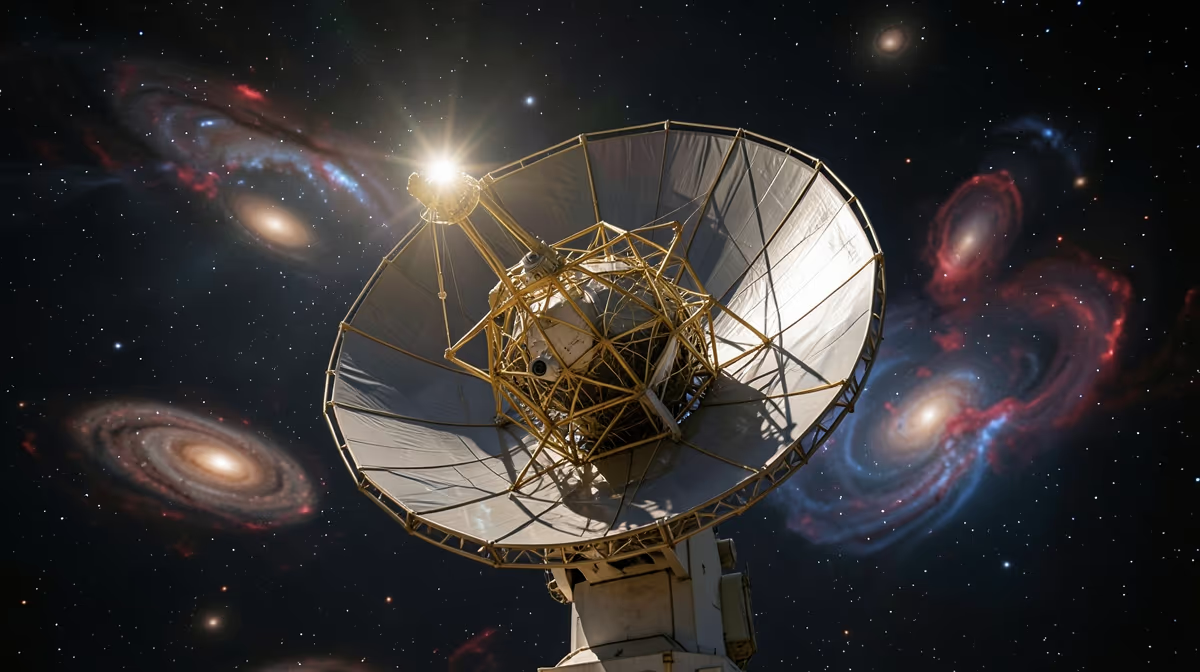
The universe often communicates in fleeting, high-energy whispers that challenge our fundamental understanding of time and space. A millisecond-long pulse of energy has completed a journey spanning 10 billion years across the cosmic void, finally reaching our terrestrial and orbital sensors. Researchers have detected a fascinating distant galaxy signal originating from a time when the universe was just 3 billion years old, sparking a global effort to understand how such a powerful burst could emerge from the infancy of the cosmos.
This record-breaking signal, a fast radio burst (FRB) traveling from a 10-billion-year-old origin point, provides a unique window into the early universe and challenges existing astrophysical models regarding galactic formation.
The Ancient Pulse: Decoding the Fast Radio Burst
The signal reached Earth after traveling through the vacuum of space since the universe was approximately 3 billion years old. For context, the universe is currently estimated to be roughly 13.8 billion years old, meaning this pulse has been in transit for the vast majority of cosmic history. The detection of such a 10 billion-year-old millisecond signal allows researchers to study the distribution of matter and the conditions of the "ancient" universe in unprecedented detail.
The James Webb Breakthrough: Pinpointing the Source
This astronomy breakthrough highlights the increasing synergy between ground-based radio astronomy and space-based infrared observation. The James Webb Space Telescope’s ability to peer through cosmic dust and capture the faint light of distant structures was critical in identifying the exact home galaxy of this ancient signal. Without this level of technological precision, the source of the farthest fast radio burst yet would have remained a ghost in the data.
A Surprising Galactic Host
The Global and Geopolitical Context
The Evolution of Data Sovereignty
| Milestone | Discovery Phase |
|---|---|
| Detection | Recording of the record-breaking fast radio burst from the ancient universe. |
| Identification | Imaging of the host galaxy using the James Webb Space Telescope. |
| Current Analysis | Investigation of the host galaxy's properties challenging existing astrophysical models. |
Historical Parallels and Scientific Significance
Discoveries like this help scientists peer deep into the history of the universe, offering a clearer picture of how galaxies and cosmic phenomena evolved billions of years ago.
The ability to study a signal from 10 billion years ago provides a rare glimpse into the infancy of the cosmos. Understanding these rare, distant signals pushes the boundaries of modern astrophysics and technology, forcing researchers to refine their understanding of the fundamental physics governing the universe.
Economic and Technological Drivers
- Advanced optical engineering for deep-space telescopes.
- High-speed data processing for transient signal detection.
- Global radio array synchronization for precise triangulation.
Future Horizons and Expert Predictions
Expert analysts expect that this is only the beginning. With the continued operation of the James Webb telescope, researchers are likely to uncover more distant fast radio bursts. Each new detection provides a deeper insight into the early universe's conditions. In the best-case scenario, the detailed identification of this host galaxy will lead to a breakthrough understanding of the mechanisms behind fast radio bursts themselves—a mystery that has remained largely unresolved since their first discovery.
However, researchers also acknowledge the difficulty of the task. If this signal remains an isolated anomaly, proving difficult to replicate or trace in other ancient galaxies, key questions about its origin will persist. The search for more "ancient whispers" continues as astronomers use every tool at their disposal to map the distant reaches of our shared history.
Frequently Asked Questions
What was the mysterious signal detected from the ancient universe?
Astronomers detected a record-breaking fast radio burst (FRB), which is a powerful millisecond-long burst of energy originating from space. This specific signal traveled across the cosmos for roughly 10 billion years, reaching us from a time when the universe was only about 3 billion years old.
Why is this distant fast radio burst significant for astronomers?
This discovery marks the tracking of the farthest fast radio burst yet detected using advanced instruments like the James Webb Space Telescope. By studying such ancient signals, scientists can gain unprecedented insights into the conditions of the early universe and how it has evolved over billions of years.
Who is affected by this astronomical discovery?
While this cosmic event does not directly impact daily life on Earth, it significantly affects the fields of astrophysics and cosmology. Researchers and astronomers use these findings to refine our understanding of the fundamental physics governing the universe.
What happens next in the research of these distant signals?
Astronomers plan to continue utilizing powerful observatories, including the James Webb Space Telescope, to hunt for even more distant fast radio bursts and pinpoint their host galaxies. These upcoming observations will help researchers determine the exact cosmic mechanisms that generate such extreme bursts of energy.
How do scientists track the origin of a fast radio burst?
Researchers combine data from radio telescopes and advanced space observatories like the James Webb Space Telescope to pinpoint the exact host galaxy of a signal. Pinpointing the home galaxy is crucial for understanding the environment and stellar populations that produce these mysterious events.
What makes the home galaxy of this signal so surprising?
The host galaxy of this ancient fast radio burst has surprised astronomers because its characteristics challenge previous assumptions about where these energetic events can occur. Discovering such a distant and unexpected origin point opens up new questions about the diversity of galaxies that can power FRBs.
Conclusion
The detection of a 10 billion-year-old fast radio burst represents a significant milestone in modern astronomy. By successfully identifying the host galaxy of the farthest signal recorded to date, scientists have opened a new chapter in our study of the early universe. While the exact mechanisms behind these millisecond-long bursts remain a subject of intense investigation, the use of the James Webb Space Telescope has proven that even the most distant and ancient events in the cosmos can be tracked and analyzed. As the scientific community continues to digest this data, the focus shifts toward finding more signals from the universe's infancy, hoping to solve one of the most enduring mysteries of the deep sky.
Sources
- A Mysterious Signal Reached Us From When The Universe Was Just 3 Billion Years Old. Its Home Galaxy Surprised Astronomers. — ScienceAlert
- Astronomers Use James Webb Telescope To Track Farthest Fast Radio Burst Yet — NDTV
- Astronomers identify host galaxy of most distant fast radio burst — CGTN
- Scientists Detect Record-Breaking Radio Signal from the Ancient Universe — 404 Media
- Astronomers pinpoint the origin of a 10 billion-year-old millisecond signal from space — The Conversation
- Astronomers detect mysterious burst of energy from a galaxy far, far away — The Guardian


.webp)
