
Dharmendra Pradhan Announces Major School Curriculum Overhaul Across India
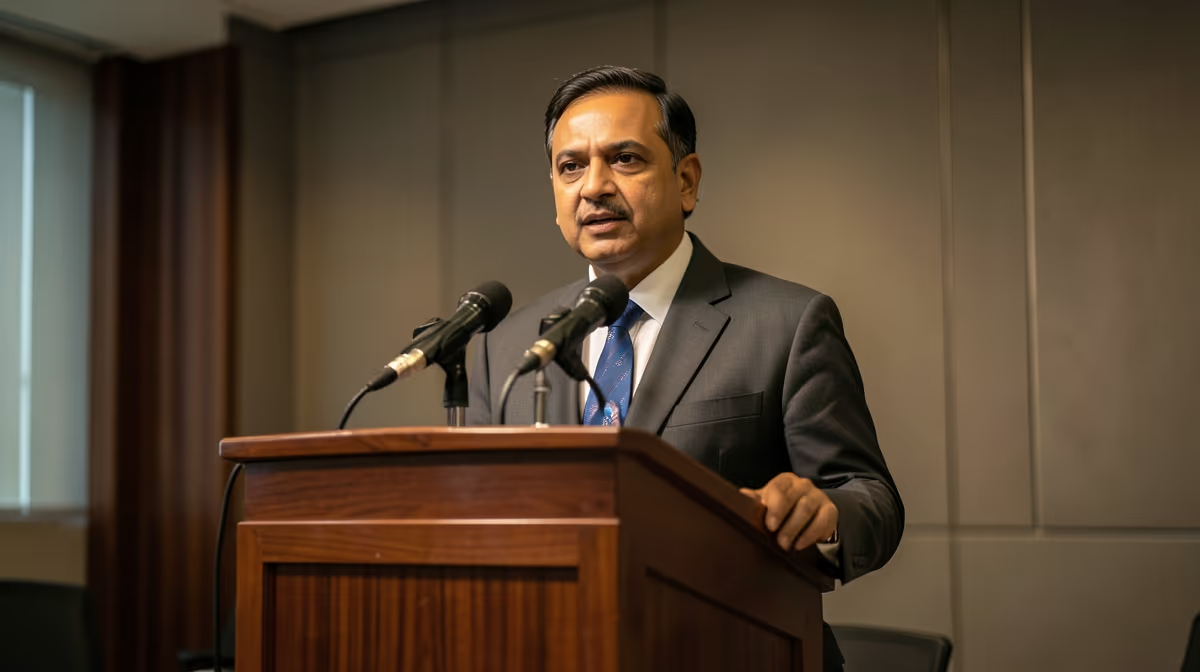
Union Education Minister Dharmendra Pradhan announced major updates to the national curriculum framework in New Delhi on Tuesday, aiming to align India's school education system with the goals of the National Education Policy 2020. To stay updated with the latest dharmendra pradhan news regarding policy changes and political developments, observers across New Delhi are closely tracking how federal mandates translate into ground-level institutional execution. The unfolding administrative trajectory highlights the complex intersection of federal governance, curriculum reform, and public stakeholder management across India.
Institutional Background And Core Responsibilities
Dharmendra Pradhan is a senior Indian politician and a prominent leader of the ruling Bharatiya Janata Party. He currently serves as the Union Minister of Education in the Government of India, playing a major role in shaping the country's schooling and higher education systems. Over the years, he has also managed critical portfolios like Petroleum and Natural Gas, where he helped implement major public welfare schemes such as providing subsidized cooking gas to rural households. His political journey began as a student leader in Odisha with the Akhil Bharatiya Vidyarthi Parishad. Over decades, he rose through party ranks, serving as a Member of Parliament and a key strategist for the Bharatiya Janata Party in several states before taking on high-profile cabinet responsibilities. He contested and won the 2024 Lok Sabha elections from the Sambalpur constituency in Odisha, having previously served as a Member of Parliament in the Rajya Sabha. Before taking charge of the Education Ministry, he served as the Minister of Petroleum and Natural Gas, and has also handled portfolios such as Minister of Skill Development and Entrepreneurship and Minister of Steel. As the Minister of Petroleum, he played a key role in the Pradhan Mantri Ujjwala Yojana, which provided subsidized LPG connections to rural households.
Curriculum Overhaul And Policy Execution
During a press briefing at the Ministry of Education, Pradhan emphasized that newly structured textbooks and pedagogical approaches will reduce rote learning and foster critical thinking among students. The ministry has collaborated with various educational boards, academic experts, and stakeholders over the past year to finalize the blueprint for implementation across central and participating state schools. The revised framework introduces holistic assessment methods, moving away from traditional year-end examinations toward continuous and comprehensive evaluation. Additionally, greater emphasis has been placed on regional languages, vocational training, and foundational literacy and numeracy skills, ensuring a seamless transition from early childhood care to secondary education. Opposition parties and certain teachers' unions have raised concerns regarding the rapid pace of implementation and potential resource constraints in rural institutions. However, the ministry maintains that adequate teacher training programs and digital infrastructure rollouts are currently underway to support the transition without disrupting the academic calendar. Our goal is to create a future-ready generation rooted in Indian values yet globally competent, stated Union Education Minister Dharmendra Pradhan during the official rollout. The National Education Policy 2020 is not just a policy document, but a philosophy for national transformation through education.
Analytical Perspectives And Structural Challenges
The root cause of current policy friction involves balancing populist welfare demands with India's aggressive green energy transition and fiscal deficit targets within a complex federal structure. Acting as a key party troubleshooter across portfolios including education, skill development, and petroleum, the minister balances ideological mandates with pragmatic electoral coalition management, particularly in crucial states like Odisha. Economically, the administration navigates the high-stakes intersection of fossil fuel price volatility, inflationary pressures on liquefied petroleum gas and petrol, and the mammoth task of scaling India's human capital for a five trillion dollar economy. Geopolitically, the broader administrative machinery manages India's delicate energy security diplomacy amid Western sanctions on Russia, Organization of the Petroleum Exporting Countries supply cuts, and the transition toward critical mineral supply chains. Historical parallels can be drawn to the mid-nineteenth-seventies dual challenge faced by Indian technocrat-politicians who had to simultaneously manage severe oil shocks and restructure domestic industrial and educational capacities. Key milestones mark this trajectory, including his appointment as Minister of State for Petroleum and Natural Gas in 2014, initiating targeted subsidy reforms like the Ujjwala Yojana, his shift to the Ministry of Education and Skill Development in 2021 to oversee the implementation of the National Education Policy, and his retention of key cabinet responsibilities in the Modi third term in 2024, tasked with aligning national education frameworks with future workforce demands amid energy transition.
Real World Impact And Affected Stakeholders
As the Education Minister, Dharmendra Pradhan's decisions directly shape the future of millions of students and the overall quality of India's workforce. His policies determine what children learn in schools, how universities operate, and how the country prepares its youth for global job markets. Students, teachers, parents, educational institutions, and job seekers across India are directly impacted by his policy decisions and reforms. While urban centers often adapt swiftly to structural changes, rural institutions face unique resource and training constraints, making the deployment of adequate teacher support modules an essential component of the ongoing transition. The final adoption rates across various state-level educational boards and the nationwide deployment of teacher training modules remain the primary developing metrics watched by policy analysts.
Short Term Outlook And Administrative Expectations
Over the next twenty-four hours, Dharmendra Pradhan is expected to hold high-level review meetings with education ministry officials regarding the implementation of the National Education Policy and upcoming academic reforms. Within seventy-two hours, he may announce new initiatives or address press briefings focusing on skill development programs and higher education infrastructure improvements across states. Analysts predict a continued push toward vocational integration and digital learning infrastructure, keeping policy execution as his primary focus. The best case scenario involves a smooth consensus among state stakeholders leading to accelerated and successful nationwide rollout of key educational reforms. Conversely, the worst case scenario entails administrative bottlenecks or resistance from non-aligned states regarding specific centralized education policies and curriculum changes.
Frequently Asked Questions
Who is Dharmendra Pradhan?
Dharmendra Pradhan is a prominent Indian politician and senior leader of the Bharatiya Janata Party. He currently serves as the Union Minister of Education in the Government of India.
What is Dharmendra Pradhan's current portfolio?
He holds the crucial portfolio of the Ministry of Education. In his role, he oversees the implementation of national educational policies, including the National Education Policy 2020.
Which constituency does Dharmendra Pradhan represent?
Dharmendra Pradhan contested and won the 2024 Lok Sabha elections from the Sambalpur constituency in Odisha. He has also previously served as a Member of Parliament in the Rajya Sabha.
What ministries has Dharmendra Pradhan previously headed?
Before taking charge of the Education Ministry, he served as the Minister of Petroleum and Natural Gas. He has also handled portfolios such as Minister of Skill Development and Entrepreneurship and Minister of Steel.
What are some major initiatives led by Dharmendra Pradhan?
As the Minister of Petroleum, he played a key role in the Pradhan Mantri Ujjwala Yojana, which provided subsidized liquefied petroleum gas connections to rural households. In education, he has been instrumental in modernizing the curriculum and promoting vocational training.
Where was Dharmendra Pradhan born?
Dharmendra Pradhan was born on June 26, 1969, in Talcher, a town in the Angul district of Odisha. He comes from a political background, being the son of former Union Minister Dr. Debendra Pradhan.
Conclusion
The release of the updated curriculum framework guidelines and the ministry's timeline for phased textbook introduction in participating schools mark confirmed developments in India's educational landscape. As the Ministry of Education proceeds with high-level review meetings and administrative rollouts, the focus remains on navigating federal alignment, teacher training deployments, and structural policy execution across participating states.


