
Iran War Escalation Triggers Emergency US Military Response
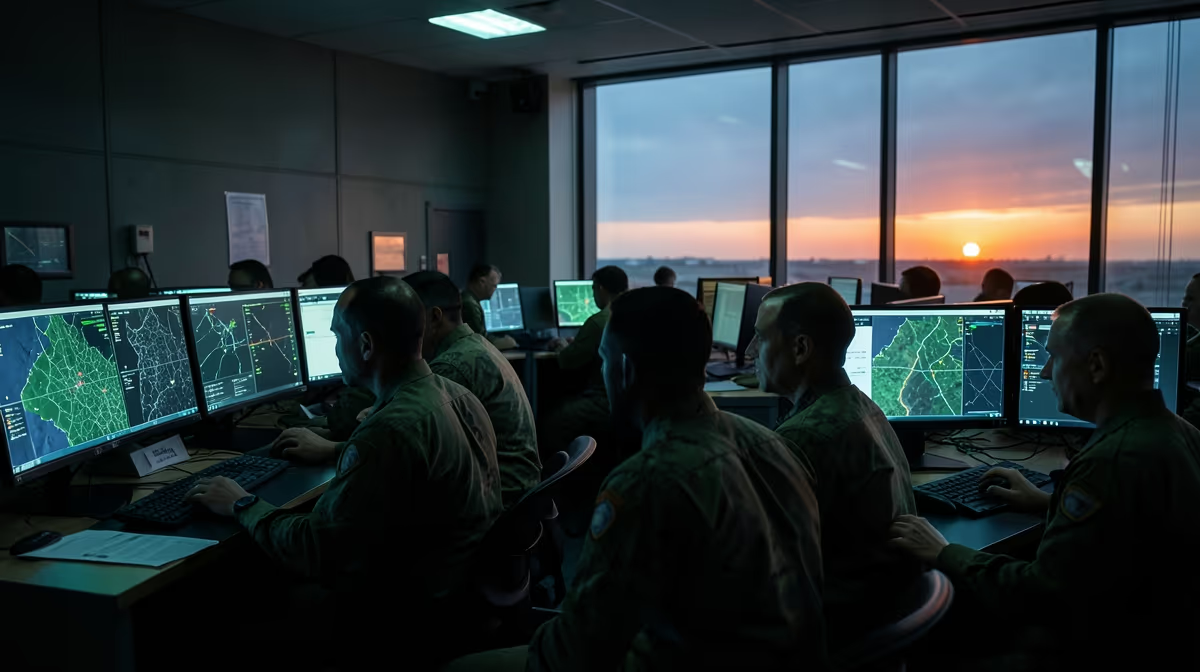
As tensions reach a boiling point, the looming threat of an iran war has dominated international headlines and forced global policymakers into a state of acute vigilance. Beneath the surface of diplomatic maneuvering lies a fragile security architecture that is increasingly strained by asymmetric proxy conflicts and escalating regional hostilities.
WASHINGTON — The United States military launched precision airstrikes against Iranian-backed militia facilities in Iraq and Syria late Thursday, following a surge of drone attacks on coalition bases that officials say injured multiple American service members. The retaliatory strikes, authorized by President Biden, targeted command and control nodes, ammunition storage facilities, and logistics centers utilized by groups affiliated with Iran's Islamic Revolutionary Guard Corps. Defense officials stated the operation was designed to degrade the capabilities of the militias and deter future aggression against United States personnel stationed in the region. Tensions between Washington and Tehran have remained elevated amid ongoing regional conflict stemming from the Israel-Hamas war. United States installations in Iraq and Syria have faced persistent drone and rocket attacks by proxy groups demanding an end to American support for Israel. Pentagon press secretary Major General Pat Ryder emphasized that the United States does not seek broader conflict in the Middle East but will take necessary measures to protect its forces. Meanwhile, regional allies have expressed concern that the cycle of retaliatory strikes could spiral into a wider direct confrontation between the United States and Iran. U.S. Defense Secretary Lloyd Austin stated in an official briefing that the nation will not tolerate attacks on personnel, emphasizing that military actions were directed to hold accountable those who harm troops. Verified reports confirm that the strikes successfully hit specific ammunition storage and command facilities linked to the Islamic Revolutionary Guard Corps in Iraq and Syria, though independent verification of militia casualties remains ongoing while intelligence assessments evaluate the full extent of the structural damage.
Geopolitical Pressures and Structural Incompatibility
The root cause of this persistent instability stems from a structural incompatibility between Iran's regional hegemony ambitions and the United States-led security architecture in the Middle East. This friction has been severely exacerbated by the collapse of the Joint Comprehensive Plan of Action and the fundamental imperative to protect critical energy transit corridors. Political analysts note that domestic electoral vulnerabilities in Washington frequently intersect with Tehran's complex succession calculations and the hardline consolidation of power under the Islamic Revolutionary Guard Corps. Furthermore, the geopolitical angle highlights an accelerating polarization of the international order, forcing a reluctant United States into overextension while emboldening a Sino-Russian axis that leverages Iranian proxy networks to divert Western strategic bandwidth. In the shadows, a parallel domain of cyber and financial warfare operates continuously, where the asymmetrical disruption of critical infrastructure and cryptocurrency laundering bypass traditional sanctions regimes with minimal public oversight. Historically, observers draw parallels to the 1980 through 1988 Iran-Iraq War combined with Operation Praying Mantis, reflecting the persistent risk of protracted maritime skirmishes and economic attrition without any decisive conventional victory. The historical timeline spans from the 1979 Islamic Revolution and the United States Embassy hostage crisis, through the 2018 United States withdrawal from the nuclear deal and implementation of maximum pressure sanctions, to the 2020 assassination of Qasem Soleimani and subsequent direct missile exchanges, culminating in the current state of perpetual shadow war and nuclear threshold brinkmanship.
Economic Consequences and Global Market Vulnerabilities
Economic markets, particularly global oil prices, are reacting nervously to the escalating instability as investors weigh the risks of a broader supply shock. The economic angle centers heavily on the weaponization of vital global shipping chokepoints like the Strait of Hormuz, resulting in severe oil shock vulnerabilities, inflationary pressures on the American consumer, and the acceleration of de-dollarization strategies among BRICS nations. A major conflict involving Iran would almost certainly cause United States and global gas prices to spike dramatically because Iran borders the Strait of Hormuz, a critical transit route through which a significant portion of the world petroleum supply passes. Any military disruption in this maritime corridor threatens global oil supplies, leading to immediate market panic and higher fuel costs for consumers everywhere. For the average person, this news can feel overwhelming, but at its core, it involves fundamental questions about energy security, global commerce, and influence in a volatile part of the world. Governments remain engaged in intense diplomatic and military strategizing to prevent a localized clash from turning into a full-scale regional war, while authorities continue to urge calm and prepare for various potential outcomes.
Military Posture and Regional Threat Assessment
Military tensions between the United States and Iran have reached a critical juncture following recent escalations, placing American forces in the Middle East on heightened alert to protect against potential attacks. The United States maintains a significant military presence in the region, including naval strike groups, air bases, and thousands of troops stationed in allied nations such as Qatar, Bahrain, and the United Arab Emirates. This deployment is designed to deter Iranian aggression, protect vital shipping lanes, and reassure regional partners, with the Pentagon frequently adjusting force postures in response to heightened threat levels. While Iran's conventional military forces are much smaller than those of the United States—which possesses a vastly superior military across defense spending, advanced technology, aircraft, and naval power—Tehran has developed formidable asymmetric capabilities. These capabilities include massive ballistic missile arsenals, advanced drone technology, and the strategic ability to disrupt shipping in the Strait of Hormuz. Diplomatic channels are being severely tested as international leaders attempt to de-escalate the situation, and while both nations have signaled a desire to avoid a full-scale war, the risk of dangerous miscalculations remains exceptionally high.
Anticipated Near-Term Developments
Predictive intelligence models indicate that the next twenty-four hours will likely witness increased diplomatic signaling, heightened intelligence collection, and reconnaissance drone activity in the Persian Gulf region. Looking toward the next seventy-two hours, analysts anticipate potential retaliatory cyber operations, the strategic positioning of naval assets, and emergency United Nations Security Council consultations. Expert predictions suggest that the situation will likely manifest as a prolonged period of asymmetric proxy conflict and economic sanctions rather than direct conventional warfare, constrained primarily by mutual deterrence between Washington and Tehran. In the best-case scenario, back-channel negotiations yield a temporary de-escalation framework and restraint from regional proxy groups. Conversely, the worst-case scenario warns that miscalculation could lead to a direct kinetic strike on regional assets, triggering a wider Middle East conflict and severe energy market shocks that would reverberate across the global economy.
Frequently Asked Questions
Are the US and Iran currently at war?
The United States and Iran are not currently engaged in a direct, all-out military war. However, tensions remain exceptionally high due to ongoing proxy conflicts, regional militia attacks, and disputes over Iran's nuclear program. Both nations actively seek to avoid a direct military confrontation while maintaining a strong posture in the Middle East.
What would happen if the US went to war with Iran?
A direct war between the US and Iran would likely cause massive regional destabilization and severe disruptions to global oil supplies. Military analysts predict it would involve extensive air and missile strikes rather than a large-scale ground invasion, given Iran's difficult terrain and capable military. Such a conflict could also trigger asymmetric warfare and cyberattacks against US interests globally.
Why are the US and Iran enemies? hostility origins
Hostility between the two nations largely stems from the 1979 Iranian Revolution, which overthrew the US-backed Shah and led to the US Embassy hostage crisis. Decades of subsequent US sanctions, Iranian support for regional militant groups, and disputes over regional influence have further deepened the divide. The collapse of the 2015 Iran nuclear deal also contributed significantly to modern diplomatic friction.
Does Iran have a stronger military than the US?
No, the United States possesses a vastly superior military compared to Iran across virtually all conventional metrics, including defense spending, advanced technology, aircraft, and naval power. While Iran's conventional forces are much smaller, it has developed formidable asymmetric capabilities. These include massive ballistic missile arsenals, drone technology, and the strategic ability to disrupt shipping in the Strait of Hormuz.
Is the US military currently deployed near Iran?
Yes, the US maintains a significant military presence in the Middle East, including naval strike groups, air bases, and thousands of troops stationed in allied nations like Qatar, Bahrain, and the United Arab Emirates. This deployment is designed to deter Iranian aggression, protect vital shipping lanes, and reassure regional partners. The Pentagon frequently adjusts these force postures in response to heightened threat levels.
How would an Iran war affect gas prices in the US?
A major conflict involving Iran would almost certainly cause US and global gas prices to spike dramatically. Iran borders the Strait of Hormuz, a critical chokepoint through which a significant portion of the world's petroleum passes. Any military disruption in this area would threaten global oil supplies, leading to immediate market panic and higher fuel costs for American consumers.
Conclusion
The United States military has executed targeted airstrikes in response to ongoing drone attacks on coalition personnel in Iraq and Syria, underscoring the volatile nature of current Middle East dynamics. While diplomatic channels remain open and both Washington and Tehran signal an aversion to direct conventional warfare, the risk of regional escalation persists through proxy networks and maritime chokepoint vulnerabilities. Global intelligence observers, policymakers, and financial markets continue to monitor force postures, intelligence reports, and diplomatic signals as authorities navigate this critical juncture in international security.


